




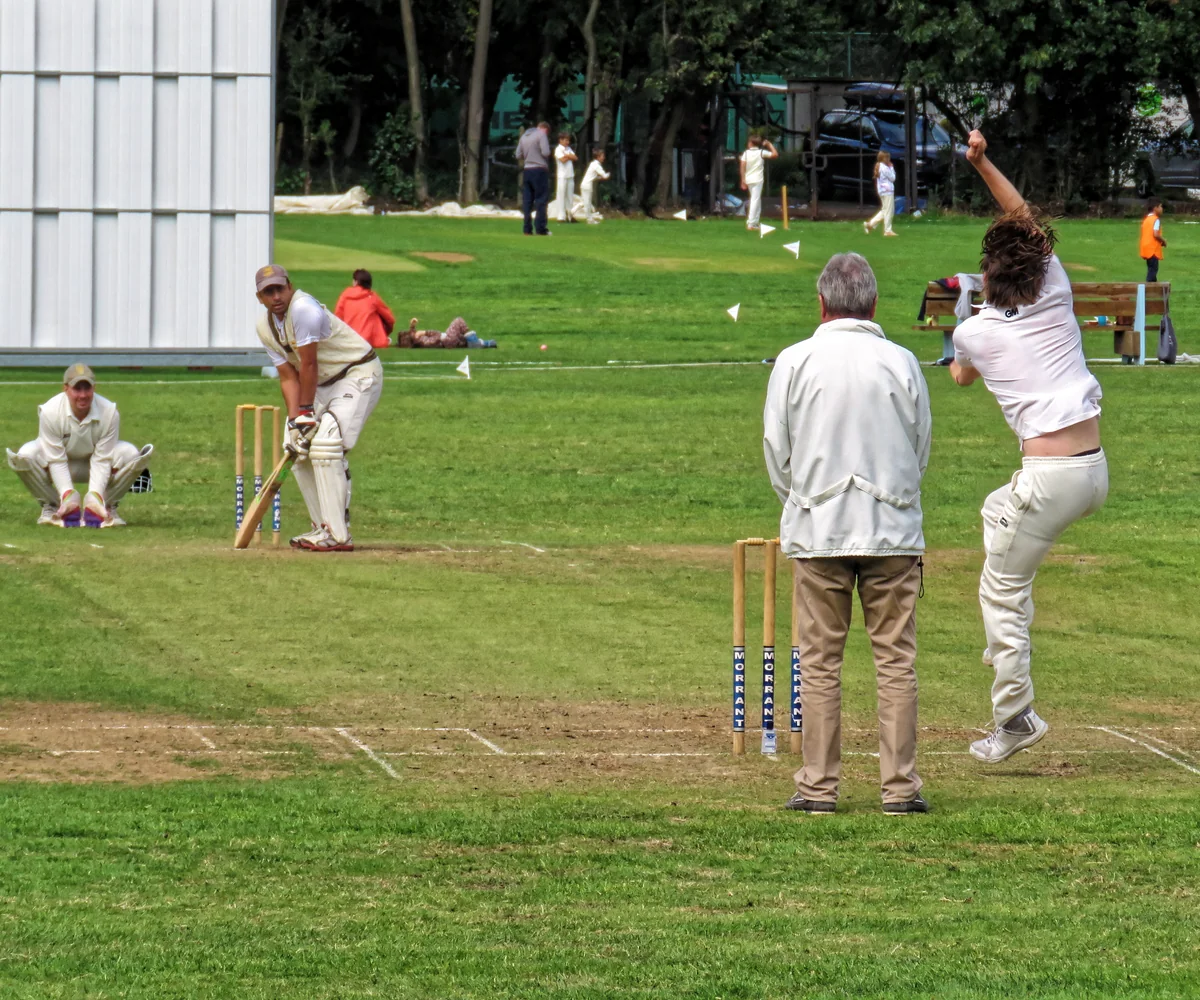
Cricket has its own language, and most of it is never explained on TV. Commentators talk about maidens, gullies, and golden ducks as if everyone already knows what they mean.
This glossary explains the cricket terms you will hear most, grouped by part of the game so related words sit together. If you want the big picture first, start with our cricket basics and rules guide, then come back here whenever a word stops you.
Quick Answer
The cricket terms new fans need first are run, wicket, over, innings, four, six, bowled, caught, LBW, and run out. Learn those ten and you can follow most of any match. The full list below covers the rest.
The Field and the Pitch
These words describe where the game is played. The map below shows where each one sits.

Pitch: The strip in the middle of the field where the ball is bowled. Under the MCC Laws of Cricket, it is 22 yards (20.12 m) long and 10 feet wide.
Wicket: The three wooden stumps with two bails on top at each end of the pitch. The word also means an out. See our full guide to what a wicket is.
Stumps and bails: The three upright posts are the stumps. The two small pieces of wood resting on top are the bails.
Crease: The white lines painted at each end of the pitch. The bowling crease runs through the stumps.
Popping crease: The line 4 feet in front of the stumps. A batter is safe, or “in their ground,” when the bat or body is grounded behind it.
Return crease: The two side lines at each end. A bowler’s back foot must land inside them.
Striker’s end and bowler’s end: The striker’s end is where the batter facing the ball stands. The other end is the bowler’s end, where the non-striker waits.
Off side and leg side: For a right-handed batter, the off side is the half of the field they face, and the leg side (also called the on side) is behind their legs. For a left-handed batter, the two sides swap.
Boundary: The edge of the playing field, usually marked by a rope.
Fielding circle: A ring marked 30 yards from the stumps at each end, used for fielding restrictions in limited-overs cricket.
Fielding positions: Named spots where fielders stand, such as slip, gully, point, cover, mid-off, mid-on, and fine leg. Our fielding positions guide shows them all.
Batting Terms
Batter: A player who is batting. Two batters are on the field at a time. Older sources say “batsman,” but the Laws of Cricket now use “batter.”
Striker and non-striker: The striker is the batter receiving the ball. The non-striker stands at the bowler’s end, ready to run.
Run: One point. Batters score a run each time they both run safely to the other end.
Four: The ball reaches the boundary after touching the ground. It scores 4 runs without running.
Six: The ball clears the boundary without touching the ground. It scores 6 runs, the closest thing to a home run.
Not out: A batter who is still in when the team’s innings ends. It is shown with an asterisk, like 45*.
Partnership: The runs two batters score together before one of them is out.
Batting order: The sequence in which players come in to bat. Our guide to the cricket batting order explains who bats where and why.
Openers: The two batters who start the innings.
Tail-enders: The players at the bottom of the batting order, usually bowlers.
Nightwatchman: A lower-order batter sent in late in a day’s play to protect a better batter. Read more about the nightwatchman in cricket.
Strike rate (batting): Runs scored per 100 balls faced. Our strike rate guide shows how to calculate it.
Bowling Terms
Bowler: The player who delivers the ball to the batter. Unlike a baseball pitcher, a bowler may not throw the ball by straightening the elbow.
Over: A set of 6 valid balls bowled by one bowler from one end. Our guide to what an over is covers the details.
Delivery: A single ball bowled to the batter.
Maiden: An over in which the bowler gives away no runs. See our guide to the maiden over.
Dot ball: A delivery from which no runs are scored. Read more about the dot ball.
Wide: A ball that passes too far from the batter to be hit with a normal shot. The batting team gets 1 run and the ball does not count toward the over.
No ball: An illegal delivery, for example when the bowler’s front foot lands fully over the popping crease. It gives the batting team 1 run and must be bowled again. Our no ball rules guide lists every type.
Free hit: In international one-day and T20 cricket, the ball after any no ball. The batter can only be out by the methods allowed on a no ball, such as a run out, so they can swing freely.
Line and length: Line is the direction of the ball. Length is where it bounces on the pitch.
Yorker: A full ball aimed to land at the batter’s feet, very hard to dig out.
Bouncer: A short ball that rises sharply toward the batter’s chest or head.
Beamer: A full toss that reaches the batter above waist height without bouncing. It is dangerous and called a no ball. Read about the beamer ball.
Pace bowler: A fast or medium-fast bowler. Our guide to pace bowling basics explains the craft.
Spinner: A slower bowler who makes the ball turn sideways off the pitch.
Googly: A leg-spinner’s ball that turns the opposite way from what the batter expects.
Swing and reverse swing: Swing is sideways movement through the air. Reverse swing is when an older ball swings the opposite way. See reverse swing explained.
Over the wicket and round the wicket: If the stumps are on the same side as the bowler’s bowling arm during the run-up, the bowler is bowling over the wicket. If the return crease is on that side, it is round the wicket.
Economy rate: The average number of runs a bowler gives away per over.
Want to see a yorker? The ICC put together the best ones from the 2019 Cricket World Cup:
Getting Out and Fielding Terms
Dismissal: Any way a batter is out. Each dismissal is also called a wicket.
Bowled: The ball hits the stumps and knocks a bail off.
Caught: A fielder catches the ball off the bat before it touches the ground.
LBW (leg before wicket): The ball hits the batter’s body when it would have hit the stumps. Our LBW rule guide explains the conditions.
Run out: A fielder breaks the wicket while a batter is outside the crease. See the run out rule.
Stumped: The wicketkeeper breaks the wicket when the batter steps out of the crease without trying to run. Read the stumping rule.
Mankad: A nickname for running out the non-striker who leaves the crease before the bowler’s arm reaches the top of the delivery swing. The Laws now treat it as a normal run out. See our guide to the Mankad rule.
Appeal (“Howzat?”): The fielding side asking the umpire if a batter is out. Under the Laws, the umpire cannot give a batter out unless a fielder appeals.
Wicketkeeper: The fielder who stands behind the batter’s stumps, a bit like a catcher. Only the wicketkeeper may wear gloves.
Slip: A close catching position beside the wicketkeeper, waiting for edges off the bat.
Edge: When the ball clips the side of the bat instead of the middle.
Scoring and Result Terms
Innings: One team’s turn to bat. The word is both singular and plural. See innings in cricket explained.
All out: An innings ends when 10 batters are out, because the last batter has no partner left.
Extras: Runs added to the team total that are not scored off the bat, such as wides, no balls, byes, and leg byes.
Bye: Runs taken when the ball passes the batter without touching the bat or body.
Leg bye: Runs taken when the ball hits the batter’s body, as long as the batter tried to play it or get out of the way.
Run rate: The average runs a team scores per over. The required run rate is how fast the chasing team needs to score.
Net run rate: A tiebreaker used in tournament tables. Our net run rate guide shows the math.
Won by runs: The team that batted first won. The margin is how many more runs it scored.
Won by wickets: The team batting second reached the target. The margin is how many wickets it still had left.
Declaration: In a Test match, a captain choosing to end the team’s innings early.
Follow-on: In a Test, a team that trails by a big margin can be made to bat again right away. Read about the follow-on rule.
Draw: A Test match that runs out of time before a result. A tie, where scores finish level, is much rarer.
Super Over: A one-over-per-side tiebreaker played when a limited-overs match is tied. See the Super Over rules.
DLS method: The formula used to reset targets when rain shortens a limited-overs match. See the Duckworth-Lewis method explained.
Milestones and Nicknames
Century: 100 runs by one batter in a single innings. A half-century is 50.
Duck: A batter out for 0. A golden duck means out on the very first ball faced.
Five-wicket haul: A bowler taking 5 wickets in one innings, often called a “five-for.”
Hat-trick: A bowler taking wickets with 3 balls in a row. Our hat-trick guide covers the rules and rare records.
Here is every hat-trick in men’s Cricket World Cup history, from the ICC:
Match Formats and Officials
Test match: The longest format. Each team bats twice over as many as five days.
ODI (One Day International): 50 overs per team, played in one day.
T20: 20 overs per team, the shortest of the three international formats. Compare all three in our guide to Test vs ODI vs T20.
Powerplay: Overs with tighter fielding limits. In a men’s T20 international, the first 6 overs allow only two fielders outside the 30-yard circle. See the powerplay rules.
Toss: A coin flip before the match. The winning captain chooses to bat or field first.
Umpire: One of the two on-field officials who make decisions. See umpire duties explained.
Third umpire: An off-field official who reviews TV replays.
DRS (Decision Review System): The process that lets the third umpire review an on-field decision, either at a player’s request or the umpires’.
Match referee: The official who oversees player conduct and penalties. See referee vs umpire.
Important
Some terms here, such as the free hit, powerplay, Super Over, and DRS, come from ICC playing conditions for international matches. They are not in the basic Laws of Cricket, so local leagues may play them differently.
Frequently Asked Questions
What does “howzat” mean in cricket?
It is short for “How’s that?” Fielders shout it to appeal to the umpire. Under the Laws, a batter cannot be given out unless the fielding side appeals.
What is the difference between a wide and a no ball?
Both give the batting team 1 run and must be bowled again. A wide is too far from the batter to hit. A no ball is an illegal delivery, such as a front-foot overstep, and it brings a free hit in one-day and T20 internationals.
Is it “batter” or “batsman”?
Both mean the same player. The Laws of Cricket now use “batter,” and many broadcasters have followed, but you will still hear “batsman.”
What does “45 not out” mean?
The batter scored 45 runs and was still batting when the innings ended. Scorecards show it as 45*.
What does “250 for 6” mean?
The batting team has scored 250 runs and lost 6 wickets. Australians often say it the other way round, as “6 for 250.”
Final Thoughts
You do not need to learn every word at once. Start with the ten terms in the quick answer, keep this page open during your next match, and look up new words as you hear them.
Read More: How to Read a Cricket Scorecard: A Simple Beginner’s Guide
