




You are standing in the outfield, the captain has just put you somewhere, and the next ball is being bowled. You have no idea whether you are in the right place, and you have about two seconds to work out whether the ball is coming towards you or away from you.
That confusion is normal, and it comes from one specific gap: almost nobody teaches the off side and the leg side properly before they teach the position names. Get those two right and the whole field makes sense. This guide covers the fielding positions you will hear named on commentary, why each one exists, and the handful of fielding rules that are actual laws rather than opinions.
Quick Answer
Fielding positions are named relative to the batter, not the bowler. The off side is the side the batter is facing, and the leg side is the side their back foot is on. For a left-handed batter those two sides swap, which is why the slips and point move across the field. The positions themselves are cricket convention rather than law, but the number of fielders who may stand in certain places, and what they are allowed to wear, are set out in the Laws of Cricket.
Off Side and Leg Side: Get This Right First
Every fielding position name is built on one distinction, and beginners who skip this step never stop being confused about where they are standing.
The off side is the side the batter is facing. The leg side is the side their legs point to, the side their back foot is on, and the side their back is turned towards.
Think about a right-handed batter. Their legs and hips are turned across the line, pointing to one side, while their chest and bat are facing the bowler. The side their chest faces is the off side. The side their hips point to is the leg side.
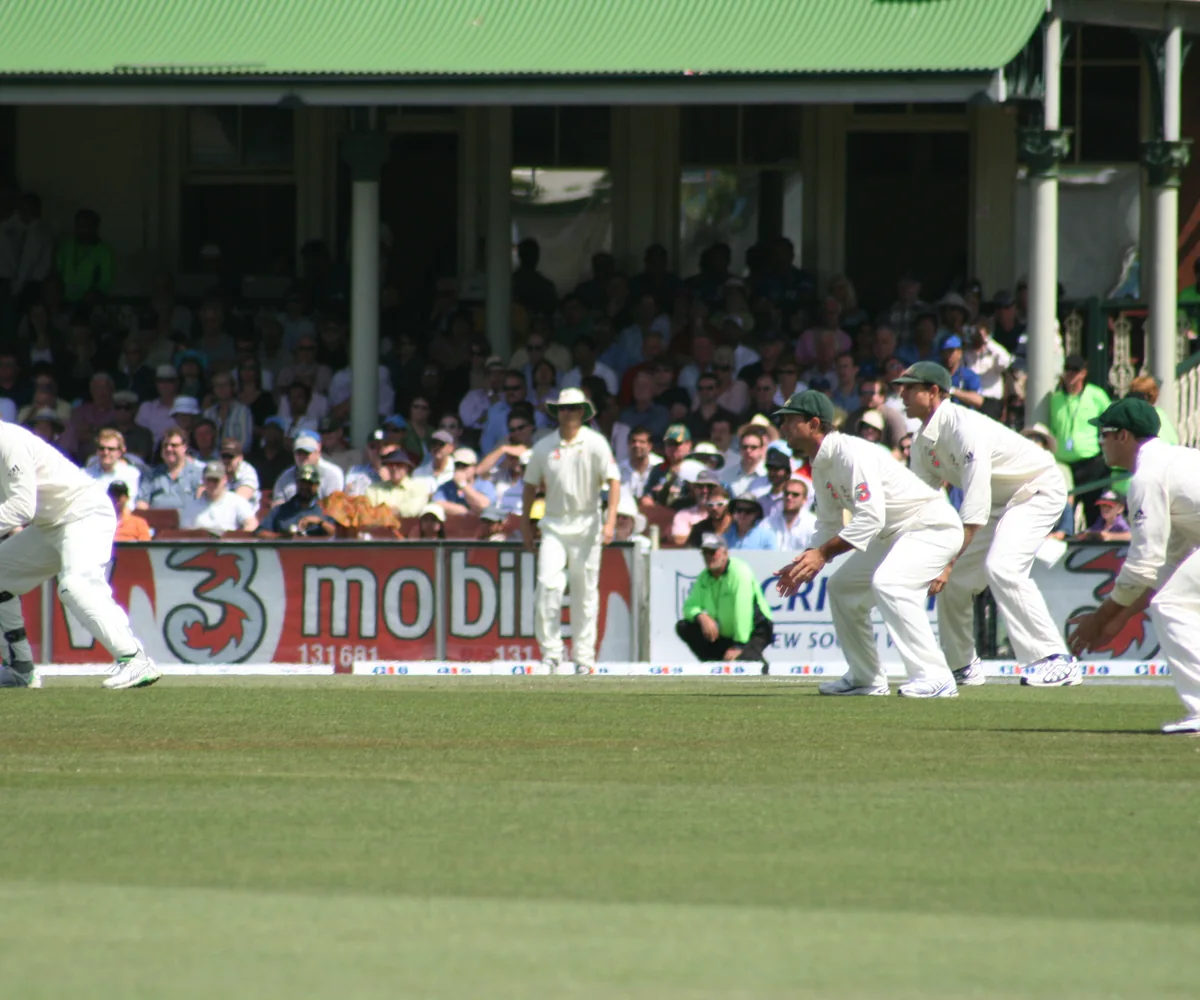
Now the practical shortcut, and this is the one that ends the confusion for most people. The slips are always on the off side. Always, in every format, for every batter. So if you are standing in the field and you cannot remember which way is off, look for the slip cordon behind the wicket. Whatever side they are on is the off side, and the other one is the leg side.
This works from any position on the field and for both kinds of batter, which is more than left and right will manage.
What Changes for a Left-Handed Batter
When the batting side changes handedness, the off and leg sides swap over. A left-handed batter faces the opposite direction, so everything that was on the off side is now on the leg side.
It is not subtle. The slips, the point and the cover all move to the other side of the field, and the off-side boundary riders become leg-side boundary riders. The same field that was attacking the stumps is now set up so the ball goes straight to the boundary.
This is why you should never learn a field by memorising a diagram with a right-handed batter drawn on it. Learn the off side and the leg side, and the diagram rebuilds itself every time.
The Standard Positions
These are the names you will hear most often. Once you know the two sides, every one of them becomes obvious from where it sits relative to the batter.
| Position | Where it sits | What it is for |
|---|---|---|
| Slip | Behind the wicketkeeper, slightly to the off side | Catching an edge. The hardest position in the field and the first one anyone asks for |
| Gully | Further out from the slips on the off side | Edges that carry further than the slip can reach |
| Third man | Off side, behind the wicket and deep | Edges that do not carry, and the deep off-side boundary |
| Point | Off side, level with the batter | Stopping cuts and drives, and stopping them from scoring |
| Cover | Off side, between point and straight | Drives and lofted shots through the off side |
| Mid-off | Straight down the off side, off the pitch | Straight and lofted drives, and stopping a quick single |
| Mid-on | Straight down the leg side, off the pitch | Drives and glances off the leg side, and working the ball into the ground |
| Midwicket | Leg side, between mid-on and square | Pulls, hooks and anything pulled to the leg side |
| Square leg | Level with the batter, on the leg side | Pulls to square, and the most common place to run out a batter who is going for a quick single |
| Fine leg | Behind square on the leg side | Edged swings that miss everything else, and the deep leg-side boundary |
| Long-on and long-off | Straight, at the boundary, one on each side | Stopping the ball reaching the rope |
You will also hear deep midwicket, long stop, silly point, backward point and the coven, which is a shortened cover and mid-off. Learn the ones above first. Every extra name is a variation on the same idea, and none of them are official.
Two Jobs, and You Only Need to Do One
Once you can name the positions, the next thing to understand is that fielding is really two different jobs, and every captain is choosing how to split them.
Stopping runs. This is the infield. Fielders close to the bat exist to cut off singles, cut off twos, and make the batter work. Square leg and point are the two that matter most, because a ball struck to either of them is a ball the batter is trying to turn into a single, and a fielder who picks it up cleanly and throws at the stumps turns a single into a direct run out. That single act is worth more than any boundary a fielding side will concede all day.
Stopping boundaries. This is the outfield, or the ring. Fielders on the boundary exist so that when the batter does get a good shot, someone is there to cut off the four or at least prevent the six. They are usually slower, because they need to cover a lot of ground, and they are the ones who have to judge a ball bouncing over their head.
A captain who fields five infielders is saying they would rather concede a boundary than a single. A captain who fields four deep is saying the opposite. Both are correct, and which one you want depends on the match situation, the pitch and how well your bowlers are bowling.
What the Laws Actually Say About Fielding
Here is the part most fielding guides leave out. The position names are convention, and a captain may put fielders almost anywhere. A few restrictions are not, because they are written into the Laws of Cricket.
You may not wear gloves or leg guards. Law 28.1 says no fielder other than the wicketkeeper is permitted to wear gloves or external leg guards, and that protection for the hand or fingers may be worn only with the consent of the umpires. If you are new and you turn up with batting gloves on, that is not a style issue, it is against the Laws.
Helmets go behind the keeper. Law 28.3.1 says that protective helmets, when not in use by fielders, may not be placed on the ground above the surface except behind the wicketkeeper and in line with both sets of stumps. This one matters constantly in club cricket, because helmets end up lying around near the pitch. If the ball strikes a helmet that has been put down properly, Law 28.3.2 makes the ball dead and the umpire awards five penalty runs to the batting side.
You may not stand on the pitch. Law 28.5 says that while the ball is in play and until it has made contact with the striker’s bat or person, or has passed the striker’s bat, no fielder other than the bowler may have any part of their person grounded on or extended over the pitch. A breach is a no ball. This is the rule that catches close fielders who wander onto the pitch for a better view of the edge.
You may not move before the ball reaches the batter. Law 28.6 makes it unfair for any fielder other than the wicketkeeper to move once the ball is in play and before it reaches the striker, with three exceptions: minor adjustments of stance or position, movement by a fielder who is not a close fielder towards the batter that does not significantly alter their position, and movement in response to the stroke the striker is playing or that their actions suggest they intend to play. Unfair movement brings a dead ball, five penalty runs and a report to the governing body.
You may not cheat with the ball. Law 28.2.1 says a fielder may field the ball with any part of their person, but is deemed to have fielded it illegally if they wilfully use anything other than part of their person, extend their clothing with their hands to field it, or discard an item of clothing or equipment which then makes contact with the ball. Illegal fielding brings five penalty runs and a report.
Important
Read Law 28.4 carefully rather than skimming it. At the instant of the bowler’s delivery there must not be more than two fielders, other than the wicketkeeper, behind the popping crease on the on side, and a fielder counts as behind that crease unless the whole of their body, whether grounded or in the air, is in front of the line. A breach is a no ball. Test cricket routinely places three or four fielders in the slips on the off side, so how this restriction is applied to a full slip cordon is a matter of umpiring practice rather than something the wording resolves on its own. If you want a definite answer for your own league, ask your umpires or read your competition’s playing conditions, and do not assume the televised version applies to you.
Run Out and Stumping: The Two Fielding Wickets
A bowling delivery can only dismiss a batter in a limited number of ways. Two of them belong to the fielding side rather than the bowler, and both are worth understanding because they are where fielding turns directly into wickets.
Run out is the fielders’ own dismissal. The batter is out run out if they are still at their crease when the fielder breaks the wicket with the ball in hand, and the whole difficulty of the dismissal is the small window in which it has to happen. That is why throwing from square leg or point at the stumps is not optional effort but the primary job of those two positions. Our guide to the run out rule covers the details of when the batter is considered out of their ground.
Stumping needs the wicketkeeper rather than a fielder, and it is only possible when the batter misses. If the batter is bowled or hits the stumps, the batter has to be given out bowled, and the keeper has no say. If the batter misses, the keeper puts the wicket down with the ball in hand while the batter is still outside their crease and stumping is the correct decision. The wicketkeeper’s own guide covers that in more detail.
Neither of these is awarded automatically. The umpire has to be given a clear and definite request for the decision, and a hesitant call is not treated as an appeal at all.
Field Restrictions and the Powerplay
One more thing to be clear about, because it confuses new players constantly. The fielding restrictions you see in one-day and T20 cricket, where only a limited number of fielders may stand on the boundary, are not in the Laws. They come from each competition’s own playing conditions.
That is why the number changes depending on where you are playing. A domestic T20 competition, a franchise tournament and an international T20 can all have different rules about how many fielders may be on the boundary, and the fielding captain can often use only one fielding change per over. Our guide to the powerplay rules covers the restrictions that apply in the early overs of a limited-overs innings, which is the point at which the field is at its most spread out and the batting is hardest.
Check your own competition’s rules before you assume anything about how many fielders you are allowed on the rope.
Frequently Asked Questions
Which side is the off side for a right-handed batter?
The off side is the side the batter is facing, and the leg side is the side their legs point to. Rather than trying to hold left and right in your head, use the slips as a marker. The slips are always on the off side, so the side of the wicket the slip cordon is standing on tells you which side is off from wherever you are standing on the field. For a left-handed batter the two sides swap completely.
Why is the slip position so difficult?
Because the ball has to travel through a very small space at very high speed, and it may be moving away from you. A slip is crouching close to the wicket with the hands low and the head still, reacting rather than moving, and a ball that goes through to the keeper or past the slips is normally down. Test captains put fielders there anyway because a caught edge is worth far more than the one delivery that beats you.
How do fielders decide where the ball is going?
From the batter’s bat face, the bowler’s release point, and the bowler’s body position. Beginners should watch the bowler’s arm rather than the ball, because the arm tells you the line before the ball has finished its path. Then watch the bat face, because the face angle is the second clue. Watching the ball itself gives you much less time to react, which is why fielding is coached in stages and not all at once.
Can I stand anywhere I like in the field?
Almost. The named positions are convention, so a captain has a lot of freedom. But the Laws set real limits: no gloves or leg guards other than for the wicketkeeper, no standing on or over the pitch while the ball is in play, helmets put down only behind the wicketkeeper and in line with the stumps, and no moving before the ball reaches the batter outside the three exceptions. Limited-overs competitions add their own boundary-fielding rules on top of all of that.
What is the difference between run out and stumped?
Run out can happen to a batter who has played the ball, or to a batter caught short of their ground attempting a run, and it is a fielding dismissal. Stumping can only happen to a batter who missed the ball entirely, is out of their ground, and is put out by the wicketkeeper. If the batter hit the stumps, the batter is out bowled and the keeper cannot claim stumping instead.
Conclusion
Work through it in this order and the field stops being a set of names to memorise. Learn the off side and the leg side. Notice that the slips are always on the off side and use them to orient yourself. Then learn one infield position and one deep position properly, because that is all most club cricket asks of you.
Fielding is the part of the game where the least glamorous work produces the most value. Nobody claps for the fielder who cuts off the single that would have been four, but that is the innings.
Photo: fielders in a slip cordon crouching behind the wicket, waiting as a ball is bowled. Photograph by Privatemusings, licensed under CC BY-SA 4.0. Cropped to 1200 by 1000 pixels.
Read More: Cricket Scoring System Explained: Runs, Boundaries and Dots
