




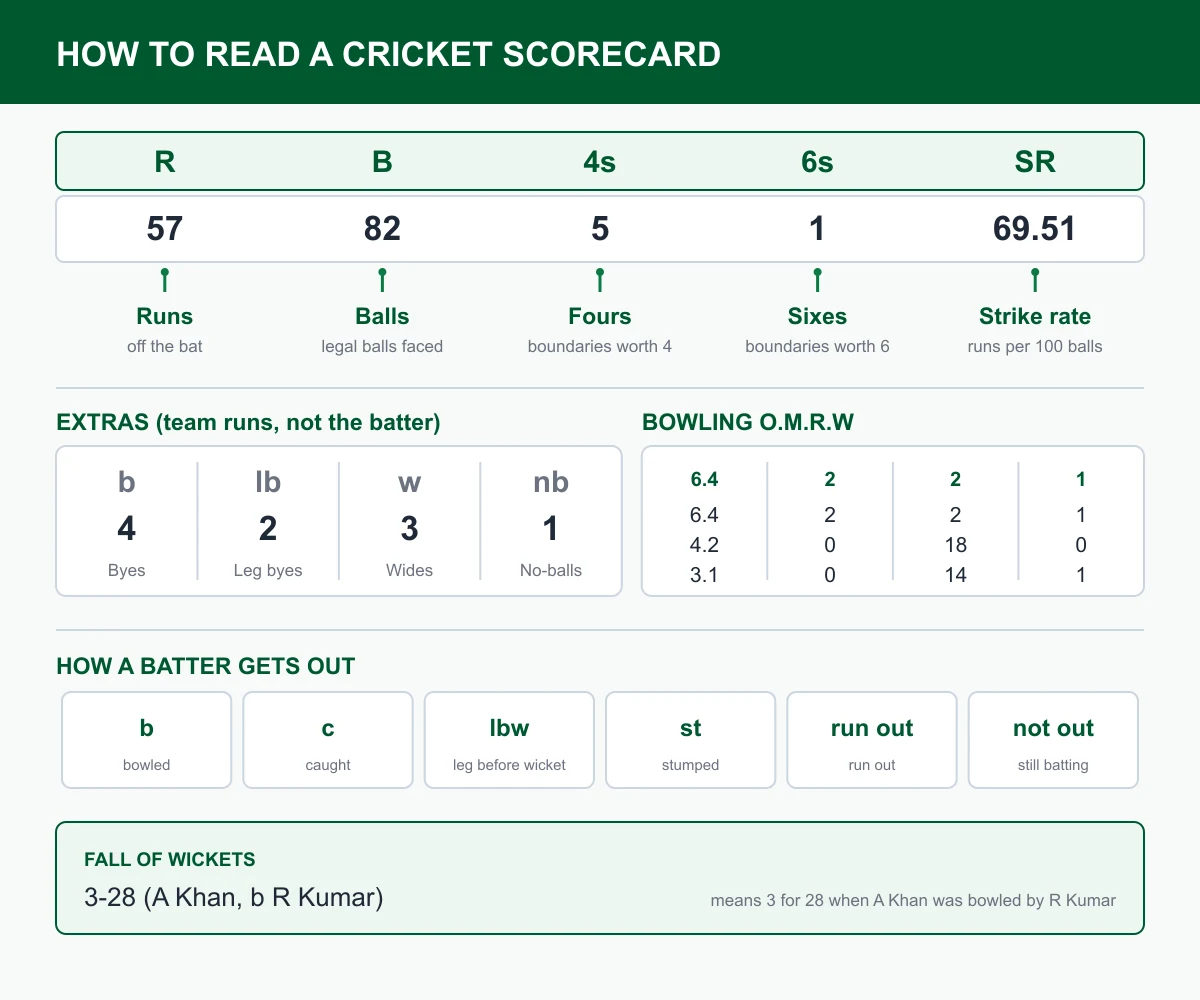
Most new cricket fans can tell you their team scored a lot of runs. The harder job is sitting in front of an actual scorecard and working out what happened. A scorecard looks like a wall of numbers, and beginners often assume the big total is the only thing worth reading.
That is the wrong idea. A scorecard tells you far more than a score. It shows you how each dismissal happened, which bowler took which wicket, where the runs came from, and how hard a batter was working. Once you know what the columns mean, the page stops being confusing and starts being the best story in the sport.
Quick Answer
A cricket scorecard is the official record of one innings. It gives every batter’s runs, balls faced, fours, sixes and strike rate, then lists the extras, the team total, and for each wicket the bowler who took it. It is produced by the two official scorers, who are appointed under Law 3 of the MCC Laws of Cricket.
What a Scorecard Actually Is
A scorecard is not a summary written by a journalist. It is the legal record of an innings, kept by two people called scorers who sit behind the bowler’s arm at the boundary.
The MCC Laws of Cricket set out their job in Law 3, which covers the scorers. Law 3.1 says two scorers shall be appointed to record all runs scored, all wickets taken and, where appropriate, the number of overs bowled. Law 3.2 then makes them check their records against each other and agree with the umpires at every interval, other than drinks intervals, and at the end of the match.
That last part matters. A scorecard is therefore a checked record, not a rough tally. If the number on the page looks wrong to you, it is usually your reading that is off rather than the scorers.
If you have never seen the game explained from the ground up, our cricket basics and rules guide covers the terms this page assumes you already know.
The Batter Columns, One by One
Every batter gets one line. The order of the lines tells you the batting order, because batters are listed in the order they came in, except the two opening batters who appear first.
| Column | What it means |
|---|---|
| R | Runs scored. This does not include extras, because extras belong to the team, not to the batter. |
| B | Balls faced. Only legal deliveries count, so no-balls and wides are not added here. |
| 4s | How many of those runs came as fours. |
| 6s | How many of those runs came as sixes. |
| SR | Strike rate, which is runs per 100 balls faced. It measures scoring speed, not quality. |
So a line reading 57 (82) means 57 runs from 82 legal balls. A line reading 12 (14) 0 2 85.71 means 12 runs off 14 balls, no fours, two sixes, and a strike rate of 85.71.
Notice that 12 is not made up of fours and sixes here. That is normal. Most runs in cricket are singles, twos and threes, and the 4s and 6s columns only count the boundaries.
How to Read the Dismissal Code
The short letters in the middle of a batter’s line tell you how that batter got out. This is the part beginners find most useful, because it explains the story of the innings.
| Code | Meaning |
|---|---|
| not out | Still batting when the innings ended. |
| b | Bowled. The ball hit the stumps and broke the wicket. |
| c & b | Caught and bowled. The bowler took the catch himself. |
| c | Caught. The fielder’s name follows, so c Smith means caught by Smith. |
| lbw | Leg before wicket. The ball would have hit the stumps but it hit the batter’s leg first. |
| st | Stumped. The wicketkeeper broke the wicket behind the batter. |
| run out | Run out. A fielder broke the wicket while the batter was still running. |
| hit wicket | The batter’s own bat or body struck the stumps. |
| c & st | Caught and stumped, a combination that happens off a spin bowling delivery. |
| did not bat | The player was in the eleven but never came to the crease. |
When you see a name printed without any code, that batter was not out. The two codes most often confused by newcomers are lbw and run out, and the difference is simple: lbw is a dismissal decided by the umpire, while a run out is a fielding effort that can be lost by failing to collect the ball.
Extras: The Runs That Are Not Off the Bat
Below the batting lines there is an extras section. These are runs added to the team’s total that nobody scored as a run off the bat, which is why they never appear in any batter’s column.
- Byes are runs taken after the ball has missed the bat and gone past the wicketkeeper.
- Leg byes are runs taken after the ball has hit the batter somewhere other than the bat, usually off the pads.
- No-balls are illegal deliveries. Law 21.15 of the MCC Laws states that a penalty of one run is awarded the moment a no-ball is called, and that this penalty stands in addition to any other runs scored, any boundary, and any other penalties.
- Wides are deliveries too far outside the batter’s reach for a normal stroke. Each one is recorded on its own line and adds a penalty run.
- Penalty runs are awarded by the umpires for other Law breaches and are added to the extras.
Two no-ball details surprise almost everyone. First, a no-ball does not count as one of the balls in the over, so it has to be bowled again. Second, Law 21.18 says that when a no-ball is called neither batter can be given out under any Law except hit the ball twice, obstructing the field, or run out. You cannot be bowled or caught off a no-ball.
Fall of Wickets
The fall of wickets line sits under the batting section and shows the score at each wicket. Reading 3-28 (A Khan, b R Kumar) means the team was 3 for 28 when A Khan was dismissed, and the wicket came off R Kumar’s bowling.
This one line tells you the shape of the innings. A stack of wickets all falling at a similar score means a collapse. Wickets spread across the innings with a long partnership in between means a side that recovered.
How to Read the Bowling Figures
Each bowler gets a line too, written as four numbers separated by dots or dashes. The order is always the same:
Overs bowled, maidens, runs conceded, wickets taken.
So 6.4.2.1 means 6 overs and 4 balls, 2 maidens, 2 runs conceded, and 1 wicket. The detail that confuses people is the second number. You will never see a 6 in the balls position, because 6 legal balls make a complete over, and a bowler starts the next one. If the number is 0 to 5, you are reading balls, not overs.
A maiden is an over in which no runs were scored. A bowler who takes 6.4.2.1 has bowled most of a spell, conceded almost nothing, and picked up a wicket, which is the line you look for when you want to know who actually did the work.
Important
A four and a six are not simply the same shot going further. Law 19.7.1 says a boundary six is scored only if the ball was struck by the bat and was first grounded beyond the boundary without ever touching the ground inside the field, and that this still applies even if the ball previously touched a fielder. Law 19.7.2 says a boundary four is scored when a ball grounded beyond the boundary was first grounded inside the field, or was not struck by the bat at all. So a hard shot that bounces inside the rope and rolls away is a four, and a ball that clips a fielder on its way over is still a six.
How to Read a Cricket Scorecard in Order
Here is a simple routine that works every time.
- Find the team total and the number of overs it took.
- Read the batting lines from the top, and note who was not out.
- Check the fall of wickets to see when wickets fell.
- Look at the extras to see how many runs came from mistakes rather than shots.
- Read the bowling figures to find the bowler who took the most wickets.
- Compare the two highest strike rates to see who scored fastest.
For the scoring side of this, our cricket scoring system guide explains how runs, boundaries and extras are actually awarded.
Common Scorecard Questions
Why does a batter’s strike rate not match his runs?
Strike rate is runs divided by balls faced, multiplied by 100. A batter who scores 30 from 100 balls has a strike rate of 30.00, and one who scores 30 from 30 balls has 100.00. The runs are the same, but the speed is not. If you want that number explained properly, see our page on what strike rate means in cricket.
What does DNB mean on a scorecard?
DNB stands for did not bat. It means the player was listed in the eleven but the innings finished, or the team was all out, before that player reached the crease. It is not a criticism of the player. A lower-order batter listed as DNB usually means the match ended early.
Do no-balls and wides count in the batter’s balls faced?
No. Only legal deliveries count, and no-balls and wides are not legal deliveries. That is why a batter can score 0 from 3 balls and still have faced a good number of deliveries. The no-ball or wide is added to the extras instead.
What is the difference between a bye and a leg bye?
Both are extras, so neither counts as a run for the batter. A bye is taken when the ball passes the bat and wicketkeeper without touching either. A leg bye is taken when the ball has struck the batter’s body, usually the pads, and runs are run off that. In both cases the runs go into the team’s total through the extras section.
Why does the bowling line show 6.4 and not 6.4 overs?
It does show overs, but cricket counts the balls separately. An over is 6 legal balls, so 6.4 means 6 completed overs plus 4 balls of the next over, which is 40 balls in total. Because a bowler can never deliver a 6th ball of an over, that position is always 0 to 5.
Once these columns stop being mysterious, a scorecard becomes easy. You can tell who carried the bat, who broke the match with the ball, and how the runs were actually made. That is the difference between watching the score and understanding it.
