




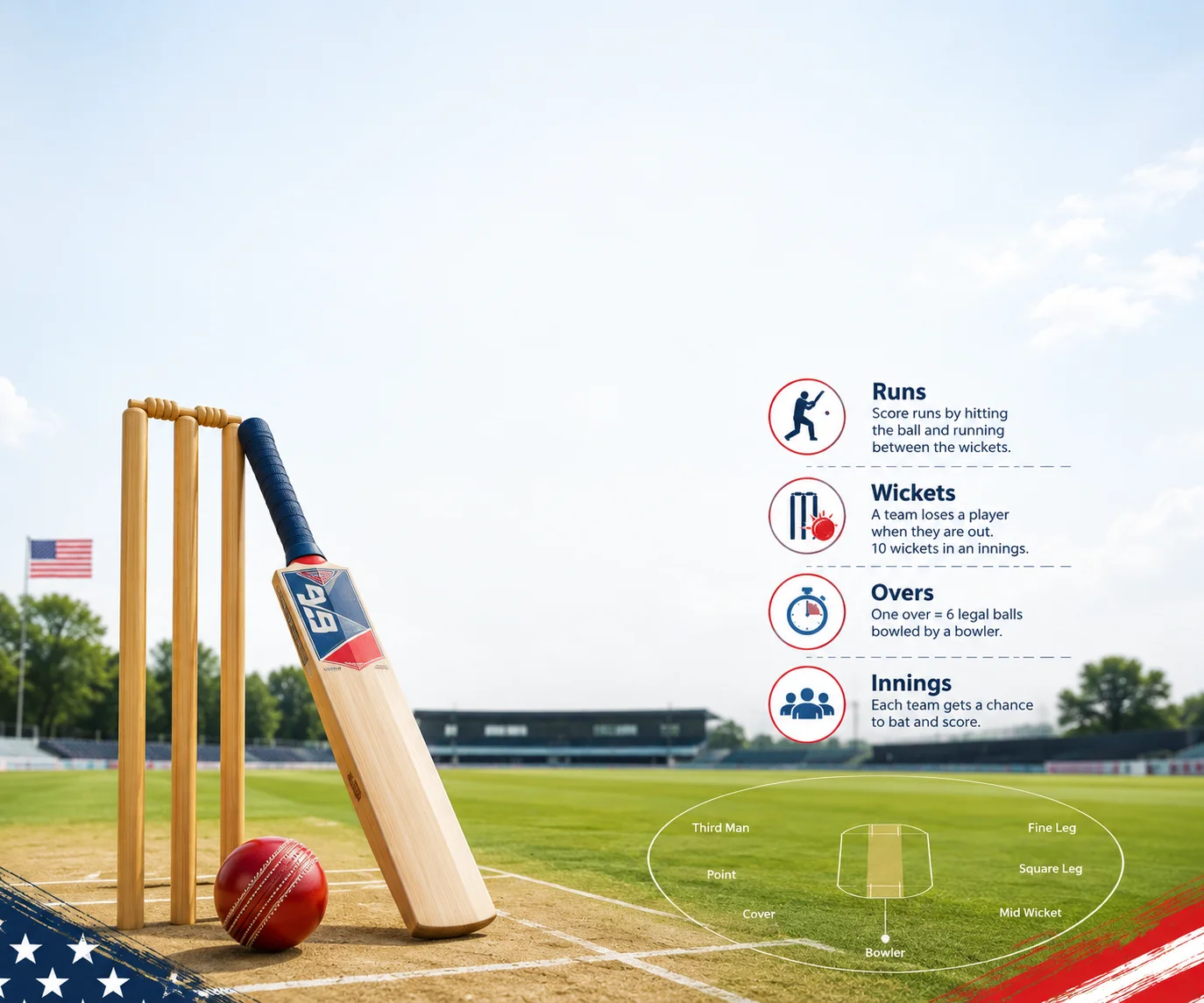
The same confusion comes up again and again among cricket beginners, especially people in the USA. They understand that cricket has a bat and ball, but words like overs, wickets, innings, LBW, and boundaries make the game feel difficult. Many beginners also compare cricket with baseball, but then they get confused because cricket has its own rules, scoring style, and match flow.
That is why this guide explains cricket basics and rules in simple words. You do not need to learn every cricket law to enjoy your first match. Start with four main ideas: runs, wickets, overs, and innings. Once these are clear, cricket becomes much easier to watch and enjoy. Easy examples, beginner-friendly explanations, and USA-style comparisons help you understand the game without feeling lost.
Key Takeaway
Cricket is simple when you understand four basics: runs, wickets, overs, and innings. One team bats and scores runs, while the other team bowls and fields. The team with the most runs wins.
Cricket Basics & Rules: Simple Guide for USA Beginners
Cricket can look confusing when you watch it for the first time. You may hear words like runs, wickets, overs, innings, LBW, and boundaries. At first, it feels like there are too many rules.
But cricket is easier than it looks.
The basic idea is simple. One team bats and scores runs. The other team bowls and fields. The team with the most runs wins.
This guide explains cricket basics and rules in simple words. It is made for beginners, especially USA fans who may already understand baseball. You do not need to know every cricket law to enjoy your first match. Start with runs, wickets, overs, and innings. These four ideas explain most of the game.
Beginner’s Guide to Cricket
Cricket is a bat-and-ball game. It is played between two teams. Each team has 11 players.
One team bats first. The batting team tries to score as many runs as possible. The other team bowls and fields. Their job is to stop runs and get batters out.
After the first team finishes batting, the second team gets its turn to bat. The second team tries to beat the first team’s score.
Cricket is popular in many countries. These include England, India, Pakistan, Australia, South Africa, New Zealand, Sri Lanka, Bangladesh, and the West Indies. Cricket is also growing in the USA.
For new fans, T20 cricket is the easiest format to watch. It is short, fast, and exciting. A T20 match is a good starting point because it does not take several days.
Cricket Explained for USA Beginners
If you understand baseball, cricket becomes easier to understand.
The bowler is like a pitcher. The batter is like a hitter. The wicketkeeper is like a catcher.
But cricket is also very different from baseball.
In baseball, the hitter runs around bases. In cricket, two batters run between two wickets.
In baseball, a player can be out after three strikes. In cricket, a batter can keep batting until they get out.
In baseball, the ball is mostly hit forward. In cricket, the batter can hit the ball almost anywhere around the field.
Cricket vs Baseball: Simple Comparison
This table helps USA beginners understand cricket using familiar baseball terms.
| Cricket | Baseball | Simple Meaning |
|---|---|---|
| Bowler | Pitcher | The player who delivers the ball. |
| Batter | Hitter | The player who hits the ball and scores runs. |
| Wicketkeeper | Catcher | The player behind the stumps. |
| Wicket | Out / target | Can mean stumps, an out, or the pitch area. |
| Over | No exact match | A set of 6 legal balls. |
| Four | Extra-base hit style idea | Ball reaches the boundary after bouncing. |
| Six | Home run style idea | Ball crosses the boundary without bouncing. |
Basics of the Game
A cricket match is played on a large oval field.
In the middle of the field, there is a strip called the pitch. The pitch is 22 yards long.
At both ends of the pitch, there are three wooden sticks. These are called stumps. Two small pieces of wood sit on top of the stumps. These are called bails.
Together, the stumps and bails are called the wicket.
Two batters stand on the field at the same time. One batter faces the bowler. The other batter stands at the opposite end of the pitch.
The bowler bowls the ball toward the batter. The batter tries to hit the ball and score runs.
The fielding team tries to stop the ball, catch it, or hit the stumps to get the batter out.
Visual Guide: Pitch, Wicket, and Field
This section is important for visual learners.
A beginner should understand three basic parts of the field:
| Cricket Area | Simple Meaning |
|---|---|
| Pitch | The 22-yard strip in the middle |
| Wicket | Stumps and bails at each end |
| Boundary | Outer edge of the field |
| Crease | Safe line near the wicket |
| Outfield | Large area outside the pitch |
Toss Before the Match
Before the match starts, both captains take part in a coin toss.
The captain who wins the toss chooses whether to bat first or field first.
This choice depends on the pitch, weather, and match plan.
For example, if the pitch looks good for batting, the captain may choose to bat first. If the weather helps bowlers, the captain may choose to field first.
Understanding Teams & Players
Each cricket team has 11 players. Every player has a role.
Some players are batters. Their main job is to score runs.
Some players are bowlers. Their main job is to get batters out.
Some players are all-rounders. They can bat and bowl well.
There is also one wicketkeeper. The wicketkeeper stands behind the stumps.
A cricket team usually has:
- Batters
- Bowlers
- All-rounders
- Wicketkeeper
- Captain
- Fielders
The captain makes important decisions. The captain chooses bowlers, sets the field, and makes match plans.
Basic Rules of Cricket
The main rule of cricket is simple. Score more runs than the other team.
Each team gets a turn to bat. This turn is called an innings.
The batting team tries to score runs. The fielding team tries to stop runs and take wickets.
A wicket means a batter is out.
In most cricket formats, when 10 batters are out, the team’s innings ends.
An over has 6 legal balls. After one over, another bowler usually bowls from the other end.
The match format decides how many overs each team gets.
For example:
- T20 cricket has 20 overs per team.
- ODI cricket has 50 overs per team.
- Test cricket can last up to five days.
The team with the highest score wins the match.
How Runs Are Scored
Runs are the points in cricket.
The most common way to score runs is by running between the wickets.
After the batter hits the ball, both batters run to the opposite ends of the pitch. Each completed run adds 1 run to the team score.
A batter can also score runs by hitting boundaries.
If the ball reaches the boundary after touching the ground, it is 4 runs.
If the ball crosses the boundary without touching the ground, it is 6 runs.
These are called boundaries.
| Scoring Type | Meaning |
|---|---|
| 1 run | Batters run once between wickets |
| 2 runs | Batters run twice |
| 4 runs | Ball reaches boundary after bouncing |
| 6 runs | Ball crosses boundary without bouncing |
| Extras | Runs from wides, no-balls, byes, or penalties |
Runs can also come from extras. Extras are runs given because of certain bowling or fielding mistakes.
Common extras include:
- Wide ball
- No-ball
- Bye
- Leg bye
- Penalty runs
Penalty runs are not given for every normal mistake. They are given for specific rule breaches, such as unfair play or illegal actions.
Simple Cricket Match Example
Here is a simple example.
Team A bats first. They score 160 runs in 20 overs.
Now Team B needs 161 runs to win.
If Team B scores 161 before losing all wickets, Team B wins.
If Team B scores less than 160, Team A wins.
If both teams score the same number of runs, the match can be tied.
This is the basic idea of cricket.
What Is an Over in Cricket?
An over is a set of 6 legal balls.
For example, if a bowler bowls 6 legal balls, one over is complete.
After one over, another bowler usually bowls from the other end of the pitch.
This is important because cricket formats are based on overs.
In T20 cricket, each team gets 20 overs. That means each team faces 120 legal balls.
In ODI cricket, each team gets 50 overs. That means each team faces 300 legal balls.
What Is a Wicket in Cricket?
The word wicket can mean different things in cricket.
This is one reason beginners get confused.
A wicket can mean:
- The stumps and bails
- A batter getting out
- The pitch area
For example, if someone says, “The bowler took a wicket,” it means the bowler got a batter out.
If someone says, “The ball hit the wicket,” it means the ball hit the stumps.
Did You Know? Ways to Be Dismissed
A batter can get out in many ways. Getting out is also called being dismissed.
Here are the most common ways a batter can be dismissed.
Bowled
The batter is out if the bowler hits the stumps and removes the bails.
Caught
The batter is out if the ball touches the bat and a fielder catches it before it hits the ground.
LBW
LBW means Leg Before Wicket.
A batter can be out if the ball hits the leg and would have hit the stumps.
This rule can feel hard for beginners. But the simple idea is this: the batter cannot use the leg to block a ball that was going to hit the wicket.
Run Out
A batter is run out if the fielding team breaks the stumps while the batter is outside the crease.
The crease is the safe line near the wicket.
Stumped
A batter is stumped when the wicketkeeper breaks the stumps while the batter is out of the crease.
This often happens when the batter misses the ball and steps forward.
Hit Wicket
A batter is out if they accidentally hit their own stumps while playing the ball.
These are the most important dismissals for beginners to learn first.
What Is LBW in Cricket?
LBW is one of the most confusing cricket rules for beginners.
LBW means Leg Before Wicket.
In simple words, a batter can be out LBW if the ball hits the leg and the umpire believes the ball would have hit the stumps.
Here is a simple example.
The bowler bowls the ball. The batter misses it. The ball hits the batter’s pad. If the ball was going toward the stumps, the batter may be out LBW.
For new fans, do not worry if LBW feels difficult at first. Even regular cricket fans discuss LBW decisions.
Basic Rules & Etiquette
Cricket is known as a game of skill, patience, and respect.
Players should follow the rules and respect the spirit of the game.
The bowler must bowl fairly. The batter must play within the rules. Fielders must not distract the batter in an unfair way.
Umpires control the match. They make decisions about outs, boundaries, no-balls, wides, and other rules.
Players can appeal when they think a batter is out. The appeal is usually made by saying, “How’s that?”
The umpire then gives the decision.
Good cricket etiquette includes:
- Respecting umpires
- Respecting opponents
- Playing fairly
- Avoiding unfair distractions
- Accepting decisions
- Following the spirit of cricket
Umpire Signals in Cricket
Umpires use hand signals during a cricket match. These signals help players and fans understand the decision.
| Umpire Signal | Meaning |
|---|---|
| Raised finger | Batter is out |
| Both arms stretched wide | Wide ball |
| One arm raised | No-ball |
| Both arms raised above head | Six runs |
| Arm waved side to side | Four runs |
| Hands crossed and uncrossed | Dead ball |
What Is DRS in Cricket?
DRS means Decision Review System.
It allows a team to challenge some umpire decisions.
DRS uses technology to review close calls. It can help check LBW, catches, and ball tracking.
DRS is mostly used in professional cricket. It is not used in most casual games.
For beginners, remember this simple point: DRS helps correct close umpire decisions.
Cricket Equipment Needed to Play Cricket
Cricket needs some basic equipment.
At a professional level, players use protective gear because the ball is hard.
Basic cricket equipment includes:
- Cricket bat
- Cricket ball
- Stumps and bails
- Batting pads
- Batting gloves
- Helmet
- Thigh guard
- Arm guard
- Abdominal guard
- Wicketkeeping gloves
Beginners do not always need full professional equipment.
For casual cricket, you can start with a tennis ball, a simple bat, and something to use as wickets.
For hard-ball cricket, safety gear is very important. A cricket ball is hard and can cause injury.
Kids and new players should start with soft-ball cricket. It is safer and easier to learn.
Basic Skills and Exercises
Cricket has three main skills: batting, bowling, and fielding.
Batting
Batting means hitting the ball and scoring runs.
A good batter watches the ball carefully. The batter also learns when to attack and when to defend.
Basic batting practice includes:
- Straight drives
- Defensive shots
- Pull shots
- Running between wickets
Bowling
Bowling means delivering the ball toward the batter.
Bowlers try to hit the stumps or force the batter to make a mistake.
Basic bowling practice includes:
- Line and length
- Fast bowling
- Spin bowling
- Accuracy drills
Fielding
Fielding means stopping the ball and catching it.
Good fielding can save many runs.
Basic fielding practice includes:
- Catching
- Throwing
- Ground fielding
- Run-out practice
A good cricket player should practice all three skills.
Play Anywhere
One great thing about cricket is that you can play it almost anywhere.
You can play cricket in a park, backyard, street, school ground, beach, or sports field.
For casual cricket, you do not need a full stadium. You only need space, a bat, a ball, and something to use as wickets.
In the USA, beginners can start with tennis-ball cricket in a park, backyard, school ground, or community sports area.
You do not need a full cricket ground to learn the game.
Cricket Formats
Cricket has different formats. Each format has a different length.
T20 Cricket
T20 cricket is the shortest major format.
Each team gets 20 overs.
It is fast, exciting, and good for beginners.
ODI Cricket
ODI means One Day International.
Each team usually gets 50 overs.
This format is longer than T20 but shorter than Test cricket.
Test Cricket
Test cricket is the longest format.
It can last up to five days.
It is the most traditional form of cricket. It needs patience, skill, and strategy.
For new fans in the USA, T20 cricket is the best format to start with.
Cricket Formats Comparison
Cricket has different formats. For beginners in the USA, T20 cricket is usually the easiest format to start with.
| Format | Overs | Match Length | Best For Beginners? |
|---|---|---|---|
| T20 | 20 overs per team | Around 3 hours | Yes |
| ODI | 50 overs per team | Around 7–8 hours | Medium |
| Test | No fixed over limit | Up to 5 days | Advanced |
How to Watch a Cricket Match for the First Time
If you are watching cricket for the first time, do not try to learn every rule at once.
Focus on these four things:
- How many runs the batting team has
- How many wickets they have lost
- How many overs are left
- What score the second team needs to win
For example, if the score is 120/3 after 15 overs, it means the team has 120 runs and has lost 3 wickets.
If you understand the score, the match becomes much easier to follow.
How to Read a Cricket Score
If the score is 150/4 in 18 overs, it means the team has scored 150 runs and lost 4 wickets. They have played 18 overs.
For beginners, always check three things first: runs, wickets, and overs. Once you understand these, the match becomes much easier to follow.
Common Mistakes Beginners Make While Understanding Cricket
Many beginners make the same mistakes when learning cricket.
Mistake 1: Trying to learn every rule at once
You do not need to learn every cricket law in one day. Start with runs, wickets, overs, and innings.
Mistake 2: Thinking cricket is exactly like baseball
Cricket and baseball have some similar ideas, but they are different games.
Mistake 3: Getting confused by the word wicket
Wicket can mean the stumps, an out, or the pitch area. Always check the context.
Mistake 4: Thinking Test cricket is the best place to start
Test cricket is great, but it is long. Beginners should start with T20 cricket.
Mistake 5: Ignoring the score format
A cricket score like 150/4 means 150 runs and 4 wickets lost.
Once you understand the score, the game becomes easier.
Common Cricket Terms for Beginners
Here are some important cricket terms.
Run
A run is one point in cricket.
Wicket
A wicket can mean the stumps, the pitch area, or a batter getting out.
Over
An over is a set of 6 legal balls.
Innings
An innings is one team’s turn to bat.
Boundary
A boundary is the edge of the field.
Four
A four is scored when the ball reaches the boundary after touching the ground.
Six
A six is scored when the ball crosses the boundary without touching the ground.
Bowler
The bowler delivers the ball to the batter.
Batter
The batter tries to score runs.
Wicketkeeper
The wicketkeeper stands behind the stumps.
Umpire
The umpire controls the match and gives decisions.
Common Beginner Mistakes
Many new cricket fans make the same mistakes when learning the game. Avoiding these mistakes will help you understand cricket faster.
- Trying to learn every cricket rule at once.
- Thinking cricket is exactly like baseball.
- Getting confused by the word wicket.
- Starting with Test cricket instead of T20 cricket.
- Not understanding score formats like 150/4.
FAQs About Cricket Basics & Rules
What is cricket in simple words?
Cricket is a bat-and-ball game between two teams. One team bats and scores runs. The other team bowls and fields.
How many players are in a cricket team?
Each cricket team has 11 players.
What is an over in cricket?
An over has 6 legal balls. After one over, another bowler usually bowls from the other end.
What is a wicket in cricket?
A wicket can mean the stumps, the pitch area, or a batter getting out.
How do you score runs in cricket?
Batters score runs by running between the wickets or hitting boundaries.
Conclusion
Most beginners do not struggle because cricket is too hard. They struggle because cricket is often explained in a technical way. When you break the game into simple parts, it becomes much easier to understand. One team bats and tries to score runs. The other team bowls and fields. The team with the most runs wins.
If you are new to cricket, start with runs, wickets, overs, and innings before learning advanced rules like LBW or DRS. For USA fans, comparing cricket with baseball can help at the start because the bowler is like a pitcher, the batter is like a hitter, and the wicketkeeper is like a catcher. But cricket has its own style, strategy, and excitement. Once you understand the basics, every ball, run, wicket, and boundary starts to make sense.
