




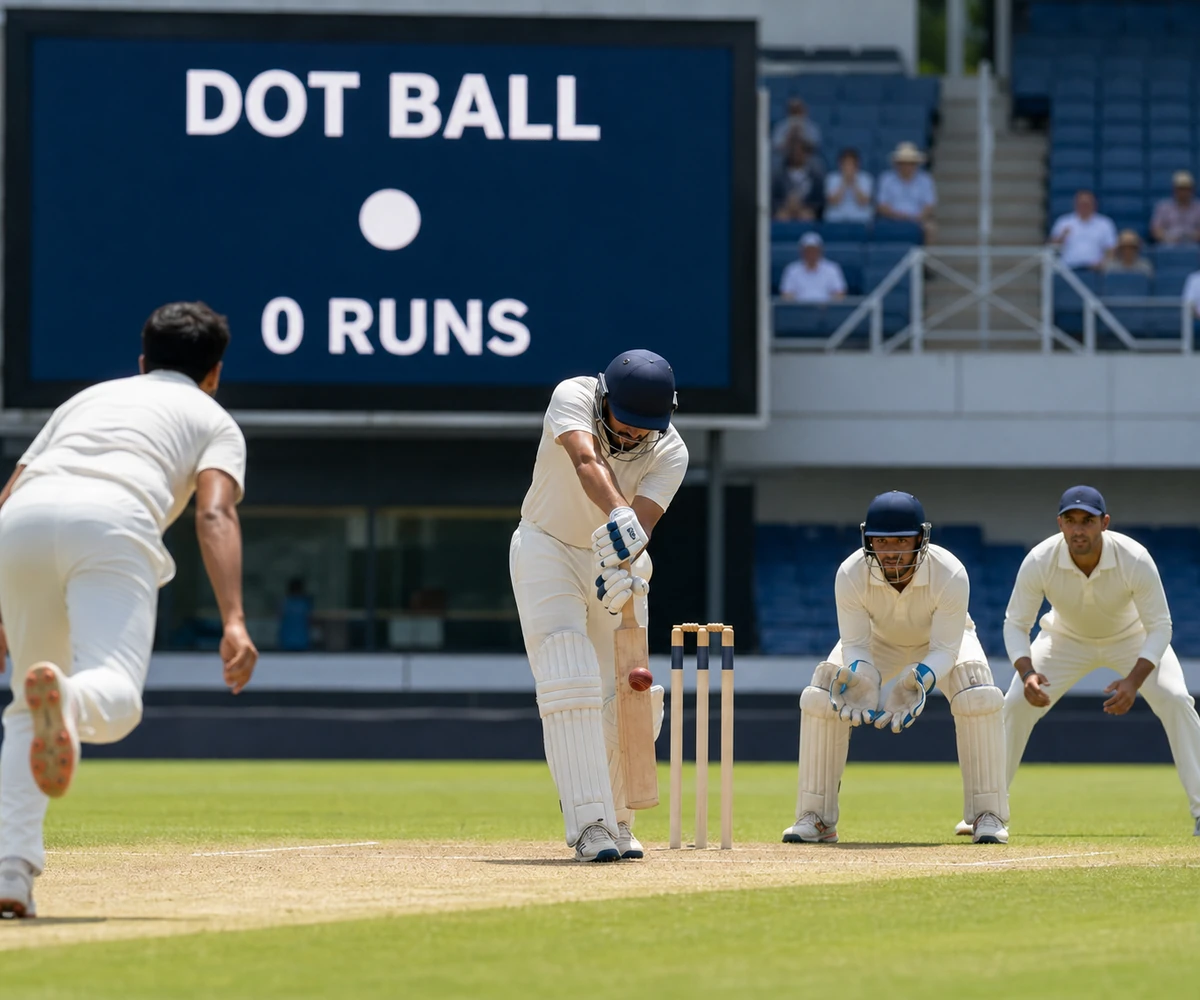
Cricket scorecards often show a small dot instead of a number after a delivery. For a new fan, that mark can look unimportant. It is actually a quick way to show that the batting team added no run from that ball. Learning this symbol is one of the easiest steps in understanding the basic cricket rules.
A dot ball can also change the mood of an over. One scoreless delivery may seem small, but several in a row can slow the batting team and create pressure. Cricket Focus explains the meaning, scoring details, and common exceptions below.
Quick Answer
A dot ball is a delivery from which the batting team scores zero runs. On a scorecard or ball-by-ball display, it is usually shown as a dot: –
An ordinary legal delivery with no run is a dot ball. A wicket can also be recorded as a dot delivery if no run or penalty is added. A wide or no-ball is not a dot ball because it adds at least one extra run.
What Does Dot Ball Mean in Cricket?
The simple dot ball meaning is one delivery that adds zero to the team score.
Imagine the score is 42 for 2. The bowler delivers the next ball, the batter defends it, and nobody runs. The score stays 42 for 2. That delivery is a dot ball.
The name comes from traditional scorebooks. A scorer places a dot beside a delivery when no run is recorded. Digital scorecards still use the same symbol in an over summary.
For example:
Over: – 1 – 4 W –
This over contains three ordinary dot balls, one single, one four, and one wicket delivery. The exact symbols may vary between scorecards, but a dot normally means zero runs.
What Counts as a Dot Ball?
A delivery counts as a dot when the team total does not increase from that ball.
Common examples include:
- The batter blocks the ball and does not run.
- The batter swings and misses a legal delivery.
- The batter leaves the ball alone.
- A fielder stops the ball before the batters can run.
- A batter is bowled, caught, LBW, or stumped and no run or penalty is added.
- The ball becomes dead without any run being scored.
The key test is simple: Did the batting team receive a run from the delivery? If the answer is no, it is normally a dot ball.
What Does Not Count as a Dot Ball?
Any delivery that adds at least one run to the team total is not a dot ball. The run can come from the bat or from extras.
| Delivery result | Team runs added | Dot ball? |
|---|---|---|
| Batter defends, no run | 0 | Yes |
| Batter misses, no run | 0 | Yes |
| Wicket, no run or penalty | 0 | Yes |
| One run from the bat | 1 | No |
| Boundary four | 4 | No |
| Wide | At least 1 | No |
| No-ball | At least 1 | No |
| Bye or leg bye | At least 1 | No |
A bye or leg bye is not credited to the batter, but it still increases the team score. Therefore, that delivery is not a dot ball. This is different from a maiden over, where byes and leg byes may still allow the bowler to receive a maiden because those runs are not charged to the bowler.
Is a Wicket Ball Also a Dot Ball?
It can be. A wicket and a dot describe different parts of the same delivery.
The wicket symbol records a dismissal. The dot describes the scoring result. If a batter is bowled and no run or penalty is added, the ball is scoreless as well as a wicket delivery.
However, not every wicket delivery is a dot. Consider these examples:
- A batter is run out while attempting a second run. One completed run may still count.
- A batter is run out after a no-ball. The no-ball penalty remains.
- A wicket falls after a wide in a situation where the dismissal is legally possible. The wide run remains.
In those cases, a wicket falls but the team score also increases. The delivery is not a dot ball.
Do Wides and No-Balls Count as Dot Balls?
No. A wide or no-ball cannot be a dot ball because each call carries at least a one-run penalty.
They also affect an over differently from an ordinary legal dot:
- A wide adds at least one run and does not count as one of the over’s valid balls.
- A no-ball adds at least one penalty run and does not count as one of the over’s valid balls.
- A legal dot adds zero runs and usually counts as one valid ball.
The official MCC Laws of Cricket explain that runs may come from the batter, boundaries, running, or penalties and extras. If any of those runs are recorded, the delivery is not scoreless.
Dot Ball vs Maiden Over
A dot ball covers one delivery. A maiden over covers a completed over.
| Term | Covers | Basic meaning |
|---|---|---|
| Dot ball | One delivery | Zero runs added to the team score |
| Maiden over | One completed over | Zero runs charged to the bowler |
| Wicket maiden | One completed over | Zero runs charged to the bowler plus a bowler-credited wicket |
Six legal dot balls will normally create a maiden over. But the two terms are not perfect opposites.
For example, a bye can add one run to the team without being charged to the bowler. That ball is not a dot because the team scored. Yet the completed over may still be a maiden if the bowler concedes no runs. Read the full maiden over meaning to understand this scoring difference.
How Is a Dot Ball Shown on a Scorecard?
Ball-by-ball displays commonly use a dot or zero for a scoreless delivery. An over might appear like this:
– – 1 – 2 –
The bowler delivered four dots. The batting team also scored one single and two runs, so the over produced three runs.
Some scorecards use different symbols:
- – or 0 = no run
- 1, 2, or 3 = runs scored
- 4 or 6 = boundary
- W = wicket
- Wd = wide
- Nb = no-ball
- B or Lb = bye or leg bye
Always check the scorecard key if a symbol is unfamiliar. Apps and broadcasters may format the same event differently.
Why Are Dot Balls Important?
Dot balls matter because cricket is played with limited scoring chances. Even in Test cricket, a batter cannot score after the delivery has ended.
They Slow the Scoring Rate
Every dot uses a delivery without adding a run. In a T20 innings, where a team normally has only 120 valid balls, repeated dots can make a target harder to reach.
They Build Pressure
A batter may feel the need to attack after several scoreless balls. That can lead to a risky shot. Pressure does not guarantee a wicket, but it can influence the next decision.
They Help the Bowler Control an Over
A dot often rewards accurate line, length, movement, or smart field placement. Sometimes the bowler beats the bat. At other times, a fielder prevents an easy single.
They Change the Required Run Rate
In a chase, the required scoring pace can rise after dots because fewer balls remain. The target stays the same while the available deliveries decrease.
Dot Balls in Test, ODI, and T20 Cricket
The definition stays the same in every format, but the match effect can change.
| Format | Why dot balls matter |
|---|---|
| Test cricket | They can build long spells of pressure and test a batter’s patience. |
| ODI cricket | They reduce the number of deliveries available in a 50-over innings. |
| T20 cricket | They can be especially costly because the batting side usually has only 20 overs. |
A Test batter may safely leave several difficult balls. That can be the correct choice. A T20 batter chasing a high target may have less time to wait. This is why a dot should always be judged in match context.
Simple Dot Ball Examples
Example 1: Defensive Shot
The batter blocks the ball back to the bowler. Nobody runs. The team score does not change. This is a dot ball.
Example 2: Good Fielding
The batter hits the ball toward cover, but a fielder stops it. The batters decide not to run. This is also a dot ball.
Example 3: Swing and Miss
The batter tries to hit a legal delivery but misses. The wicketkeeper collects it, and no run is taken. It is a dot.
Example 4: One Bye
The batter misses, and the batters complete one bye. The batter receives no personal run, but the team receives one extra. This is not a dot ball.
Example 5: Bowled
The legal ball hits the stumps. No run or penalty is added. It is a wicket delivery and also scoreless.
Common Dot Ball Confusions
“The Batter Scored Zero, So It Must Be a Dot”
Not always. The team may receive a bye, leg bye, wide, no-ball, or penalty run. A batter can score zero personally while the delivery still adds runs.
“Every Dot Is Great Bowling”
Not necessarily. A batter may choose to leave a harmless ball, especially in a Test match. Match situation and batting intent matter.
“Six Dots Always Mean the Team Scored Zero in the Over”
Six legal scoreless deliveries normally produce a zero-run over. But an over can contain extra deliveries after a wide or no-ball. Count the full sequence, not only six selected balls.
“A Wicket Cannot Be a Dot”
A wicket delivery can also be scoreless. It stops being a dot only when a run or penalty is recorded from that delivery.
“Dot Ball Percentage Tells the Whole Story”
It is useful, but it needs context. Bowling quality, fielding, pitch, format, match phase, and the batter’s role can all affect the number of dots.
Frequently Asked Questions
What is a dot ball in cricket?
A dot ball is a delivery from which the batting team scores zero runs. It is usually shown as a dot or zero on the scorecard.
Why is it called a dot ball?
Traditional scorers mark a scoreless delivery with a dot in the scorebook. The name comes from that symbol.
Does a dot ball count in the over?
Yes, an ordinary legal dot counts as one of the over’s valid balls. A wide or no-ball is not a dot and does not count as a valid ball.
Is a wicket a dot ball?
A wicket delivery can also be a dot if the team receives no run or penalty from it. If the score increases, it is not a dot.
Is a bye a dot ball?
No. A bye adds to the batting team’s total even though it is not credited to the batter. The delivery is therefore not scoreless.
What is the difference between a dot ball and a maiden over?
A dot describes one scoreless delivery. A maiden describes a completed over in which no runs are charged to the bowler.
Conclusion
A dot ball is one delivery that adds zero runs to the batting team’s score. It may come from a defensive shot, a miss, a leave, strong fielding, or a scoreless wicket. Wides, no-balls, byes, and leg byes are not dots because they add runs. When watching an over, look for the dot or zero symbol. A run of those symbols shows that the bowler and fielding team are limiting scoring chances and may be building pressure.
