




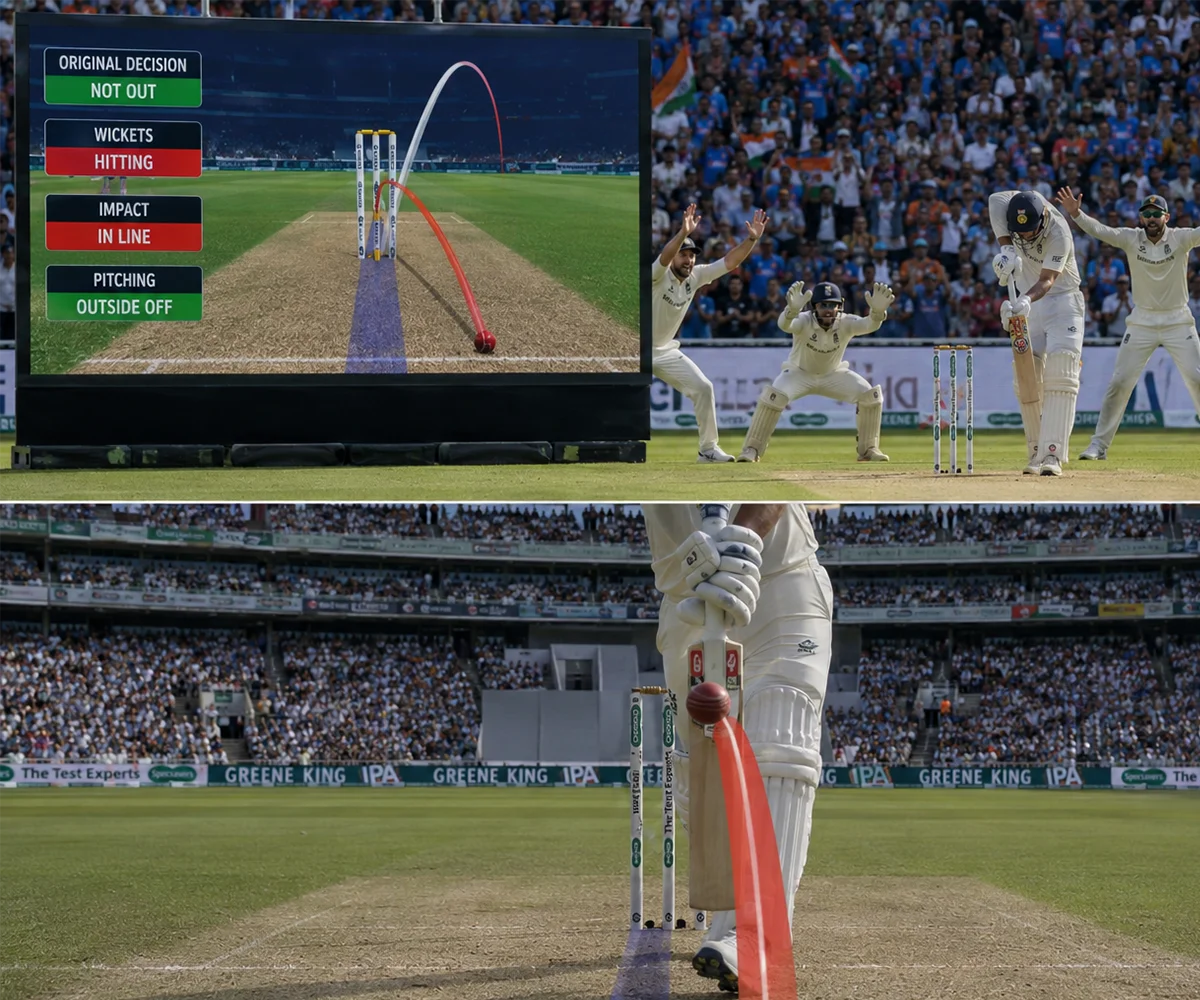
Many people feel frustrated when they try to understand the LBW rule. You watch a match, the ball hits the batsman’s pad, everyone starts appealing, and suddenly the umpire gives it out. At that moment, most viewers feel confused. You might think, “The ball did not hit the bat… but how is that out?” This confusion is very common, especially for beginners and new cricket fans who are still learning the game.
When explaining cricket rules to beginners, LBW is the one rule that creates the most confusion again and again. The problem is not the rule itself. The problem is how it is explained. Most guides use technical words without breaking them into simple steps. That is why the LBW rule is explained clearly and practically below. By the end, you will be able to understand LBW decisions easily while watching a live match.
LBW Rule Explained (Super Simple)
Quick Takeaway
A batsman is out LBW if the ball hits their body instead of the bat and would have hit the stumps.
- Ball must not pitch outside leg stump
- Ball must hit in line, or outside off if no shot is played
- Ball must be going on to hit the stumps
A batsman is out LBW if the ball hits their body instead of the bat and the ball would have hit the stumps.
Full Form of LBW
LBW stands for Leg Before Wicket.
It means the batsman used their leg to stop a ball that was going to hit the stumps.
Why LBW is Confusing for Beginners
If you feel confused, you are not alone. Most beginners struggle because:
- They don’t understand where the ball pitched
- They don’t know what “impact” means
- They cannot judge if the ball will hit the stumps
- They don’t know the difference between shot and no shot
Once you understand these four things, LBW becomes easy.
The Basic Idea Behind LBW
The idea is simple. The bat should stop the ball
The leg should not block the ball unfairly
If the leg stops a ball that would hit the stumps, the batsman can be out.
LBW Rules Explained
To give LBW, the umpire checks a few important conditions.
All conditions must be true.
The Essential Conditions for LBW

1. The Ball Must Be Legal
The delivery must not be a no-ball.
2. Where the Ball Pitched
The ball can pitch:
- In line with stumps
- Outside off stump
If it pitches outside leg stump → Always Not Out
3. Where the Ball Hit (Impact)
The ball must hit:
- In line with stumps
- OR outside off stump (only if no shot is played)
If it hits outside leg → Not Out
4. Bat First or Not
If the ball clearly hits the bat first → Not LBW
If bat and pad are very close:
- Umpire checks carefully
- If no clear edge → LBW can still be given
5. Ball Must Be Hitting the Stumps
The umpire checks:
Would the ball hit the stumps?
- Yes → Possible OUT
- No → NOT OUT
How Umpires Decide LBW (Step-by-Step)
LBW Decision Flow
- Was it a legal delivery?
- Did the ball pitch outside leg stump? If yes, it is Not Out.
- Where did the ball hit the batsman?
- Did the batsman play a shot?
- Would the ball hit the stumps?
Result: If all answers support LBW, the batsman is out.
Let’s understand this like a real match.
- Was it a legal ball?
- Where did the ball pitch?
- Where did it hit the batsman?
- Did the batsman play a shot?
- Would the ball hit the stumps?
If all answers support LBW → OUT
LBW Decision in a Real Match Situation
Imagine you are watching a match:
- Bowler bowls a straight ball
- Ball pitches in line
- Batsman misses the shot
- Ball hits the pad
- Ball is going towards stumps
Umpire gives OUT
Now you understand why.
When is a Batsman Out LBW?
A batsman is out LBW when:
- Ball is legal
- Ball does not pitch outside leg
- Ball hits in line (or outside off with no shot)
- Ball does not hit bat first
- Ball is hitting the stumps
When is a Batsman Not Out LBW?

A batsman is NOT out if:
- Ball pitches outside leg stump
- Ball hits outside leg stump
- Ball hits the bat first
- Ball is missing the stumps
Can You Be Out LBW Outside Off Stump?
Yes.
If:
- Ball pitches outside off
- No shot is played
- Ball is hitting stumps
Then LBW can be given.
Can You Be Out LBW Outside Leg Stump?
No.
If the ball pitches outside leg stump → always Not Out
What Happens If You Don’t Play a Shot?
This is very important.
If NO shot is played:
- Impact outside off → Can be OUT
If a shot IS played:
- Impact outside off → Not Out
LBW Rule in One Quick Table
| Situation | LBW Decision |
|---|---|
| Ball pitches outside leg | Not Out |
| Ball hits outside leg | Not Out |
| Ball hits bat first | Not Out |
| Impact outside off and no shot played | Can be Out |
| Impact outside off and shot played | Not Out |
| Ball missing stumps | Not Out |
| Ball hitting stumps | Out |
Examples of LBW Scenarios

Example 1
Ball pitches in line → hits pad → hitting stumps
OUT
Example 2
Ball pitches outside leg → hits pad
NOT OUT
Example 3
Ball hits bat first → then pad
NOT OUT
Example 4
No shot played → ball hits outside off → hitting stumps
OUT
Role of Technology in LBW (DRS)

Modern cricket uses technology like:
- Ball tracking
- Impact detection
- Pitch tracking
This system is used by the International Cricket Council to improve decisions.
What is “Umpire’s Call”?
If the ball is only slightly hitting the stumps:
- The umpire’s original decision stays
LBW Explained for New Cricket Fans (USA Audience)
If you are new to cricket, think like this:
The batsman cannot use their body to block the ball unfairly.
If the ball is going to hit the stumps and the leg stops it, the batsman is out.
This is like protecting the target behind the player.
Some Misconceptions About LBW
❌ Ball outside off is always not out
✔ Not true
❌ Pad hit means always out
✔ Not true
❌ Umpires guess decisions
✔ Not true
Common LBW Mistakes
Think Like an Umpire
Do not guess LBW decisions. Always check step by step: Where did it pitch? → Where did it hit? → Was a shot played? → Would it hit the stumps?
Players often:
- Play across the line
- Miss straight balls
- Use pads instead of bat
Tips for Batsmen to Avoid LBW
- Play straight
- Watch the ball closely
- Use the bat first
- Move your feet properly
Importance of LBW Rule in Cricket
The LBW rule keeps cricket fair.
It:
- Protects bowlers
- Stops unfair blocking
- Keeps balance in the game
The official rules are defined by the Marylebone Cricket Club.
FAQs (Quick Answers)
What is LBW in cricket?
Leg Before Wicket, when the ball hits the leg and would hit the stumps.
Can LBW be given outside off stump?
Yes, if no shot is played and ball is hitting stumps.
Can LBW be given if ball hits bat first?
No, if bat clearly hits first.
Why is LBW important?
It prevents unfair use of the leg.
Conclusion
Once someone understands the LBW rule properly, their confidence in watching the game improves a lot. Instead of guessing, they start thinking step by step like an umpire. If you remember one simple method, it will help you every time: check where the ball pitched, where it hit, whether a shot was played, and if it was going to hit the stumps. When you follow this process, LBW becomes clear, logical, and easy to understand during any match.
Read More: Cricket World Cup Explained (Simple Guide for Beginners)
