




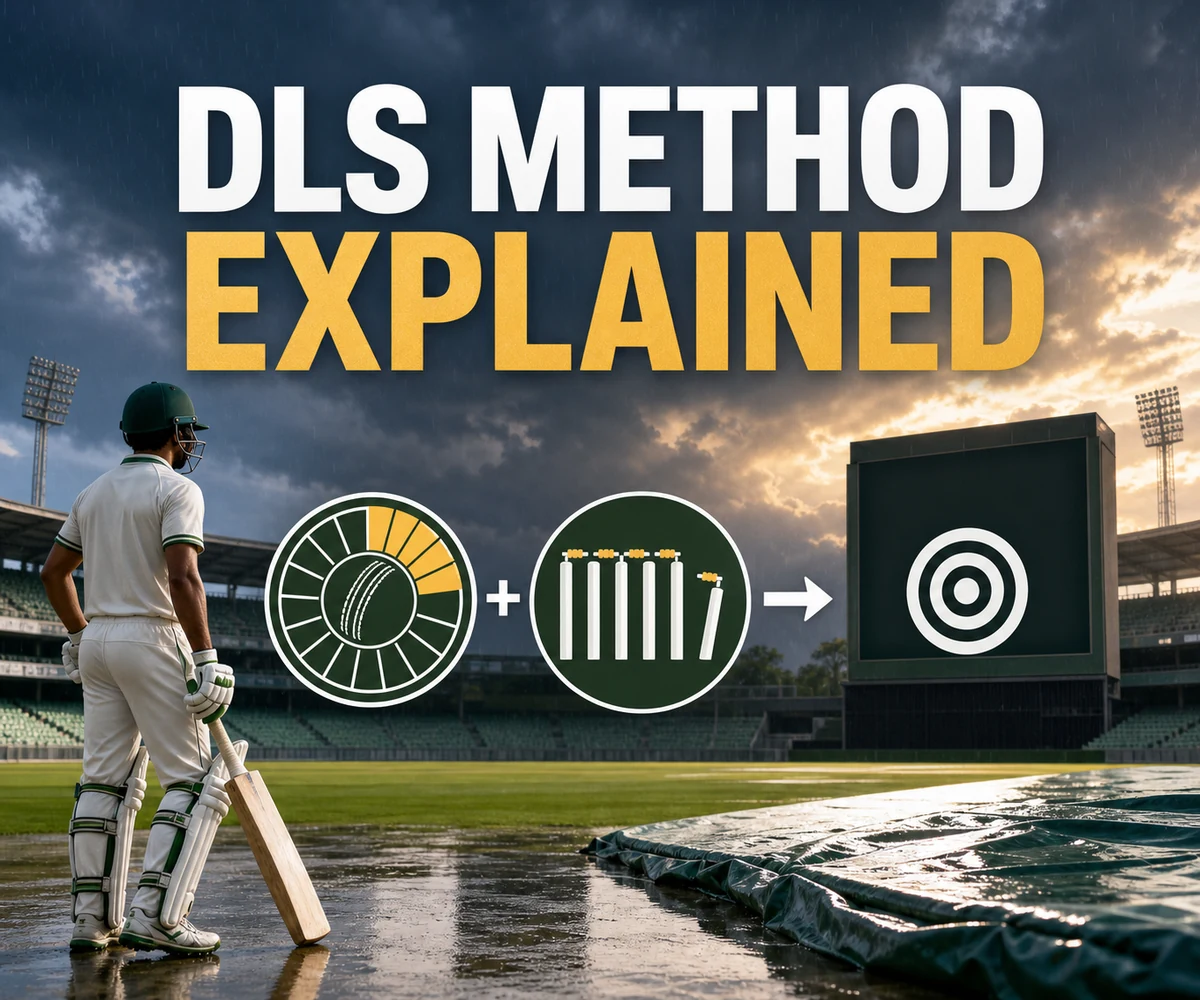
If rain stops a cricket match, the chasing team may suddenly have fewer overs to reach its target. That is where the Duckworth-Lewis-Stern method helps. It is one of the most confusing parts of the basic rules of cricket for new fans.
This guide explains the DLS method in plain English. You will learn why wickets matter, how a revised target is set, and why the method is fairer than simply comparing run rates.
The Duckworth-Lewis-Stern method, usually called DLS, adjusts the target in a rain-affected limited-overs match. It estimates how much of a team’s scoring resources remain by looking mainly at overs available and wickets lost.
What Is the Duckworth-Lewis-Stern Method?
The Duckworth-Lewis-Stern method is a mathematical system used to produce a fair result when a limited-overs match loses playing time. Rain is the most common cause, but another interruption can also lead to a DLS calculation.
According to the International Cricket Council, the system recalculates the total that a team needs when time is lost. It does not simply remove runs in the same proportion as the lost overs.
The method was first known as Duckworth-Lewis, after statisticians Frank Duckworth and Tony Lewis. Professor Steven Stern later became the method’s custodian. The updated name, Duckworth-Lewis-Stern, has been used by the ICC since 2014.
Why Does Cricket Need the DLS Method?
A batting team uses two main resources:
- Balls or overs remaining: More balls give batters more chances to score.
- Wickets remaining: More wickets allow a team to take more risks.
A simple run-rate calculation only looks at runs and overs. It ignores wickets. That can create an unfair target.
Imagine two teams both have 10 overs left. One has lost one wicket, while the other has lost eight. The first team can attack because many batters are still available. The second team must protect its final wickets. Their scoring potential is not equal, even though the number of overs is the same.
| Match situation | Overs left | Wickets left | Likely scoring resources |
|---|---|---|---|
| Team A | 10 | 9 | High |
| Team B | 10 | 2 | Much lower |
How Does the DLS Method Work?
The full professional calculation is handled by approved software. Fans do not need to solve the official formula during a match. The basic process is easier to understand:
- Measure the first team’s resources. A full uninterrupted innings starts with all scheduled overs and ten wickets.
- Measure resources lost in an interruption. The calculation considers when play stopped, how many overs were lost, and how many wickets had fallen.
- Measure the chasing team’s resources. Its available overs and wickets are compared with the first team’s opportunity.
- Set a par score or revised target. The number changes to balance the resources available to both teams.
The exact resource percentages come from DLS tables and computer software. They are not guessed by the umpires.
The example below is simplified to explain the idea. It is not a replacement for the official DLS software used by match officials.
A Simple DLS Example
Suppose Team A scores 250 runs after using its full innings. Rain then reduces Team B’s available resources to an illustrative 80%.
A simple teaching calculation would be:
250 × 80% = 200 par score
In this simplified example, 200 would be the score needed to tie and 201 would be the target to win. The official result can differ because professional DLS calculations use detailed resource values and the exact match situation.
Par Score vs Target: What Is the Difference?
These terms are often mixed up during broadcasts. They do not mean the same thing.
| Term | Simple meaning | Example |
|---|---|---|
| Par score | The score needed to be level at that point | 200 |
| Target | The score needed to win | 201 |
If rain ends the match and the chasing team is above the par score, it wins. If it is below par, it loses. A score equal to par normally produces a tie, subject to the competition’s playing conditions.
Why Do Wickets Change the DLS Score?
Wickets are part of a batting team’s resources. A team with nine wickets left can attack more freely than a team with only two wickets left.
This is why the par score shown on television may jump after a wicket. The chasing team has used more of its resources, so it needs to have scored more runs to remain level.
This point also explains a common online question: how can a team lose by DLS even when it looks close on raw runs? The answer is that the method checks both runs and remaining resources, not runs alone.
Can a Revised Target Go Up?
Yes. A revised target does not always become smaller when overs are removed.
For example, the team batting second may know from the start that it has a shorter innings. It can take risks earlier and use its wickets more aggressively. In some situations, DLS may judge that the chasing team has relatively strong scoring resources. The revised target can then be higher than a beginner expects.
This is one reason a simple “runs per over” rule would not be fair enough.
When Is DLS Used?
DLS is used in limited-overs cricket, including many ODI and T20 matches, when enough playing time is lost to affect the innings. The exact minimum number of overs required for a result comes from that competition’s playing conditions.
It is not normally needed in Test cricket because a Test innings does not begin with a fixed number of overs. Fans learning the different events can also read our guide to major cricket competitions.
Is the DLS Method Fair?
No rain rule can recreate the match that would have happened without an interruption. DLS is widely used because it considers both time and wickets, making it more balanced than a basic run-rate method.
Public cricket discussions often question whether one resource table can perfectly represent every team. Some teams bat deeper or score faster than others. That is a fair debate, but using team-specific ratings would create a different problem: targets could depend on opinions about team strength. DLS instead uses the same neutral system for both sides.
For official matches, the scoreboard and match officials’ calculation should always be treated as final.
Why Was the Method Created?
Earlier rain rules sometimes produced strange results. The famous 1992 World Cup semi-final between England and South Africa became a major example. After a rain delay, South Africa’s requirement changed from 22 runs off 13 balls to 22 runs off only one ball.
The ICC’s history of Duckworth-Lewis explains how that unfair ending helped create demand for a better system. The method was introduced in international cricket during the 1990s and later updated under Steven Stern. You can learn more about the tournament in our Cricket World Cup beginner guide.
Common DLS Mistakes
- Thinking DLS only counts overs: Wickets are a major part of the calculation.
- Calling the par score the target: The target to win is normally one run above par.
- Expecting every shorter chase to have a lower target: A chasing team can sometimes have relatively more useful resources.
- Trying to copy the official score with a simple formula: The professional calculation uses detailed tables and software.
- Assuming every rain delay gives a result: The match must meet the competition’s minimum playing conditions.
Frequently Asked Questions
What does DLS stand for in cricket?
DLS stands for Duckworth-Lewis-Stern. It is named after Frank Duckworth, Tony Lewis, and Steven Stern.
Is DLS used only when it rains?
No. Rain is the usual reason, but DLS can be used when another interruption reduces playing time in a limited-overs match.
Why does a wicket change the par score?
A wicket removes part of the chasing team’s scoring resources. With fewer wickets left, the team has less freedom to attack.
What is the difference between par score and target?
Par is the score needed to be level. The target is the score needed to win and is normally one run higher.
Can fans calculate DLS themselves?
Fans can understand the basic resource idea, but official professional calculations use approved data and software. The match scoreboard is the reliable source.
Is DLS used in Test cricket?
No, not in the normal way. Test innings do not have a fixed limit of overs, while DLS is designed for limited-overs matches.
Final Thoughts
The DLS method becomes easier when you stop thinking about rain and start thinking about resources. Overs give a team time to score, while wickets give it freedom to take risks. DLS compares those resources to set a fairer par score or target. The next time rain interrupts an ODI or T20, check the wickets lost as well as the overs remaining. The changing scoreboard will make much more sense.
Research note: Beginner questions were reviewed in public cricket discussions. Rules and historical facts were checked against ICC sources. A general overview is also available on Wikipedia.
