




Most people have watched cricket for years and still could not tell you what an umpire actually does all day. It looks like standing near the wicket. In reality the job is closer to running a small court, and the rules that define it are some of the strictest in the sport. Almost all of it is written down in Law 2 of the Laws of Cricket, which is a single long clause list that reads like a job description.
The starting point is worth knowing, because it surprises people: there are only two umpires on the ground. Before the match, two umpires are appointed, one for each end, to control the match as required by the Laws, with absolute impartiality. The third umpire, the TV umpire, and the fourth umpire exist, but they are not on the field making decisions. This matters, because it means the two people you can see are the ones who get everything right. If you have read our cricket basics and rules guide, this is the part of the match you have been watching without noticing it.
Quick Answer
Before a match, two umpires are appointed, one for each end, and they control the match as required by the Laws with absolute impartiality. Their job covers pre-match checks, deciding whether play is safe, making and changing decisions during the match, signalling to the scorers, and settling any dispute as the final authority.
Before the Toss: The Checks Nobody Sees
A large share of an umpire’s work happens before anybody is watching, and it is the part that separates an official umpire from someone who knows the rules.
Arriving and reporting in
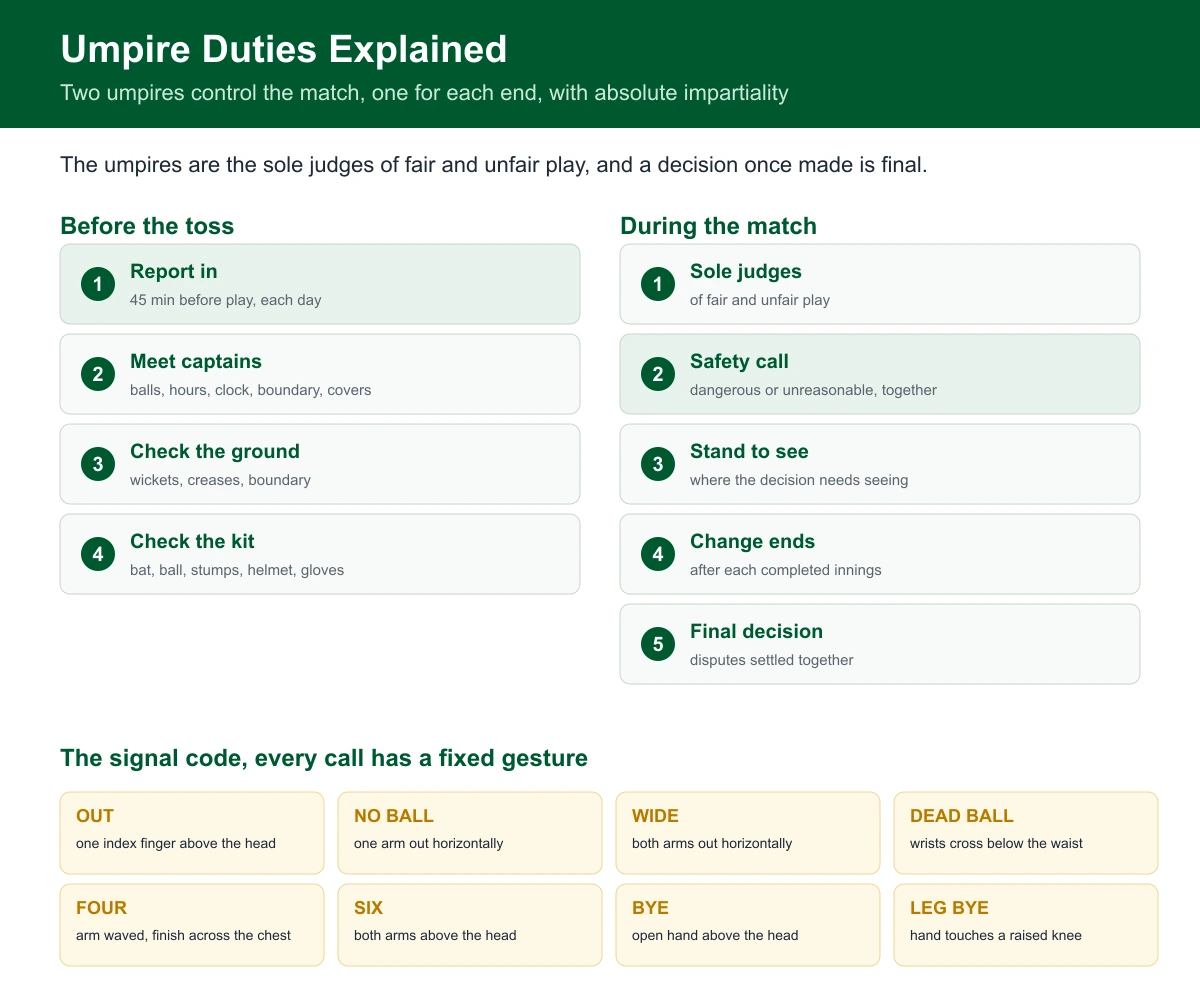
The umpires must be on the ground and report to the executive of the ground at least 45 minutes before the scheduled start of each day’s play. Not 20 minutes before. 45.
Setting the terms with the captains
Before the toss, the umpires meet with both captains and together determine six things: the balls to be used, the hours of play and the times and durations of any agreed intervals, which clock or watch and back-up timepiece will be used, the boundary of the field of play and the allowances for boundaries including whether any obstacle inside the field is to be regarded as a boundary, the use of covers, and any special conditions of play affecting the conduct of the match. The umpires then inform the scorers of the agreements on intervals, the timepiece, the boundary, and the special conditions.
That last step matters more than it sounds. The scorers have to know these things, and if they do not, the scorebook becomes wrong and the whole match becomes arguable.
Checking the ground
Before the toss and during the match, the umpires must satisfy themselves that the wickets are properly pitched, the creases are correctly marked, and the boundary of the field of play complies with the requirements of the Laws on determining, identifying and marking, and restoring the boundary.
Checking the kit
The umpires must satisfy themselves that the conduct of the match is strictly in accordance with the Laws, that the implements used conform to the Laws on the ball, the externally visible requirements of the Law on the bat, and either the Laws on the size of stumps and the bails or, where it applies, the Law on junior cricket. They must also satisfy themselves that no player uses equipment other than that permitted, with particular attention to the interpretation of the protective helmet, and that the wicketkeeper’s gloves comply with the requirements of the Law on gloves.
This is the clause that gets ignored most often. Players assume the helmet question is settled by the batter. It is not.
During the Match: Deciding Things
Being the sole judges of fair and unfair play
The umpires are the sole judges of fair and unfair play. Not the captains, not the players, not the crowd, and not you. If a player believes an umpire has made a mistake, the only route in cricket is a captain talking to the umpire between deliveries, and the umpire’s decision is still final.
Deciding whether play is safe
This is the duty with the most responsibility attached, because it is about safety rather than runs. It is solely for the umpires together to decide whether conditions of ground, weather or light, or exceptional circumstances, mean that it would be dangerous or unreasonable for play to take place.
The Law is unusually specific about not overreacting. Conditions are not to be regarded as dangerous or unreasonable merely because they are not ideal. The fact that the grass and the ball are wet does not warrant the ground conditions being regarded as unreasonable or dangerous.
Conditions are regarded as dangerous if there is actual and foreseeable risk to the safety of any player or umpire. Conditions are regarded as unreasonable if, although posing no risk to safety, it would not be sensible for play to proceed.
And there is a worked example in the Law itself. If the umpires consider the ground is so wet or slippery as to deprive the bowler of a reasonable foothold, the fielders of the power of free movement, or the batter of the ability to play their strokes or to run between the wickets, then these conditions are to be regarded as so bad that it would be dangerous and unreasonable for play to take place.
Once play is suspended, monitoring the conditions is the umpires’ responsibility. They make inspections as often as appropriate, unaccompanied by any players or officials, and only call the players back once the umpires together agree the conditions are no longer dangerous or unreasonable.
Where they stand
The umpires shall stand where they can best see any act upon which their decision may be required. That is the overriding rule. Subject to it, the bowler’s end umpire stands in a position so as not to interfere with either the bowler’s run-up or the striker’s view. The striker’s end umpire may elect to stand on the off side instead of the on side of the pitch, provided they inform the captain of the fielding side, the striker, and the other umpire.
If you have ever wondered why the umpire at the striker’s end sometimes stands on the off side, that clause is why. It is a decision, and the same Law obliges them to tell three people about it.
During the Match: The Other Duties
- Changing ends. The umpires change ends after each side has had one completed innings.
- Not being changed mid-match. An umpire shall not be changed during the match other than in exceptional circumstances, unless they are injured or ill. If there has to be a change, the replacement acts only as the striker’s end umpire unless the captains agree the replacement should take full responsibility.
- Settling disputes. Where there is disagreement or dispute about any matter, the umpires together make the final decision.
- Standing by a decision. An umpire may alter any decision provided the alteration is made promptly and does not contradict the Law that a dead ball decision cannot be revoked. Apart from that, an umpire’s decision, once made, is final.
That last point is the one players argue about most. A decision can be changed, but only promptly, and never to bring a dead ball back into play.
The Signals an Umpire Makes
Newcomers find the signal code genuinely hard to learn, and it is worth knowing the main ones because they tell you what just happened without anybody having to speak.
While the ball is in play
- Dead ball by crossing and re-crossing the wrists below the waist.
- No ball by extending one arm horizontally.
- Out by raising an index finger above the head. If not out, the umpire shall call not out.
- Wide by extending both arms horizontally.
When the ball is dead, the bowler’s end umpire repeats those signals to the scorers, with the exception of the signal for out.
To the scorers when the ball is dead
- Boundary 4 by waving an arm from side to side, finishing with the arm across the chest.
- Boundary 6 by raising both arms above the head.
- Bye by raising an open hand above the head.
- Leg bye by touching a raised knee with the hand.
- Five penalty runs to the batting side by repeated tapping of one shoulder with the opposite hand.
- Five penalty runs to the fielding side by placing one hand on the opposite shoulder.
- New ball by holding the ball above the head.
- Revoke the last decision by touching both shoulders, each with the opposite hand.
- Short run by bending one arm upwards.
- Commencement of last hour by pointing to a raised wrist with the other hand.
Every one of those is a fixed code. The umpire is not gesturing to make a point, they are communicating a decision in a form every scorer and player in the world is trained to read instantly.
Is It a Hard Job?
Yes, and the reasons are specific rather than obvious.
You are the final authority on hundreds of decisions a day while the people affected by each one want a different answer. You must be right in a split second, in front of a crowd, and you cannot be argued out of it. You carry the safety decision personally, which means a call to play on in bad light is a call you own.
You also have to know the job before you can do it. The pre-match checklist in this article is not admin. It is the part of the day when a missed check quietly invalidates something that happens six hours later.
It is also a role that goes unused. A club in the United States will happily appoint a volunteer umpire for a Saturday match, and many leagues cannot cover their fixtures without volunteers. If you have watched enough cricket to recognise a no-ball, you may be closer to qualified than you think.
Important
Appointing, training and grading umpires is organised by a governing body, and the structure, course names, minimum ages, and pass marks are set by that body and change from time to time, so the current requirements have to be checked with the league or governing body directly rather than taken from a general guide. One point is worth knowing here because it contradicts what most people assume: the decision to stop play for dangerous or unreasonable conditions belongs solely to the two umpires together, and the captains do not have a vote. The Law also refuses to treat merely imperfect conditions as a reason to stop. A wet outfield and a wet ball are not on their own grounds for abandonment.
Frequently Asked Questions
How many umpires are there in a cricket match?
Two are appointed to control the match, one for each end, and both must report to the executive of the ground at least 45 minutes before the scheduled start of each day’s play. A third umpire and a fourth umpire may also be appointed for television or replay decisions, but they are not the ones standing at the wicket on the field.
Can players change an umpire’s decision?
No. An umpire may alter a decision provided the alteration is made promptly and does not contradict the Law that a dead ball decision cannot be revoked, but apart from that an umpire’s decision, once made, is final. The only channel for a complaint is a captain speaking to the umpire, and the umpire does not have to change anything.
Who decides if the weather is too bad to play?
It is solely for the two umpires together to decide whether conditions of ground, weather or light, or exceptional circumstances mean it would be dangerous or unreasonable for play to take place. They must also monitor the conditions during a suspension, making inspections as often as appropriate and unaccompanied by any players or officials, and only resume play once they together agree conditions are no longer dangerous or unreasonable.
What is the difference between the bowler’s end umpire and the striker’s end umpire?
The bowler’s end umpire stands at the end the ball is bowled from, behind the stumps, and must not interfere with the bowler’s run-up or the striker’s view. The striker’s end umpire stands at the end the batter is facing away from, and may elect to stand on the off side instead of the on side provided they inform the captain of the fielding side, the striker, and the other umpire.
How do you become a cricket umpire?
Start by umpiring at club level where a league is short of officials, then take whatever introductory course and graded assessments your governing body offers, because the standards and age requirements differ by body. What actually makes someone good is much less theoretical than people expect: turning up early, learning the signals properly, making the same decision the same way every time, and staying firm without being confrontational.
Notice the Person, Not Just the Decision
Next time you watch a match, watch the umpire instead of the batter for one over. You will notice they move constantly, they are positioned where they can actually see what they need to see, and almost every call they make happens in under a second. Nobody claps for that. It is the reason the rest of the match is possible.
If that sounds interesting rather than dull, and you would like to know what a career in the sport looks like beyond playing, our cricket careers guide covers the roles that are open to beginners, including this one.
Read More: Fielding Positions Explained: A Guide for Beginners
