




You have watched cricket on television and you have decided you want to bowl. You are watching the fast bowler, the one who runs in, jumps, whips the arm over and hits the stumps. It looks like the only hard part of the sport.
It is not the hardest part for a beginner. The hardest part is doing the same thing over and over again, at the same speed, without the ball going anywhere near where you meant it to. That is what this guide is about. If you are new to the sport, our pace bowling section is the right place to start, and this article covers the fundamentals you need before any fancy delivery.
Quick Answer
Pace bowling is bowling the ball at speed rather than spinning it, and a beginner gets good at it by learning four things in order: a steady run-up, a grip that puts the seam where you want it, a bent front knee to drive the arm through, and a straight bowling arm at the moment you release. The one part that is a law and not a preference is the straight arm, and getting it wrong costs you a run every single time.
What a Pace Bowler Is Actually Trying to Do
New bowlers often think the goal is to hit the stumps, or to bowl fast. Neither is really the goal. A pace bowler is trying to make the batter do something they did not want to do.
That is the whole job. The good ball is not the one that hits the stumps, it is the one that arrives on a length the batter cannot score from without taking a risk. Hit the pads or the outside edge, the batter plays and misses, and you have bowled the delivery that matters.
This is why a bowler who is accurate but slow often does better at club level than a bowler who is quick and sprays the ball around. The second one concedes far more than the first one.
So there are two jobs in every delivery. Bowl it in a place the batter has to think about, and bowl it fast enough that they do not have time to think properly. Length first, speed second. If you get the length right, the speed will look after itself more often than not.
The Basic Grip: Put the Seam Where You Want the Ball to Go
The ball is a two-sided object, and the seam is the line of stitching that divides it. The position of that seam relative to your fingers decides what the ball will do in the air, and that is the whole reason the grip matters.
Most beginners start with what coaches call a seam-up grip. You place the index and middle fingers across the seam, so one sits on each side of the stitched line. Your thumb rests lightly against the side of the index finger rather than squeezing, and the ring and little fingers sit on the seam behind the other two to steady the ball.
Holding it seam up points the seam roughly at the sky as the ball comes over the top. The two broad families of pace grip are the upright, seam-up position and the side-on, seam-down position, and both are legitimate. A bowler who plays club cricket can bowl well with either. The mistake is having no idea which one you are using on any given delivery.
Two practical points. Grip firmly enough to control the ball, because a loose ball goes where the weather takes it, but not so tightly that your wrist cannot move. And settle the grip before the arm starts coming through, not during it. Changing your fingers mid-arm-swing is the single most common cause of a delivery that leaves the hand differently from how it was bowled at practice.
Coaching schools differ slightly on exactly where the fingers sit, and that is fine. Get one position coached properly in person rather than copying finger placement from a video, then change one thing at a time while you practise.
The Run-Up: Boring and Essential
The single biggest problem with a beginner pace bowler is not the arm. It is the run-up.
A run-up is a repeatable series of steps that gets you to the crease with the same speed, from the same direction, every single time. Its purpose is rhythm. A bowler who arrives at the crease the same way on ball one of an over and ball six has a chance of repeating a delivery. A bowler who is still changing their mind arrives at the crease differently each time and has to hope.
For a beginner, a straight run is fine. Side-on approaches look athletic and are the mark of an experienced bowler, and you can move to one later when your body is strong enough and your landing spot is reliable. Trying to copy a side-on run before you can land in the same place twice in a row just produces a lot of diving.
Three things to work on. Mark out the length of your run on the ground and hit the same mark. Start slowly and build the speed up over the last few steps rather than sprinting and then trying to control yourself. And keep your eyes level, because looking at your feet or at the ground in front of you changes your balance and your delivery.
The Front Foot Brace: Where the Power Comes From
This is the part beginners skip, and skipping it is why their deliveries die halfway to the batter.
As you land, your front knee bends and your body leans forward over that front leg. Coaches call this bracing. It sounds like a small movement and it is not. The brace is what turns your leg and hip into the engine for your arm, and it is where the speed in your delivery actually comes from.
Without the brace, the only thing driving the ball is the arm, and an arm on its own produces a slow, flat delivery. With the brace, you rotate your body through the shot, your shoulder gets ahead of the ball, and the arm comes through fast as a consequence of the body rather than as an effort in its own right.
Lift your front foot early and you will see this yourself. Bowl ten balls with a deliberately stunted brace, then ten with a full one, and you will hear the difference in your own hands.
Land on the front foot rather than jumping into the air and falling over. A small hop is fine and most bowlers have one, but if you land and have to catch yourself with your hand, the brace is gone and so is the speed.
The Straight Arm Is a Law, Not a Style Choice
Important
This is the one part of bowling technique that is not a matter of taste. Law 21.2 of the Laws of Cricket states that a ball is fairly delivered in respect of the arm if, once the bowler’s arm has reached the level of the shoulder in the delivery swing, the elbow joint is not straightened, either partially or completely, from that instant until the ball has left the hand. In plain terms, your arm must not start to bend after it passes shoulder height. The Law explicitly does allow you to flex or rotate your wrist, so the wrist is not the problem. Straightening the elbow late in the swing is. Beginners break this constantly, usually because they have been taught to “push” the ball or to snap the arm down rather than to keep it straight and let it go past.
The consequences are set out in Law 21.3 of the Laws of Cricket and they are worth knowing before you get them wrong in a match. On the first offence in an innings, the umpire calls no ball and the bowler’s end umpire warns the bowler, and that warning is a first and final one that stands for the whole innings.
On a second offence in the same innings, the bowler is suspended from bowling immediately and takes no further part in that innings. The over is completed by a different bowler, and Law 21.3.2 restricts who that replacement can be: they may not have bowled the previous over or any part of it, and they may not bowl any part of the next one. The umpires then report what happened to the executive of the offending side and to the governing body, and they may take whatever action they consider appropriate against the captain or anyone else involved.
In other words, a repeated throwing action is not just a nuisance. It can end your innings as a bowler and put your team in front of its governing body. Learn the straight arm before anything else.
The Foot Faults That Cost Runners
Law 21.5 sets two conditions for the feet during the delivery stride, and both are checked by the umpire.
- Your back foot must land within the return crease and must not touch it.
- Your front foot must land with some part of the foot, and it does not matter whether that part is grounded or raised, on the correct side of the imaginary line joining the two middle stumps and behind the popping crease.
So a back foot that lands past the return crease is a no ball, and so is a front foot that lands past the popping crease on the wrong side of the middle stumps. A deliberate front foot no ball is treated as its own offence and is dealt with separately in the Laws under Law 41.8.
The back foot fault is by far the most common one in club cricket, usually because a bowler over-strides and their momentum drags the foot past the line. The cure is not to slow down. It is to shorten the run-up by a step or two so that you arrive in balance, because a delivery with a faulted foot is worth far less than a slightly slower legal one.
Follow Through: Let the Arm Go Across
After the ball leaves the hand, the arm should keep going and come across the front of the body, finishing somewhere around the opposite hip or shoulder. The word is finish, not check.
A bowler who stops the arm halfway has to slow it down, and that kills the pace and ruins the line. Let the arm complete its path. It feels strange for about a month and then it becomes automatic.
Two more habits worth building. Say nothing between the run-up and the release, because talking mid-delivery changes your breathing and your rhythm. And pick a target: decide before you start running whether you are aiming at the top of off stump or at the stumps, and aim at the same place regardless of what the batter did last ball.
The Deliveries to Learn, in the Right Order
Beginners try to learn the yorker and the bouncer in their first month. Both are hard, and both are useless until you can bowl reliably on a length. Work down this list in order, and do not move on until the previous step is automatic.
| Step | What to learn |
|---|---|
| 1 | A straight delivery, seam up, landing on a good length. Nothing fancy. Repeatability is the goal |
| 2 | Variations of angle: the same action with the seam angled slightly towards the slips and then slightly towards the leg side |
| 3 | The straight and inswinging yorker, full and aimed at the base of the stumps. This is the wicket-taking ball |
| 4 | The bouncer, back of a length and rising towards the body. Learn the length before you learn the pace |
| 5 | A slower ball, which is a change of rhythm rather than a trick. Release it out of the same action |
One warning about the bouncer. Law 21.10 means a delivery that passes over the striker’s head height is a no ball, and the Laws also contain provisions covering dangerous and unfair short-pitched deliveries, which is why a bouncer in amateur cricket is genuinely restricted in some leagues. Check your own competition’s rules before you bowl one, and remember that a short-pitched delivery is far less dangerous to you and the batter than a mistimed full toss.
There is also a delivery to avoid entirely at club level. A beamer is a delivery that pitches above shoulder height, and it is called a no ball with one run awarded. Under Law 21.10 any delivery that passes or would have passed over head height is a no ball, so a beamer is not a clever surprise, it is simply an illegal ball that is dangerous to hit.
Getting Bowled: The Wicket You Are Chasing
Your target wicket is the one that needs no help from the umpire, no help from the fielder and no luck. Law 32.1.1 says the striker is out bowled if their wicket is fairly broken by a ball delivered by the bowler that is not a no ball, and it adds a useful detail: the ball does not have to hit the stumps directly. If it touches the batter’s bat or body first and then goes on to break the wicket, it still counts as bowled.
Two things can still stop it counting. If, before striking the wicket, the ball makes contact with any other player or with an umpire, the striker is not out bowled. And Law 32.2 gives bowled precedence over every other dismissal, so if the same delivery would also have the batter caught or leg before, bowled is what the umpire will signal.
Your other wicket is leg before wicket, and the two go hand in hand. A pace bowler who misses the edge of the bat and hits the pad is very often going to be appealing for leg before, which is why accuracy and a good length are worth so much more than raw speed.
What Not to Copy From the Television
Watch a Test fast bowler and you are seeing the end of a long process, not the start of it. Those deliveries are produced by a body that has spent years being trained, often by coaches in countries where that is the entire profession, and no beginner can borrow the outcome without the process.
Two specific things cause injury rather than wickets. Jumping into the delivery with no idea how to brace the front leg puts a huge amount of load through the front knee, and a bowler who lands stiff-legged will damage it. And trying to bowl 90 mph on an untrained arm, with an untrained shoulder, is how people get hurt and how they end up never bowling again.
Progress at your own pace, keep the sessions short, warm up properly, and if something hurts, stop and get it looked at rather than bowling through it. The cricket you are trying to reach in five years is not worth a damaged shoulder now.
Frequently Asked Questions
What is the difference between pace bowling and spin bowling?
Pace bowling is about how fast the ball is released and how straight it travels, and the ball is usually put into the air with the seam angled to make it move sideways. Spin bowling is about putting spin on the ball, mainly by rotating the wrist or fingers at release, so that the ball turns sharply off the pitch. A fast bowler tries to beat the bat, a spinner tries to beat the bat and then beat the pads as the ball turns. They are different skills and a beginner can only really develop one at a time.
How do I stop bowling no balls?
Watch your own arm from the side rather than from behind. The commonest cause is straightening the elbow after the arm passes shoulder height, which Law 21.2 does not allow, and the second commonest cause is over-striding so that your back foot lands past the return crease. Practise releasing the ball in front of the stumps without any step, over and over, so your arm learns what straight feels like without your legs interfering. Bowl a full spell with a partner watching specifically for the elbow and the back foot, because you cannot see either yourself in real time.
Should I bowl seam up or seam down?
Both work and both are used at the highest level. Start with whichever grip a coach puts in your hand first, learn to control it, and only then start changing seam position deliberately. The important thing is not the position itself but that you know which position you are using on every ball and that it stays the same through your delivery.
How fast should a beginner bowl?
There is no useful number, and chasing one is a mistake. Bowl as fast as you can while still landing your front foot beside the crease, keeping your arm straight, and putting the ball on a length, because that is the standard. Pace that you cannot control is worth less in a scoreboard sense than slower pace that lands on the spot, and the speed comes back on its own as your brace and rhythm improve. The published research on how much pace is needed to make the ball move in the air is a good next read, and the same physics explains reverse swing.
What is a maiden over?
A maiden over is an over in which no runs are scored off the bat, meaning the bowler has conceded zero runs for the six legal deliveries. It is a small piece of cricket vocabulary worth knowing because it comes up constantly in scorecards and commentary.
Conclusion
Pace bowling is one skill built on top of another, and the order matters. Get a repeatable run-up. Get a grip that points the seam somewhere deliberate. Brace the front knee so the body drives the arm. Keep the arm straight and let it go across your body. Then, and only then, start worrying about which delivery to bowl next.
Most of that list is free. It needs repetition rather than money or talent, and it will still feel terrible for the first few months. Stay in, keep the sessions short, and bowl more overs than you think you need to.
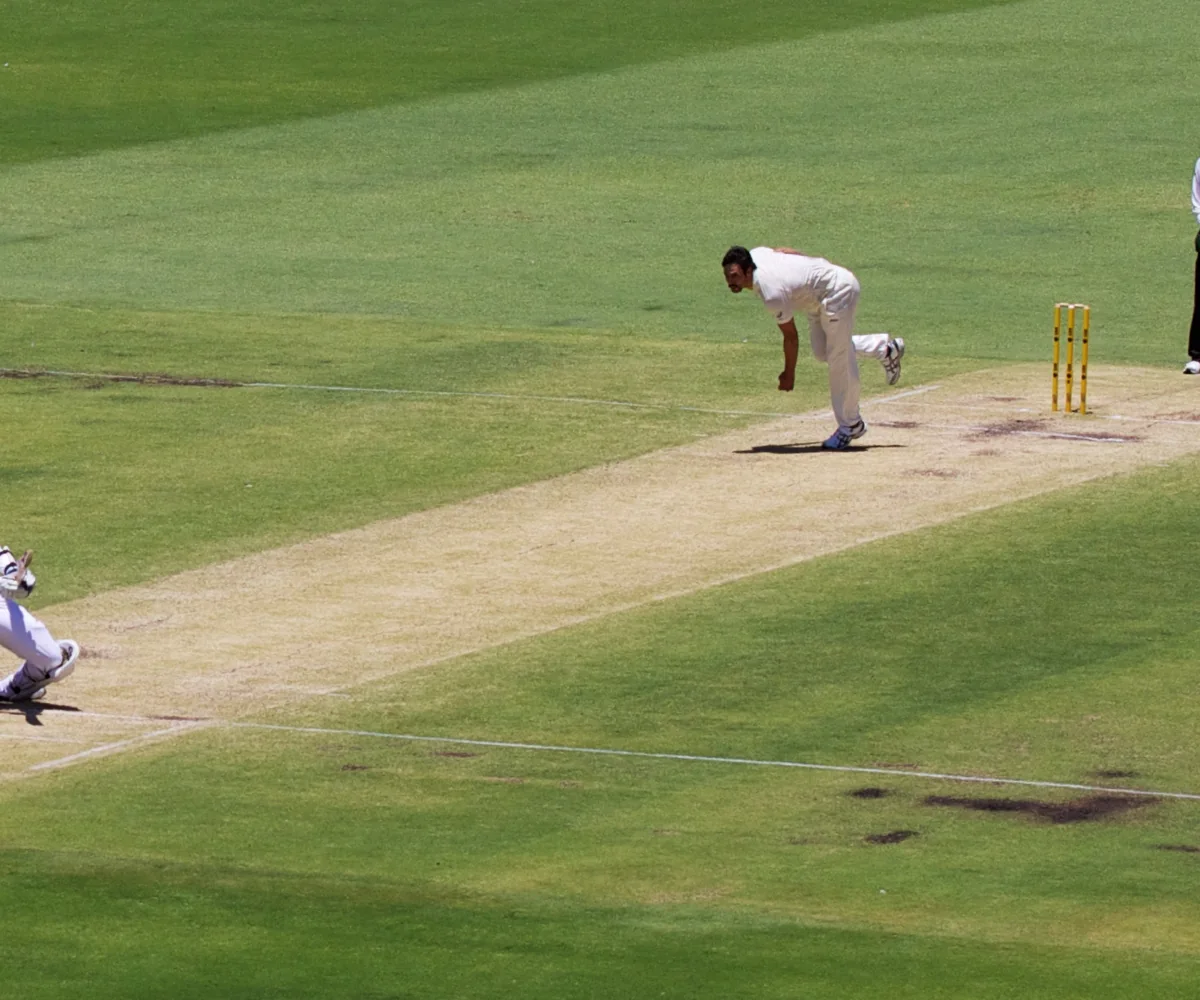
Photo: Mitchell Johnson in his delivery stride during the 2013-14 Ashes series in Australia. Photograph by Dan Heap, licensed under CC BY 2.0. Cropped to 1200 by 1000 pixels.
