




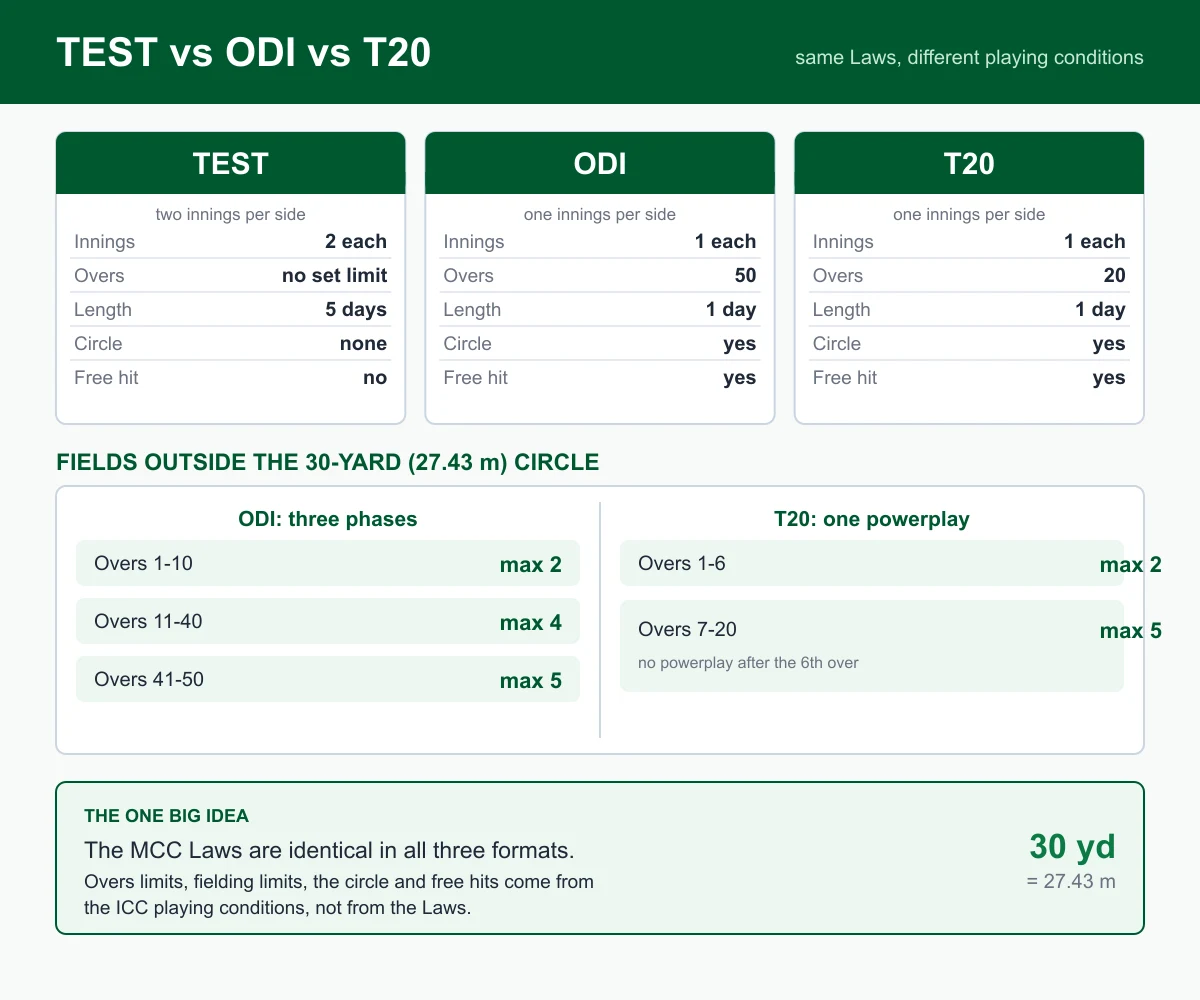
Beginners often get Test, ODI and T20 mixed up because the three names are used constantly and nobody explains what actually changes between them. The overs are different, the length is different, and the fielding rules are different, but the basic way you score runs and take wickets stays the same.
There is also a bigger point that almost every explanation misses. The three formats do not use different cricket Laws. Batting, bowling, dismissals and scoring work identically in all of them. The differences come from playing conditions, which are the extra rules each competition sets on top of the Laws. Once you understand that split, the formats stop feeling random.
Quick Answer
Test cricket gives each side two innings and lasts up to five days. ODI gives each side one innings of 50 overs. T20 gives each side one innings of 20 overs. All three use the same cricket Laws, but limited overs formats add fielding restrictions, a free hit after a no ball, and a fixed time limit that Test cricket does not have.
What Never Changes
Before the differences, here is what stays the same in every format. Two teams of eleven players. One team bats, the other bowls and fields. A match starts with a toss. Six legal balls make an over. Ten batters are out before the innings ends, unless the overs run out first. The same dismissals apply, so a batter can be bowled, caught, given out leg before wicket, stumped or run out in any format.
The extra format rules are published separately by the International Cricket Council. You can see all three documents on the official ICC playing conditions page, and every numbered clause quoted in this guide comes from there.
If you are not sure about those terms yet, our cricket basics and rules guide covers the ones you will meet first.
Our guide on how a cricket match works walks through the flow of a match from toss to result in detail. This page is about something different: which rules change, and how to pick the format that suits you.
Test Cricket: Two Innings and No Clock
Test cricket is the oldest format and the slowest to play. The ICC Men’s Test Match Playing Conditions are specific about the structure.
Clause 13.1.1 says a match shall be two innings for each side, and clause 13.2 says each side shall take their innings alternately. That means the batting order goes team A, team B, team A, team B.
Duration is set in clause 13.6, which states that matches shall be of five days scheduled duration. On any day other than the last, clause 12.7.1.1 requires play to continue until a minimum target of 90 overs is completed, or a minimum of 15 overs per hour, whichever is later, with play allowed to run up to 30 minutes past the scheduled finish.
Two consequences follow from this. There is no fixed limit on how many overs a team faces in an innings, and there are no fielding restrictions. A fielding side in a Test can place as many fielders outside any circle as it likes, which is why you often see six or seven fielders spread around the boundary waiting for a long shot.
Test cricket is the only one of the three formats that can end in a draw, where the match is unfinished when time runs out. It is also the only one where a team can choose to bat again in the same match and set a target, which is the follow on, available under clause 14.1.1 when the side batting first leads by at least 200 runs.
ODI Cricket: 50 Overs and Three Fielding Phases
ODI stands for One Day International. Clause 13.6.1 of the ICC Men’s Standard ODI Playing Conditions says all matches will consist of one innings per side, each innings limited to a maximum of 50 overs. Clause 13.7.1.1 adds that each team shall bat for 50 overs unless all out earlier. Clause 13.6.2 states there shall be no reserve days allocated for any matches.
What makes an ODI interesting to watch is the fielding restriction. Clause 28.7.2.1 says two semi circles shall be drawn on the field, centred on the middle stump at either end of the pitch, with a radius of 30 yards, which is 27.43 metres. The two semi circles are joined by two parallel straight lines drawn on the field. That marked area is the fielding restriction area.
How many fielders may stand outside it changes three times in the innings.
| Phase | Overs in a full 50-over innings | Fielders allowed outside the circle |
|---|---|---|
| Powerplay 1 | 1 to 10 | No more than 2 |
| Powerplay 2 | 11 to 40 | No more than 4 |
| Powerplay 3 | 41 to 50 | No more than 5 |
Those three lines come straight from clauses 28.7.2.2.1, 28.7.2.2.2 and 28.7.2.2.3. The effect on the game is clear. Early on, the fielding side has to protect its boundary and keep two fielders back, so scoring is hard. Late in the innings, fielders can spread out and take more risks, and batters push harder.
T20 Cricket: 20 Overs and a Six-Over Powerplay
T20 is the shortest international format. Clause 13.6.1 of the ICC Men’s T20I Playing Conditions says all matches will consist of one innings per side, each innings being limited to a maximum of 20 overs.
The fielding restriction works differently here. Clause 28.7.3 sets the same 30-yard, 27.43-metre semi circles, centred on the middle stump. But clause 28.7.2 says the additional fielding restrictions apply to the first 6 overs of each innings, and those are the Powerplay overs. Clause 28.7.4 states that during the Powerplay overs only two fielders shall be permitted outside the fielding restriction area at the instant of delivery. Clause 28.7.5 then says that during the non Powerplay overs, no more than 5 fielders shall be permitted outside it.
So in T20 you get one tight six-over block at the start and freedom for the remaining fourteen overs. In an ODI you get three separate phases spread across fifty overs. It is the same circle, but a very different rhythm.
If you want to see what live competition looks like, our page on what cricket competitions are covers the main tournaments and the formats they use.
Test vs ODI vs T20 Side by Side
| What changes | Test | ODI | T20 |
|---|---|---|---|
| Innings per side | 2 | 1 | 1 |
| Overs per innings | No set limit | 50 | 20 |
| Scheduled length | 5 days | 1 day | 1 day |
| Fielders outside the circle | No restriction | 2, then 4, then 5 | 2 for 6 overs, then up to 5 |
| Free hit after a no ball | No | Yes | Yes |
| Can end in a draw | Yes | No | No |
| Follow on available | Yes | No | No |
What a Free Hit Means for You
A free hit is a limited overs rule, and it is one beginners meet sooner than they expect. In ODI and T20, clause 21.19.1 of the playing conditions says the delivery following a no ball called, in all modes of no ball, shall be a free hit for whichever batter is facing it. If that free hit delivery is itself not legitimate, such as another no ball or a wide, then the next delivery becomes the free hit instead.
Clause 21.19.2 explains the protection. For any free hit, the striker can be dismissed only under the circumstances that apply for a no ball, even if the free hit delivery is called a wide.
In practice, if you are the batter on a free hit you cannot be bowled or caught. You can still be given out run out, out hit the ball twice, or out obstructing the field. As a bowler, a free hit is the worst possible next ball, so bowlers work hard to avoid no balls in the first place.
Important
You will often read that a free hit is only awarded for a front foot no ball. That was the older rule and it is no longer correct for men’s limited overs cricket. The current ICC one day and T20 international playing conditions both say a free hit follows a no ball in all modes of no ball. Anyone still telling you otherwise is working from an outdated summary, not from the current playing conditions.
Which Format Should You Start With in the USA?
If you are new to cricket in the United States, pick based on your time and your goal rather than on which format looks most exciting on television.
Choose T20 if you want a complete match in one sitting. Twenty overs per side means you can watch a whole match without needing to follow it over several days, and most local adult leagues in the USA use this format. It is the easiest entry point for someone with a job and limited free time.
Choose ODI if you want a middle ground. Fifty overs per side takes longer, but the innings still ends in one day, so you do not have to track a five day contest. It is a good format for learning how a team plans a full innings and chases a target.
Choose Test if you want to see the traditional game at its most complete, and you are willing to follow a score over several days. There is no substitute for it, because the two innings per side structure and the absence of fielding restrictions create situations you will never see in the shorter formats. Just do not start with Test as your only exposure, or the length can put you off the sport entirely.
A practical approach is to watch a different format each week. You will pick up the shared rules much faster once you have seen the same concepts, like a powerplay or a free hit, behaving differently in three different games.
Common Cricket Format Questions
Is an ODI the same as a one day Test match?
No, and the name causes a lot of confusion. An ODI is a separate format with its own playing conditions. A Test match lasts up to five days and gives each side two innings. An ODI is limited to 50 overs per side, and clause 13.6.2 of the ODI playing conditions states there shall be no reserve days. The word one day describes the scheduled length, not the rules.
Why do limited overs cricket have a circle on the field?
The circle is the fielding restriction area, and it exists to stop the fielding side from simply parking everyone on the boundary. Inside a 30-yard, 27.43-metre area the fielders are free. Outside it, the number is capped, which forces them to choose between protecting the boundary and covering the infield. Test cricket has no such area, which is why it looks so spread out.
Does a Test match really use 90 overs a day?
It is a minimum target, not a fixed quota. Clause 12.7.1.1 of the Test playing conditions says that on days other than the last, play continues until a minimum target of 90 overs or a minimum of 15 overs per hour is completed, or until the scheduled finish time, whichever is later. Bowlers can be taken off and brought back to spread the work, so you rarely see one bowler deliver all 90.
Can a T20 match end in a tie?
A tied match is possible, because the format has no draw, but the playing conditions provide for a Super Over to settle it. If the scores are level at the end of the second innings, the sides play an extra short innings to decide a winner. The core format stays one innings per side of 20 overs.
Are the Laws of Cricket different in each format?
No, and this is the single most useful thing to understand. The MCC Laws of Cricket, which cover batting, bowling, dismissals and scoring, apply the same way in all three formats. What differs are the playing conditions published by the International Cricket Council, which add the overs limits, the fielding restrictions, the free hit and the time rules. When you see a rule explained, it helps to ask which document it came from.
Once you separate the Laws from the playing conditions, the three formats stop competing with each other. They are the same game with different clocks, different fielding budgets and different amounts of time to fill. Pick the one that fits your week, and the rules will follow.
Read More: How to Win a Test Match
