




If you have tried to understand the World Test Championship, you may have felt confused within minutes. Terms such as points percentage, available points, rankings, and qualification rules can make even regular cricket fans feel lost. The confusion becomes greater because teams do not play the same number of matches. As a result, a team with fewer total points can sometimes rank above a team with more points. The WTC is one of several major cricket competitions that give international matches a clear tournament structure.
From more than 12 years of studying and covering global cricket, I have found that most beginners struggle with the same issue. They understand wins and losses, but they do not understand why the standings use a percentage. The World Test Championship itself is not too difficult. However, it is often explained with unnecessary technical language. This guide uses official competition rules, clear calculations, and simple examples to explain the format, points system, qualification process, and final.
What Is the World Test Championship and Why Is It Happening?
The ICC World Test Championship, also called the WTC, is an international competition for Test cricket. It is organized by the International Cricket Council.
Before the WTC, countries played bilateral Test series and appeared in the ICC Test rankings. However, there was no regular championship final that decided a world champion.
The WTC gives Test matches a wider purpose. Results from selected series contribute to one league table. At the end of a cycle, the two highest-ranked teams play in the World Test Championship Final.
In simple terms, it works like a long league. Teams compete over about two years instead of playing the whole tournament within a few weeks.
Why the World Test Championship Feels Confusing
The WTC feels confusing because its schedule is not the same for every team. Each country plays six series, but one series may contain two Tests while another may contain four or five.
Therefore, teams can finish a cycle after playing different numbers of matches. Total points alone would favor teams that play more matches. The WTC solves this problem by ranking teams according to the percentage of available points they earn.
History and Origins of the World Test Championship
The idea of creating a world championship for Test cricket was discussed for many years. The first official World Test Championship cycle began in August 2019.
The first cycle ended in 2021. New Zealand defeated India in the final and became the first World Test champions.
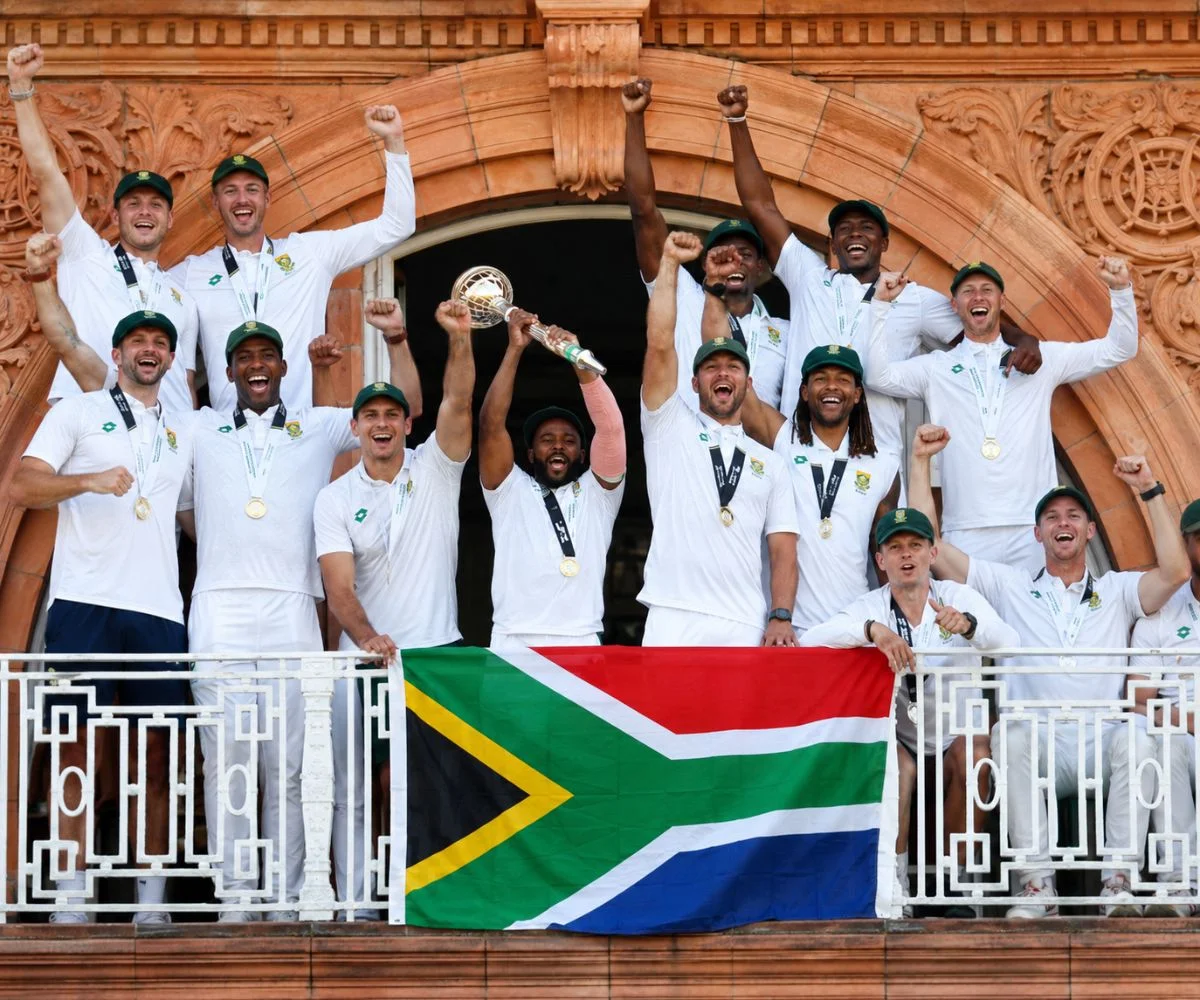
Australia won the second final in 2023. South Africa then defeated Australia by five wickets in the 2025 final at Lord’s and became the third WTC champion.
The 2025–2027 competition is the fourth World Test Championship cycle.
World Test Championship Cycles
Each WTC cycle lasts around two years. A new league table begins when a new cycle starts, and points from the previous cycle do not carry forward.
| WTC cycle | Final winner |
|---|---|
| 2019–2021 | New Zealand |
| 2021–2023 | Australia |
| 2023–2025 | South Africa |
| 2025–2027 | In progress |
Format and Structure: How the WTC Is Organised
Nine countries compete in the World Test Championship. During each cycle, every country plays six Test series.
- Three series are played at home.
- Three series are played away.
- Each team faces six different opponents.
- There are no quarter-finals or semi-finals.
A team does not play every other WTC country during one cycle. The number of matches in a series can also vary. A series may contain between two and five Test matches.
These schedules are normally agreed between the cricket boards involved.
Which Teams Play in the World Test Championship?
The nine teams competing in the current WTC structure are:
- Australia
- Bangladesh
- England
- India
- New Zealand
- Pakistan
- South Africa
- Sri Lanka
- West Indies
Other Test-playing countries may play official international Test matches, but those matches are not automatically part of the WTC league.
How the World Test Championship Works Step by Step
The World Test Championship follows a clear process from bilateral Test series to the championship final.
- Nine teams play selected Test series.
- Each team plays three series at home and three away.
- Teams earn points from each match result.
- Slow over-rate penalties may reduce a team’s points.
- Earned points are converted into a points percentage.
- Teams are ordered by their points percentage.
- The top two teams qualify for the WTC Final.
- The final decides the world champion.
World Test Championship Points System Explained
Teams receive the same number of points for each match, regardless of the length of the series.
| Match result | Points earned |
|---|---|
| Win | 12 |
| Tie | 6 |
| Draw | 4 |
| Loss | 0 |
A win gives a team all 12 available points. A draw gives each team four points, while a tie gives each team six points.
Teams can also lose championship points because of Slow over-rate penalties. Therefore, a team’s recorded total may be lower than the points it originally earned from its results.
How the WTC Points Percentage Works
The WTC table uses points percentage, often shown as PCT. It compares the number of points a team earned with the maximum number of points it could have earned.
Simple Percentage Example
Imagine a team plays five Test matches. A maximum of 12 points is available in each match.
Five matches × 12 points = 60 available points
If the team earns 36 points, the calculation is:
36 ÷ 60 × 100 = 60%
Therefore, the team’s points percentage is 60%.
Why Percentage Matters
The percentage system makes it possible to compare teams that play different numbers of matches.
| Team | Matches | Points earned | Points available | Points percentage |
|---|---|---|---|---|
| Team A | 10 | 72 | 120 | 60% |
| Team B | 8 | 60 | 96 | 62.5% |
Team A has more total points. However, Team B has earned a greater share of its available points. Therefore, Team B ranks higher.
How Teams Qualify for the WTC Final
Teams are ranked according to their points percentage after match results and applicable penalties have been included.
The two teams with the highest percentages at the end of the league stage qualify for the final.
There are no quarter-finals or semi-finals. A team must finish inside the top two to continue. This means one win, draw, defeat, or points penalty can have a major effect late in the cycle.
World Test Championship Final Explained
The WTC Final is a single Test match between the top two teams in the standings.
The winner is crowned the World Test champion and receives the ICC Test Championship mace. The final may also have a reserve day that can be used when playing time is lost, according to the playing conditions for that edition.
If the final ends in a draw, tie, or abandonment under the competition conditions, the two finalists are declared joint champions.
Is Every Test Match Part of the World Test Championship?
No. Not every Test match counts toward the WTC table.
Only designated series included in the championship schedule contribute points. A Test match can still have full international status without being part of the World Test Championship.
This is why fans should check whether a series belongs to the current WTC cycle before using its result in qualification calculations.
WTC vs a Traditional Test Series
A traditional Test series is a direct contest between two countries. The World Test Championship adds the results of selected bilateral series to a wider international league.
| Feature | Traditional Test series | World Test Championship |
|---|---|---|
| Main contest | Between two countries | Between nine teams across a cycle |
| Length | Usually a few weeks | Around two years |
| Points table | Not normally required | Uses points percentage |
| Qualification | No qualification stage | Top two reach the final |
| Final champion | Series winner | World Test champion |
WTC vs the Cricket World Cup
The WTC and the Cricket World Cup both produce a world champion, but their formats are very different.
| Feature | World Test Championship | Cricket World Cup |
|---|---|---|
| Cricket format | Test cricket | One Day International cricket |
| Tournament length | Around two years | Several weeks |
| Match duration | Up to five days | One day |
| Main ranking method | Points percentage | Group points and knockout results |
| Finalists | Top two in the WTC table | Teams advancing through tournament stages |
For a new fan in the United States, the WTC can be compared loosely to a long regular season followed by one championship game. However, there are no playoffs or semi-finals.
Example of a WTC Qualification Scenario
Imagine that Australia has earned 84 points from 144 available points.
84 ÷ 144 × 100 = 58.33%
Now imagine India has earned 76 points from 120 available points.
76 ÷ 120 × 100 = 63.33%
Australia has more total points. However, India has the better points percentage. India would therefore appear higher in the standings.
This example shows why fans must check both the points earned and the points available.
Common Mistakes About the WTC
Thinking the Team With the Most Points Must Be First
The standings use points percentage. A team can have fewer total points but a higher percentage.
Assuming Every Team Plays Every Other Team
Each country plays six opponents during a cycle, not all eight possible opponents.
Assuming Every Test Match Counts
Only Test matches included in designated World Test Championship series count toward the standings.
Ignoring Slow Over-Rate Penalties
A team can lose championship points for failing to complete its overs within the required time.
Expecting Semi-Finals
The WTC has no semi-final stage. The top two teams move directly to the final.
Why the World Test Championship Matters
The WTC gives context to Test matches played across different countries and seasons.
A match is no longer important only because of the bilateral series. Its result may also affect which teams reach the world final.
The championship encourages teams to perform consistently at home and away. It also gives fans a clear table, qualification race, and final to follow.
Most importantly, the WTC creates a regular way to crown a world champion in the longest format of cricket.
Key WTC Definitions
Frequently Asked Questions
What is the World Test Championship?
It is an ICC competition in which nine teams earn points from selected Test series. The top two qualify for a final.
How many teams play in the WTC?
Nine teams compete in the current World Test Championship format.
How long does a WTC cycle last?
A World Test Championship cycle lasts around two years.
How are WTC standings calculated?
Teams are ranked by the percentage of available points they earn after applicable penalties.
How many points does a team receive for a Test win?
A team earns 12 World Test Championship points for a win.
Why does the WTC use points percentage?
The percentage system compares teams fairly even when they play different numbers of matches.
Do all Test matches count in the WTC?
No. Only matches included in designated World Test Championship series count.
How do teams qualify for the WTC Final?
The two teams with the highest points percentages at the end of the league stage qualify.
Are there semi-finals in the World Test Championship?
No. The two highest-ranked teams move directly to the final.
What happens if the WTC Final is drawn?
A drawn, tied, or abandoned final results in both teams being declared joint champions.
Is the World Test Championship system fair?
The percentage system reduces scheduling imbalance. However, fans still debate unequal opponents and match totals.
Why are there no semi-finals in the World Test Championship?
The current format sends the top two teams directly to the final. Some fans support adding semi-finals.
Why are WTC Finals held in England?
England hosted the first three finals and will host the 2027, 2029, and 2031 editions after receiving ICC hosting rights.
Can slow over-rate penalties affect WTC qualification?
Yes. A points deduction can lower a team’s percentage and affect its position in the qualification race.
Could more teams join the World Test Championship?
The current competition includes nine teams. Any expansion would require an official ICC decision and schedule changes.
Conclusion
The World Test Championship may look complicated at first because teams play unequal numbers of matches and are ranked by points percentage. However, the system becomes much easier once you focus on one rule: standings are based on the share of available points a team earns. Teams play six series, collect points from their results, and try to finish inside the top two before the final.
From more than 12 years of studying global cricket and explaining its rules to beginner audiences, I have found that the percentage calculation is the part readers most often need to see through a real example. Once earned points are compared with available points, the table becomes much easier to understand. The WTC has given Test cricket a clearer competitive structure while keeping bilateral series important. It allows fans to follow a two-year qualification race and see a recognized world champion crowned in the longest format of the game.
