




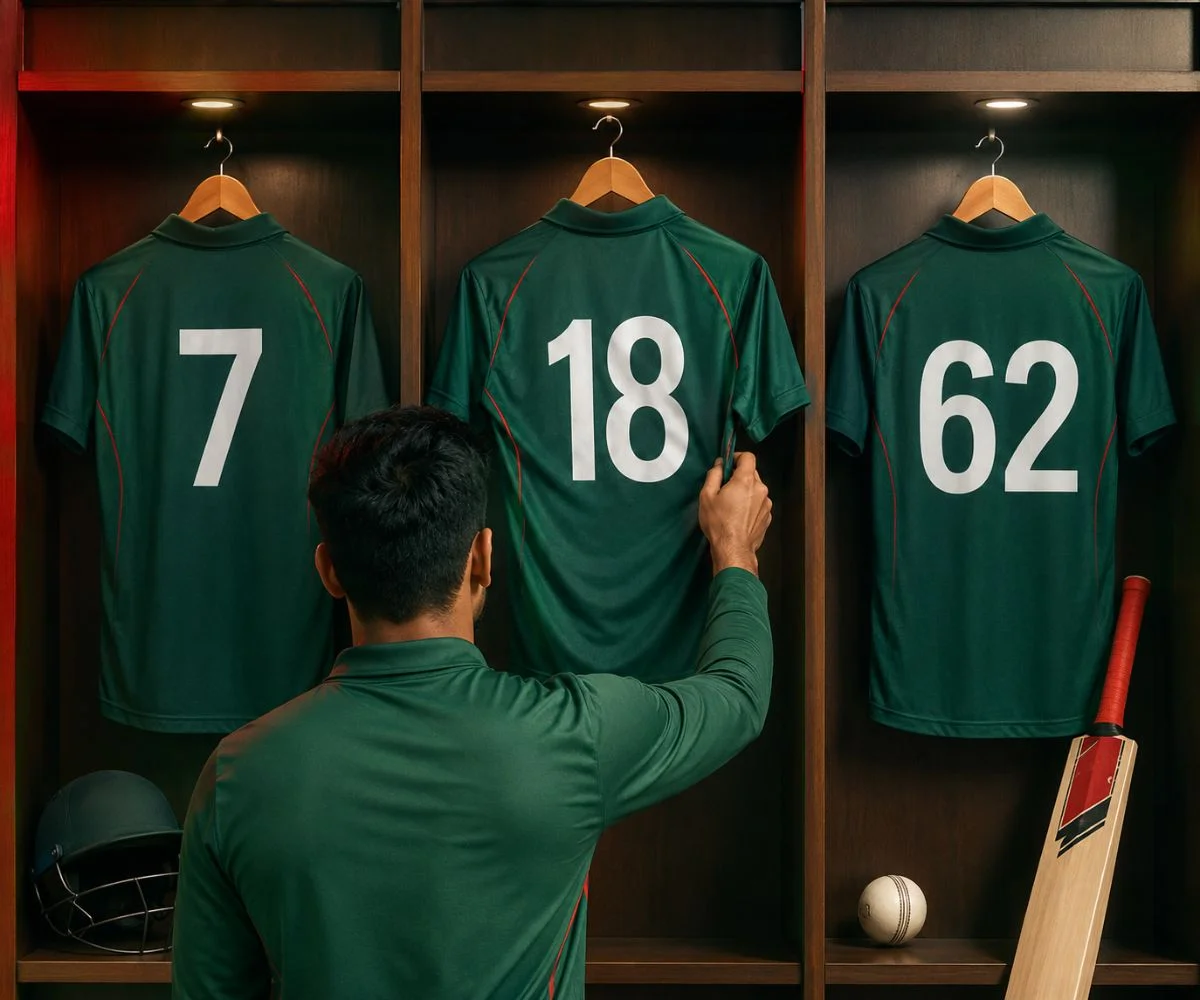
When new cricket fans see numbers such as 7, 18, 49, or 62 on the backs of players’ shirts, they often wonder what those numbers mean. Do they show batting position? Are some numbers reserved for bowlers or captains? Jersey numbers are an interesting part of cricket culture and gear, but their purpose is often misunderstood by beginners.
While researching this guide for Cricket Focus, I reviewed official ICC clothing rules, Cricket Australia reports, historical coverage, player explanations, and recurring fan questions. I found that the process is simpler than many online discussions suggest. A player normally requests a preferred number, the team checks whether it is available, and the board or franchise approves it for the official kit.
What Is a Cricket Jersey Number?
A cricket jersey number is the large number displayed on the back of a player’s shirt. It is mainly used to identify that player during a match.
It may also be called a shirt number, squad number, playing number, or uniform number. The number helps spectators, commentators, broadcasters, photographers, and match officials identify players from a distance.
A player’s surname normally appears close to the number. Unlike numbers in some other sports, a cricket jersey number does not usually explain the player’s position or job in the team.
How Are Cricket Jersey Numbers Chosen?
There is no single worldwide formula that automatically gives every cricketer a specific personal number. The process normally follows five simple steps.
The player requests a favorite or personally meaningful number.
The team checks whether another squad member already uses it.
The board, team, or franchise approves the available choice.
The approved name and number are placed on the official shirt.
The player chooses another number when the first option is unavailable.
The Player Requests a Preferred Number
Most players are allowed to express a preference. They may select a number connected with:
- Their birthday or birth year
- A family member
- A lucky number
- A childhood memory
- A junior or domestic cricket team
- Another sport they played
- A favorite athlete
- Numerology or personal beliefs
Not every number has a deep story. Some cricketers simply choose a number because they like it or because it is available.
The Team Checks Whether the Number Is Available
A player cannot always receive the first number requested. If an established teammate already uses it, the new player may need to choose another number.
Teams generally avoid duplicate numbers within the same active squad because the number is intended to identify one player clearly. A player from a different country or franchise may still use the same number.
The Team or Cricket Board Approves the Number
The player normally chooses the preference, but the team manages the final approval. This may involve the national cricket board, team manager, kit manager, franchise administration, or league uniform department.
A player cannot simply print any name or number on a shirt and use it in an official match. The uniform must follow the rules of the team, competition, cricket board, and the ICC where international cricket is involved.
The Approved Number Is Added to the Kit
Once approved, the kit staff add the correct name and number to the official playing shirt. They must make sure that the shirt identifies the correct player, the number is easy to read, the name is spelled correctly, and the design follows the competition’s uniform rules.
The Player Chooses an Alternative When Needed
If the first number is unavailable, the player may add another digit, choose a similar number, use a childhood number, select an important date, or pick another unused option.
Who Decides a Cricketer’s Jersey Number?
The player, team, and ICC have different responsibilities.
| Person or Organization | Main Responsibility |
|---|---|
| Player | Requests or suggests a preferred number. |
| Team or cricket board | Checks availability and approves the final choice. |
| Kit manager | Adds the correct name and number to the official uniform. |
| ICC | Regulates how names and numbers appear in international cricket. |
Simple way to remember it: The player chooses a preference, the team checks and approves it, and the ICC regulates how it appears.
Does the ICC Assign Cricket Jersey Numbers?
The ICC does not publish one universal system that assigns every cricketer a personal number based on age, seniority, batting position, or playing role.
The official ICC Clothing and Equipment Regulations focus on how names and numbers must appear on international playing shirts. The number must identify the correct player, remain clearly visible, and be positioned in the center of the back.
The regulations also state that names and numbers cannot contain advertising. For Test shirts, the permitted range is 1 to 99, and the number must be sewn on or fixed through heat transfer rather than attached temporarily with Velcro.
These rules control the appearance of the uniform. They do not provide one worldwide method for deciding which personal number every player must receive.
What Happens If Two Players Want the Same Number?
There is no universal ICC rule saying that the oldest player, captain, or most senior squad member must always receive the number.
The decision may depend on:
- Which player already uses the number
- Previous use for the national team
- The team or franchise policy
- Seniority within that particular team
- An agreement between the two players
- Whether the number is reserved or retired
An established player will normally keep a number already connected with their international career. A newer player may then be asked to choose another available option.
Can Two Cricketers Wear the Same Jersey Number?
Yes. Players from different teams can wear the same number. The same number may be used by cricketers representing different countries, playing in separate franchise leagues, competing in different domestic tournaments, or playing during different generations.
Teams normally avoid duplicate numbers within the same active squad because duplicate numbers could confuse broadcasters, officials, and spectators.
Do Cricket Jersey Numbers Show Playing Positions?
No. A jersey number does not normally tell you whether someone is a batter, fast bowler, spin bowler, wicketkeeper, all-rounder, or captain.
It also does not show where the player bats. A cricketer wearing number 7 does not have to bat seventh, and a bowler wearing number 10 does not have to bowl the tenth over.
Why Do Cricketers Choose Specific Jersey Numbers?
Cricketers choose their numbers for many different reasons.
A player may use their birth date, birth year, or an important date connected with a family member.
Some players keep a number they believe has brought them good luck in school, junior, or domestic cricket.
The number may represent a parent, sibling, spouse, child, family address, or shared memory.
Some cricketers continue using a number they received in junior cricket or for a domestic team.
A player may reuse a number previously worn in basketball, soccer, rugby, or another sport.
Some players look at the unused options and choose a number without giving it a deeper meaning.
Personal Branding
Over time, a jersey number can become part of a famous player’s public identity. Fans may connect it with replica shirts, social media, merchandise, banners, and memorable performances.
However, personal branding is normally a result of the player becoming popular. It is not an ICC requirement for choosing the number.
Real Cricket Jersey Number Examples
| Player | Number | What the Example Shows |
|---|---|---|
| Travis Head | 62 internationally | His domestic number was already taken, so he selected an unused international number. |
| Herschelle Gibbs | 00, 05–09 and 74 | Players can change numbers and use unusual personal systems. |
| Phillip Hughes | 64 | A cricket board can retire a number as a memorial tribute. |
International vs. Franchise Cricket Jersey Numbers
A professional cricketer may represent several teams during the same year. These can include a national team, domestic state or county, Indian Premier League franchise, Big Bash League team, Major League Cricket team, or another T20 franchise.
Each team manages its own squad and number list. A number that is available for the national team may already belong to someone else in a franchise squad.
| Situation | Possible Result |
|---|---|
| Preferred number is available | The player may keep it. |
| Number is already used by a teammate | The player selects another option. |
| Player joins another franchise | The new team checks availability again. |
| Number has been retired | The team normally does not issue it. |
| Player changes their preference | A new number may be requested. |
This is why a cricketer can appear with one number internationally and another in domestic or franchise cricket.
Can Cricketers Change Their Jersey Numbers?
Yes. A jersey number does not always remain the same throughout a player’s career.
A player may change it because they join a new team, their preferred number is unavailable, another number becomes available, their personal preference changes, they want to honor someone, or their previous number becomes reserved or retired.
Herschelle Gibbs is a well-known example. He wore number 00 and later used numbers based on the final two digits of different years. He eventually used 74, representing his birth year of 1974.
Cricket Jersey Number vs. Cap Number
Beginners often confuse the large number on the back with a smaller number near the national badge. They are not always the same thing.
| Number Type | What It Means | Usual Location |
|---|---|---|
| Jersey number | The player’s selected shirt or squad number. | Large number on the back. |
| Debut or cap number | The player’s historical order of selection for the country. | Near the badge or on the cap. |
| Caps earned | The player’s number of international appearances. | Small number near the national logo. |
| Milestone number | Marks an achievement such as 50 or 100 matches. | On the front near the badge. |
ICC regulations allow a small front number to show the player’s order of selection, number of international caps, or a landmark such as 50, 100, or 150 matches.
Remember: The large number on the back is normally the player’s selected jersey number. A smaller number near the national badge may show debut order, international appearances, or a career milestone.
Common Cricket Jersey Number Myths
| Common Belief | Correct Explanation |
|---|---|
| The ICC assigns every player’s number | Players normally request a number, while teams check and approve it. |
| The number shows batting position | Jersey numbers do not control the batting order. |
| Bowlers have a special number range | Batters and bowlers can choose from the same available options. |
| Captains must wear number 1 | A captain can wear any number approved by the team. |
| Vice-captains must wear number 2 | There is no current worldwide rule requiring this. |
| Lower numbers belong to senior players | There is no universal seniority-based numbering system. |
| One number belongs to one player worldwide | Players from different teams can use the same number. |
| The small front number is the jersey number | It may instead show debut order, appearances, or a milestone. |
Do Test Cricketers Wear Jersey Numbers?
Yes. Modern Test players can wear surnames and jersey numbers on the backs of their white shirts.
For most of Test cricket history, players wore traditional white clothing without large back numbers. Names and numbers were introduced during the beginning of the World Test Championship era in 2019. Australia and England used them during the 2019 Ashes to make players easier for spectators to identify.
A Test jersey number still does not represent batting position, bowling order, or seniority. Readers who are new to the longer format can learn more in our World Test Championship guide.
When Were Jersey Numbers Introduced in Cricket?
Cricket jersey numbers developed gradually. They did not become standard through one single event.
Players generally wore white shirts without large personal names or numbers on the back.
Player numbers appeared in international cricket during the World Series Cup in Australia.
The Cricket World Cup helped make numbered shirts common in international limited-overs cricket.
Names and large numbers appeared on Test shirts during the start of the World Test Championship era.
Traditional Cricket Clothing
Early Test players wore plain white or cream clothing without large personal numbers on the back. This traditional uniform remained part of Test cricket for more than a century.
Early International Use
Historical reporting from Wisden states that player numbers appeared as early as the 1995–96 World Series Cup in Australia. This was an early step toward the modern numbered uniforms seen in international cricket.
The 1999 Cricket World Cup
The 1999 Cricket World Cup was the first men’s Cricket World Cup to feature player jersey numbers. The tournament helped make numbered shirts common in international limited-overs cricket.
Test Cricket in 2019
Large surnames and numbers appeared on Test shirts during the start of the World Test Championship era in 2019. The change was intended to help spectators identify players and make Test cricket easier for newer fans to follow.
Can Cricket Jersey Numbers Be Retired?
Yes, but number retirement is decided by an individual cricket board, franchise, or team. There is no universal ICC system requiring every famous player’s number to be retired.
A team may retire a number to honor an important player, create a memorial tribute, or recognize the number’s special place in team history.
One confirmed example is Phillip Hughes’s ODI shirt number 64. Cricket Australia retired the number as a tribute following his death in 2014.
Not every famous number is officially retired. Some numbers may simply be avoided informally. A number should not be described as retired unless the relevant board or team has confirmed it.
How Should a New Cricket Player Choose a Jersey Number?
A young or beginner player can follow a simple process before ordering a personalized shirt.
- Select two or three preferred numbers.
- Check which numbers are available within the team.
- Confirm the final number with the coach or team manager.
- Decide whether you want the number to have personal meaning.
- Check that it follows the team or league rules.
- Order a personalized jersey only after receiving approval.
A player can choose a birthday, favorite number, family connection, or simply an available number. There is no need to copy a famous cricketer unless that number genuinely matters to the player.
Frequently Asked Questions
Who chooses a cricketer’s jersey number?
A player normally requests a preferred number, while the team checks availability and approves it. The ICC does not personally assign every cricketer’s number.
What happens if a player’s preferred number is already taken?
The player normally selects another available number or a similar alternative. Personal preference matters, but the team’s existing number list may decide the final choice.
Can two cricketers wear the same jersey number?
Players from different teams can use the same number. Teams normally avoid duplicate numbers within the same active squad because numbers help identify players.
Do cricket jersey numbers show a player’s position?
No. A jersey number does not normally show whether someone is a batter, bowler, wicketkeeper, or all-rounder. It mainly identifies the player.
Why is the number near the badge different from the jersey number?
The large back number is the personal jersey number. A smaller front number may show debut order, international appearances, or a career milestone.
Why do cricketers choose unusual jersey numbers?
Players may choose numbers linked to birthdays, family, earlier teams, other sports, lucky beliefs, or personal jokes. Some simply select an available number.
- ICC Clothing and Equipment Rules and Regulations
- Cricket Australia: Names and Numbers for Test Shirts
- Cricket Australia: New Look Revealed for Test Shirts
- Wisden: History and Stories Behind Cricket Jersey Numbers
- Cricket Australia: Retirement of Phillip Hughes’s Number 64
- Reddit Discussion: Player Reasons for Choosing Squad Numbers
Conclusion
After comparing official ICC rules with cricket-board reports, historical records, player explanations, and recurring fan questions, I found that the biggest source of confusion is mixing personal choice with official regulation. A cricketer may request a number linked to a birthday, family member, childhood team, lucky belief, or simple preference, but the team must check availability and approve it for the official kit. The ICC regulates how names and numbers appear in international cricket, but it does not assign every player a number based on position, batting order, or seniority. The practical lesson for beginners is simple: the large number mainly identifies the player, while the story behind it may come from family, history, availability, or personal meaning.
