




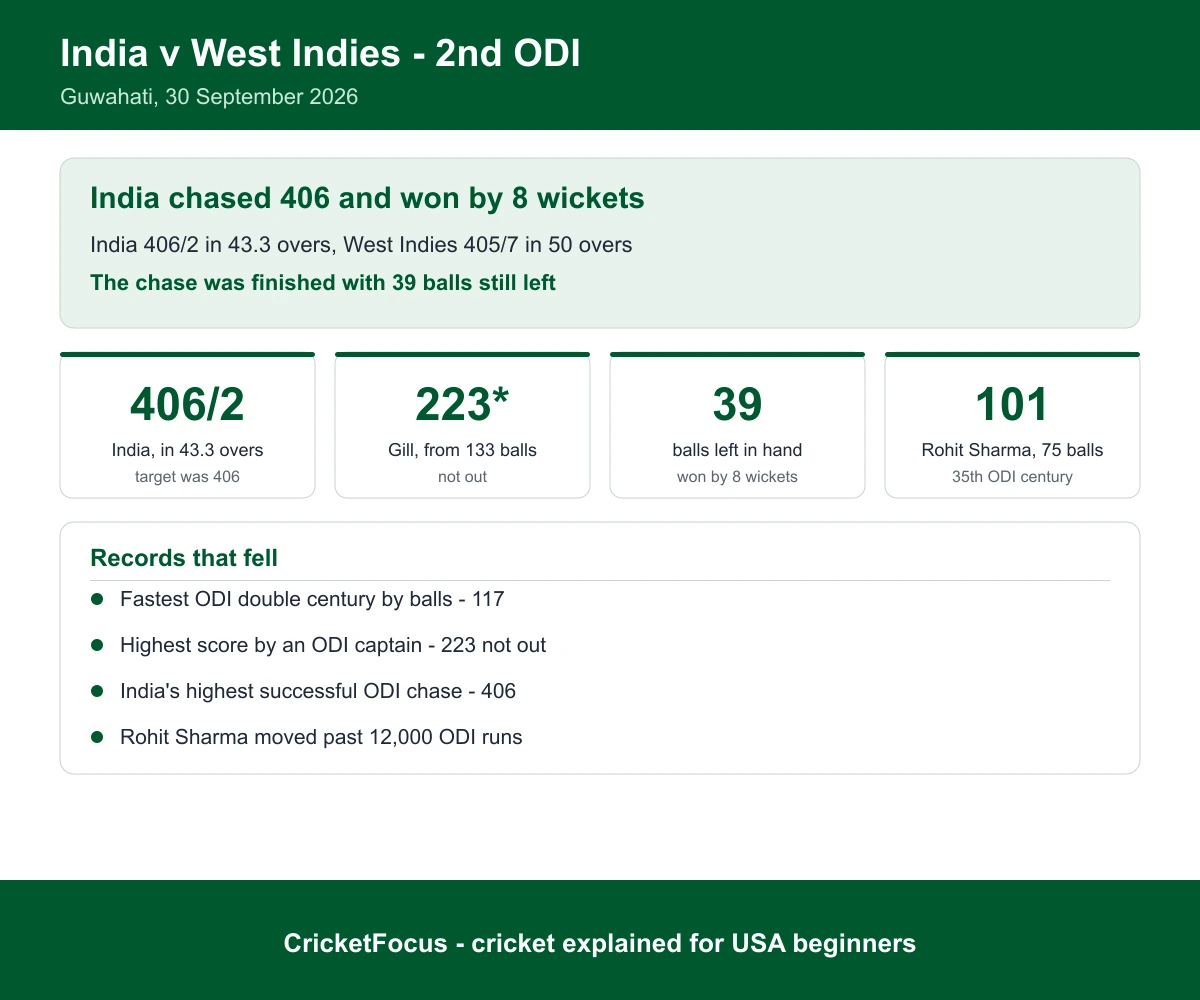
If you followed India against West Indies on 30 September 2026, you watched something cricket rarely produces. India needed 407 runs to win, they had 50 overs to get them, and they finished with 39 balls to spare. If you are new to the sport and the scoreboard numbers did not quite make sense, this match is a good place to sort that out. If you want the basics first, read how a cricket match works before you go any further.
India’s captain Shubman Gill finished on 223 not out from only 133 balls. That is a double century, and it came faster than any other in one-day international history. It was also the highest score by a captain in the format. Rohit Sharma made 101 in the same innings and moved past 12,000 ODI runs for the first time in his career.
Quick Answer
India beat West Indies by eight wickets in the second ODI at Guwahati on 30 September 2026. India chased 406 in 43.3 overs. Shubman Gill made 223 not out, which is the fastest double century in ODI history and the highest score by a captain in the format.
The official broadcaster has put together a fifteen minute highlight package of the whole match. It is worth watching once the numbers below make sense.
What the scorecard actually shows
Here is the whole match in one table. Every figure comes from the official scorecard and match report published by ESPNcricinfo, which also carries the ball by ball commentary.
| Player | Team | Runs | Balls | Note |
|---|---|---|---|---|
| Shubman Gill (c) | India | 223 not out | 133 | Fastest ODI double century |
| Rohit Sharma | India | 101 | 75 | 35th ODI century |
| Virat Kohli | India | 29 | 19 | Out for the second wicket |
| Ruturaj Gaikwad | India | 31 not out | 37 | Not out |
| John Campbell | West Indies | 101 | 68 | Opened the batting |
| Shai Hope (c) | West Indies | 104 | 94 | West Indies captain |
| Amir Jangoo | West Indies | 114 | 77 | Highest score for West Indies |
| India total | India | 406 for 2 | 43.3 overs | Won by 8 wickets |
| West Indies total | West Indies | 405 for 7 | 50 overs | First ever 400-plus ODI total |
How the chase actually unfolded
Two openers trading shots shot for shot
For long stretches of this innings, neither batter was clearly ahead. Rohit Sharma came out of the blocks quickly and reached 35 from 27 balls. When Shamar Joseph came on, Gill greeted him with a four and a six and was 36 from 21. For several overs they simply matched each other, and it looked like a very good day for India without looking like a record day.
Gill moved into a different gear
By the time Keemo Paul came back for his second spell in the 15th over, Gill was starting to hit good balls as well as bad ones. He charged the fast bowlers and pulled the short deliveries, and he did not let the slower bowling of Roston Chase settle him. He reached 100 from 62 balls, which was the fastest ODI century by an Indian captain and the fastest century of the night.
By the time Sharma brought up his own hundred from 72 balls, Gill was already on 142 from 82. Sharma celebrated his century with a jump, but he was not going to win the match from there.
One ball ended the partnership
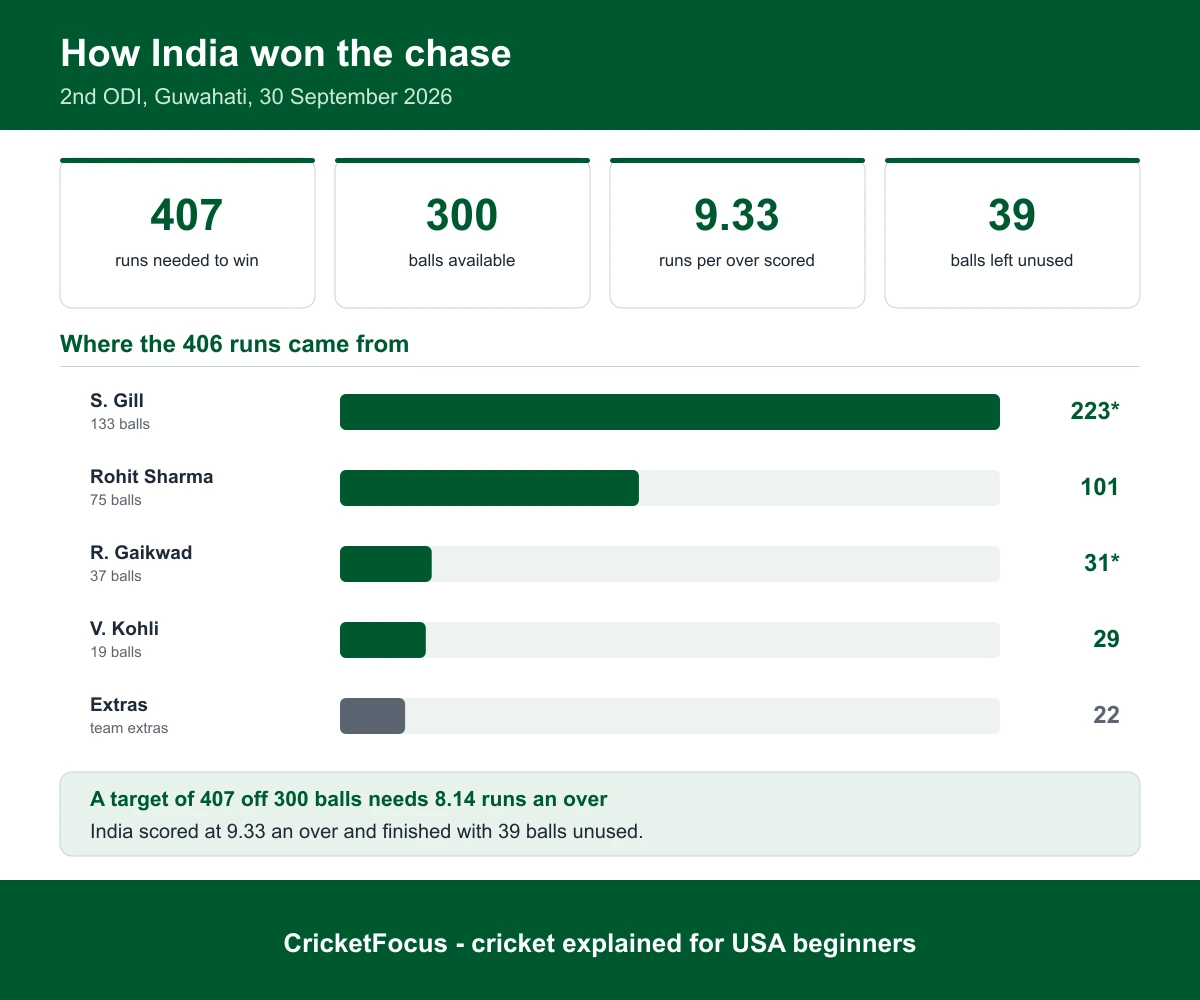
Sharma was eventually dismissed for 101 by Jayden Seales, the one delivery that seamed off the surface. India were still in command. Virat Kohli came in and scored 29 from 19 balls, and Ruturaj Gaikwad finished not out on 31 from 37. India passed 400 in the 43rd over, at which point the target was gone, and they ended on 406 for 2 with 39 balls unused.
Why the 223 is a record
Fastest double century in ODI history
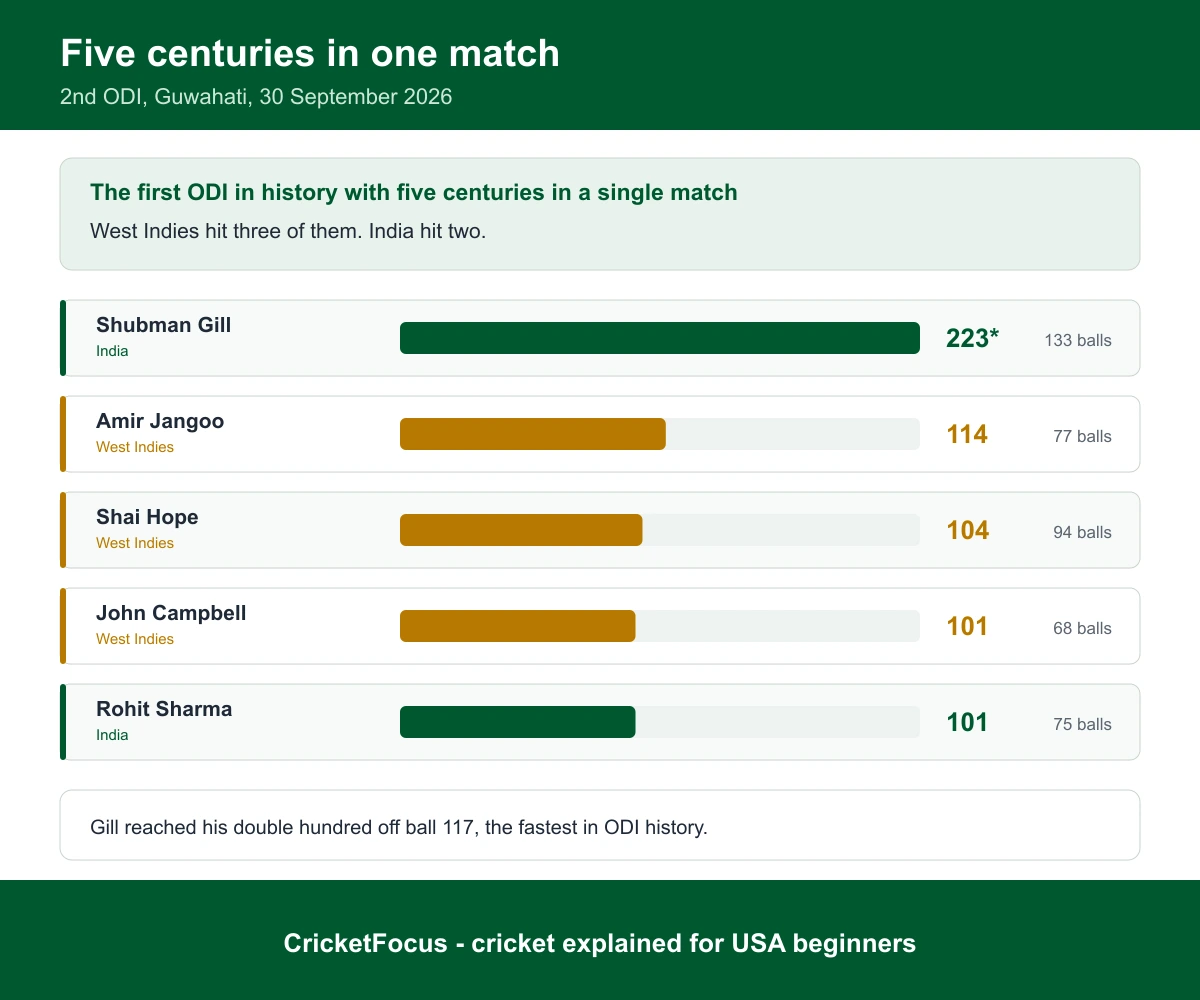
A double century means 200 runs or more in a single innings. Gill reached 200 from ball 117 of the match. Ishan Kishan had held that record with 126 balls, so Gill got there nine balls quicker. No batter in the men’s one-day game has reached double century faster.
Highest score by a captain in an ODI
This one catches people out, because the highest score in men’s ODIs does not belong to a captain. Rohit Sharma’s 264 against Sri Lanka at Eden Gardens in November 2014 is still the record, but Virat Kohli was India’s captain at the time, so it does not count as a captain’s innings. Virender Sehwag’s 219 against West Indies in 2011 came under Sachin Tendulkar for the same reason. As a captain’s innings, Gill’s 223 not out stands alone at the top.
Only the second double century in a run chase
Gill is only the second batter after Glenn Maxwell to make a double century while chasing a target. Maxwell’s 201 not out against Afghanistan at the Wankhede in the 2023 World Cup was the first, and India won that match comfortably. Rohit Sharma remains the only batter with three ODI double centuries, so Gill’s two make him the second player in the format’s history to do it twice.
The other records that fell in this match
One match produced an unusually long list, and most of these had never happened before in a one-day international:
- India finished 406 for 2 in 43.3 overs, their highest successful ODI chase.
- It was only the second successful chase of 400 runs or more in ODI history. South Africa chased 438 against Australia in 2006, and that record has stood for twenty years.
- The Gill and Sharma opening stand was 255 runs, India’s biggest partnership in a chase.
- Five separate batters scored a century in one match, which had never happened in an ODI before.
- Three of those hundreds came from West Indies batters, also a first for the format.
- Gill reached his hundred from 62 balls, the fastest ODI century by an Indian captain.
- Rohit Sharma crossed 12,000 ODI runs and made his 35th century.
- Kuldeep Yadav took his 200th ODI wicket for India.
Important
Gill’s score is written 223 not out because India won before he was dismissed. A not out innings still counts in full toward the team total, but it never adds a dismissal to that batter’s average, which is why a not out score is always worth more to an average than an out score of the same size.
Rohit Sharma and the 12,000-run mark
Sharma’s 101 was not simply a second century in the same innings. It moved him past 12,000 runs in one-day internationals, which makes him the second Indian batter to reach that mark after Virat Kohli. He now has 35 hundreds in the format, already among the highest totals of any batter in ODI history.
He was also clear afterwards that the chase mattered more to him than the personal milestone. Sharma said he wanted to keep his celebration for himself because some things are meant to be with you and not shared, and he credited Gill for staying not out and for holding his end of a partnership that lasted most of the innings.
If you want to see how that compares with the rest of the format, our cricket records guide breaks down the all-time batting, bowling and team records in plain language.
What the West Indies innings meant
Losing is not the only thing to read into a total of 405 for 7. It was the first time West Indies have passed 400 in a one-day international, and three of their batters made hundreds in the same match for the first time in the format’s history.
John Campbell opened with 101 from 68 balls. Shai Hope, the West Indies captain, made 104 from 94. Amir Jangoo finished with 114 from 77 as the innings closed. Three hundreds in one match is the sort of batting that decides a series on its own, and on this occasion India had an answer for all of it.
How to read a scorecard like this yourself
If you are new to cricket, this match is a good exercise because the numbers are large. Four things explain almost all of it.
Runs and balls. Every batter’s score shows how many runs they made and how many deliveries it took. Gill’s 223 from 133 balls was quicker than Rohit’s 101 from 75, even though Rohit got there first. Balls faced is the number that tells you how hard someone was hitting.
Not out. A batter who is still in at the end is marked not out. It does not reduce the runs, but it means the innings is treated differently when averages are worked out.
Overs. A one-day international is 50 overs, and one over is six legal deliveries. India finished after 43.3 overs, which is 43 overs and 3 balls. That is why they had 39 balls left, or 6 overs and 3 balls.
How the innings ended. 406 for 2 means two batters were dismissed and everyone else finished not out. The win margin, eight wickets, comes from the fact that India only lost two wickets and got the runs with time to spare.
What happens next
India lead the three match series two nil. The third ODI is scheduled for Saturday 3 October 2026, so a win there would seal the series before the tour moves on to five twenty20 internationals.
Both teams are also building toward the 2027 World Cup. A 400-plus total and a chase of 406 are exactly the kind of evidence that one-day cricket is moving toward conditions where 300 no longer guarantees a win.
Questions beginners ask about this match
How many runs did India need to win the second ODI?
They needed 407. West Indies finished on 405, and a one-day international cannot end in a tie in the way a Test match can, so India had to reach 406 to win. They got there with 39 balls remaining.
What does 223 not out actually mean?
It means Gill scored 223 runs and was still at the crease when the match ended, so nobody dismissed him. He is the only Indian to have been dismissed in that innings.
What is a double century in cricket?
A double century is 200 runs or more in one innings. It is a batting milestone rather than a separate format. A player can reach it in Test matches, one-day internationals and Twenty20 internationals, and each format counts its own double centuries separately.
Is 223 the highest score in one-day international history?
No. Rohit Sharma’s 264 against Sri Lanka at Eden Gardens in November 2014 is still the men’s record. Gill’s 223 is the highest score by a captain in the format. A single innings can carry more than one record, which is why a scorecard and a record list are never the same thing.
How many teams have ever chased 400 in one-day internationals?
Only two. South Africa chased 438 against Australia in 2006, and India chased 406 here in 2026. Both were successful chases. Plenty of other sides have been set 400 and failed, which is why a big total on its own does not decide a match.
What this match really showed is simple. Chasing 406 looked close to impossible when West Indies posted their first ever 400-plus total in the format, and it finished with almost seven overs unused. If you are starting to learn cricket, use this scorecard as a reference point. Check who scored, how many balls they took, and what the target was. Those three habits explain most of what you see on a cricket scoreboard.
Read More: India vs West Indies 2026 schedule, squads and US start times
