




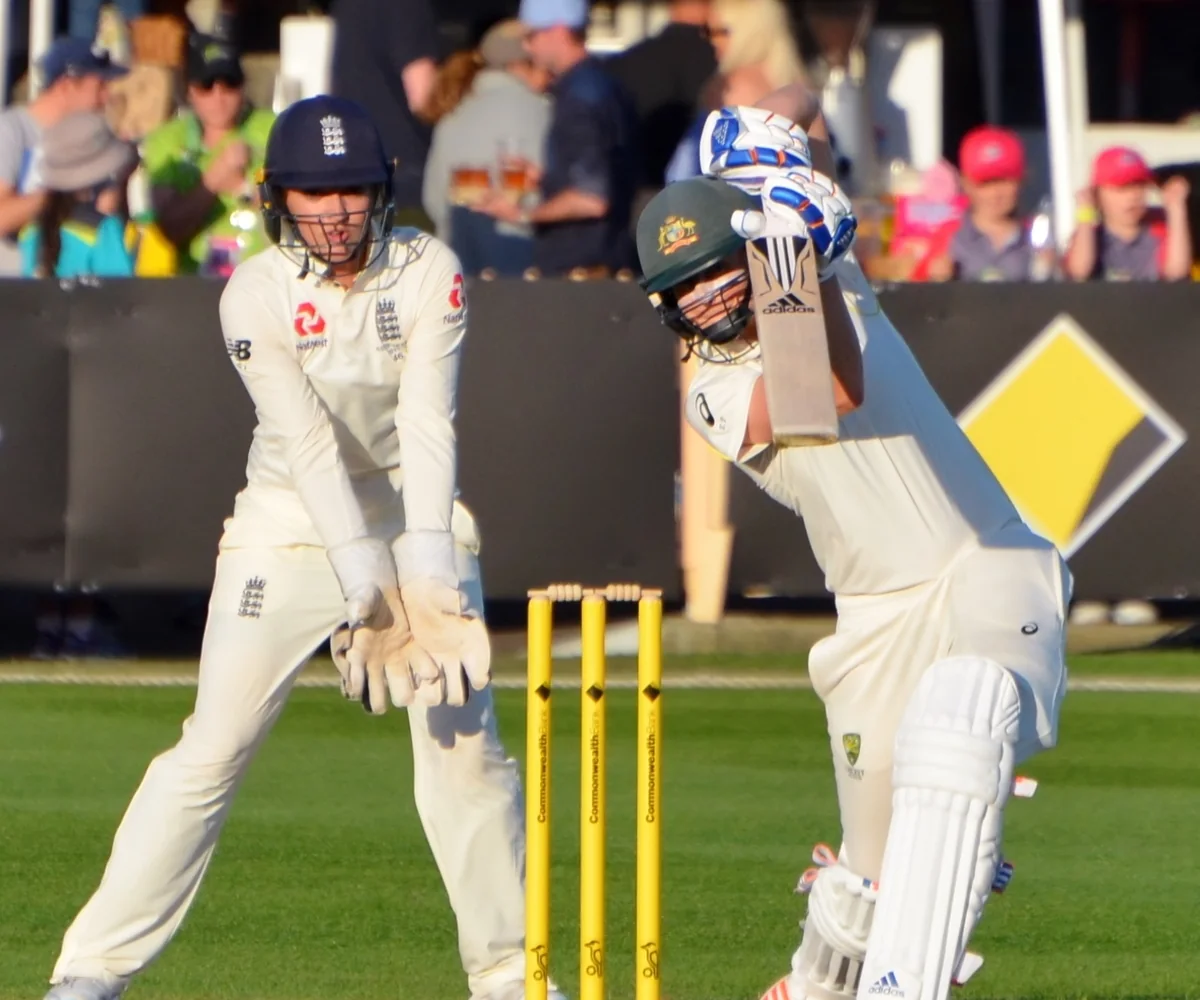
Ask a new player which shot they want to learn first and most of them say the cover drive. That is a good answer. The cover drive teaches footwork, balance, and timing in one stroke, and it works against almost every type of bowling once you get it right. It is also the shot that decides a lot of games, because batters hit it over and over on the front foot.
Plenty of beginners try it, though, and it goes badly. The bat swings hard, the ball goes straight up in the air, or it flies to the leg side no matter what they intended. Almost every one of those problems comes from the same place: the feet and the head arrive in the wrong spot before the bat moves. This guide walks through the cover drive in the order you actually need to learn it. If over, wicket, or off side are still unfamiliar, start with our cricket skills guide for beginners first.
Quick Answer
A cover drive is a front-foot stroke that hits the ball along the ground through the off side, between the cover fielder and the fielder deeper on the boundary. To play it, step forward so your front foot lands inside the line of the ball, keep your head over the bat as it comes down, and swing straight with a high elbow. Because it is a ground shot, it can score four runs but never six.
What Is the Cover Drive?
To understand the shot, you need two field terms. The off side is the half of the field a batter faces when turning away from the stumps. For a right-handed batter it is the right-hand side of the field. The leg side, sometimes called the on side, is the other half, the left-hand side for a right-handed batter.
On the off side sit several fielders. Point stands near the boundary, level with the batter. Cover stands a few paces in front of square, closer to the batter. Extra cover is deeper than cover and further toward the boundary. The cover drive is the shot aimed at the space between the cover fielder and extra cover.
That narrow definition matters, because three different shots come from the same basic movement:
| Shot | Where the ball goes | How it is played |
|---|---|---|
| Square drive | Between point and cover, behind cover | Hitting the ball across the line, straight out in front of square |
| Cover drive | Between cover and extra cover | Hitting on a slight angle, with the bat face straight down the ground |
| Off drive | Past extra cover, wider of the cover drive line | The same movement, with the face of the bat opened slightly toward the off side |
The direction changes with the angle of the swing, not with extra effort. A batter who has the shape right can play all three from the same position.
Why the Cover Drive Is the Best First Shot to Learn
Three reasons make it a good starting point for a new player.
First, it teaches the part of batting that matters most. Nearly every other shot is a variation of moving your feet toward the ball and then swinging straight. Learn the cover drive properly and the straight drive comes almost for free.
Second, it is a high-percentage shot. A ball driven along the ground can be stopped, so even a mistimed cover drive often costs you a single rather than your wicket. Compare that with a pull shot or a lofted hit, where a small error sends the ball straight to a fielder.
Third, it is available against almost every delivery. A good-length ball from a fast bowler, a spinner, or a part-time medium pacer can all be driven. That means you get to use it constantly rather than saving it for one situation.
One honest warning. A cover drive is not the shot for every ball. Trying to force it against a short ball or a ball that is too far outside off stump is one of the fastest ways to get out for no runs, and that is covered later in this guide.
How to Play a Cover Drive, Step by Step
1. Set Up in a Balanced Stance
Stand with your feet about shoulder-width apart, toes pointing slightly open toward the bowler. Keep your knees a little bent and your weight on the balls of your feet rather than your heels. Your head stays still and your eyes level, watching the bowler’s release point.
Check that your hands are close to the top of the handle, which is where the bat feels fastest. A grip that is too tight slows the hands down and is the most common reason a cover drive ends up mistimed. If the grip is not clicking yet, our batting grip guide sets out the hand position in detail. If the bat itself feels hard to move, check your cricket bat weight before changing anything about your technique.
2. Read the Length Before You Move
Length means how far down the pitch the ball bounces before it reaches you. The cover drive belongs to a full length ball, one that pitches far enough down the pitch that you can step toward it and meet it. If the ball is short, you would have to stretch forward to reach it, and the stroke falls apart.
Watch the bowler’s arm and the ball’s path, not the bowler’s body. Try to spot the release point early and hold your attention there until the ball is close enough to judge.
3. Step to the Ball, Inside Its Line
As the ball comes down, take one stride forward with your front foot. Land it just inside the line of the ball, which means slightly closer to the stumps than where the ball pitched. This gives your bat room to swing without your leg getting in the way.
Keep the stride comfortable. Reaching too far down the pitch puts you off balance, and an off-balance batter almost always sends the ball somewhere unhelpful. Let your weight settle over the front foot with the front knee bent, which is what keeps the ball on the ground.
4. Put Your Head Over the Ball
This is the single most important part of the shot. As the bat comes down, move your head so that the ball passes under your chin and your eyes. Keeping your head still over the ball is what stops you from missing it entirely, and it keeps your eyes level so you actually see where the bat is meeting the ball.
If your head stays back, you will swing under the ball and push it weakly. If your head drops too early, the bat face closes and the ball goes up. Most beginners find that simply thinking about head position fixes half their problems.
5. Swing Straight Down With a High Elbow
Bring the bat down from above the ball, close to vertical at the moment of contact. A high elbow, held up rather than dropped toward the ground, keeps the bat face from turning and sends the ball where you want it. Swing in a straight line down the ground rather than across the body.
Loosen the top hand slightly and let it guide. The top hand is the one on top of the handle for a right-handed batter, and it steers the direction of the ball. The bottom hand provides the power. Beginners who squeeze both hands hard lose the control that the top hand should be giving them.
Play the ball rather than forcing it. Trying to hit a cover drive harder than the technique allows simply makes the ball go straight, and a straight ball has fielders waiting for it.
6. Finish High and Stay Balanced
Let the bat follow through high, finishing above your shoulder. The high finish is what gives the shot its shape and keeps your head down through contact. If your follow-through drops below your waist, you have almost certainly lost balance somewhere earlier in the stroke.
Finish in a position you could hold for a count of three. That test is a simple and surprisingly accurate measure of whether the shot was clean.
Common Mistakes and How to Fix Them
| What goes wrong | Why it happens | What to change |
|---|---|---|
| Ball goes up in the air | Head came up, or weight stayed on the back foot | Bend the front knee, get the head over the ball, and let the bat follow through high |
| Ball goes to the leg side | Front foot landed in line with the ball, or the swing went across the body | Land the front foot inside the line of the ball and swing straight down the ground |
| Bat swings under and pushes it | Head stayed back and eyes left the ball | Watch the ball onto the bat and keep the chin over it at contact |
| Feet tangled, no balance | Stride was too long for the delivery | Take a shorter stride and drop the hips rather than reaching |
| Straight to the fielder every time | Bat face stayed perfectly vertical through the whole swing | Keep the face vertical at contact, then open it slightly after the ball has gone |
Pick one fault, fix it, and hit a few more balls before moving to the next. Beginners who try to correct five things at once usually end up changing nothing.
When to Drive and When to Leave It
Shot selection is what separates a batter who survives from one who does not. The cover drive works on a narrow set of deliveries.
Drive when the ball is of a good, full length and pitches on or just outside off stump. That is the delivery sitting in the driving slot, and it is the one to hit. It works especially well in the first six overs of a limited-overs innings, when the field is restricted and there is space to hit the ball. Our guide to cricket powerplay rules explains exactly which overs those are and how many fielders a captain is allowed.
Do not drive when the ball is short. A short ball needs a cut or a pull, and a drive to it means the bat arrives at the wrong height. Do not drive when the ball is too far outside off stump, either. You cannot reach it, and the umpire may call it a wide ball before the bat swings.
And do not drive a full toss that bounces above shoulder height. That is called a beamer ball, and it leaves almost no time to set up. Defend it or move out of the way instead.
Why a Cover Drive Can Only Be Four Runs
Because a cover drive is a ground shot, it can never score six runs. This surprises new players, because a well-struck cover drive races to the boundary and looks like it should be worth more.
The rule is in Law 19 of the MCC Laws of Cricket. Under Law 19.7.1, a six is scored only if the ball is struck by the bat and is first grounded beyond the boundary without having touched the ground inside the field of play. Under Law 19.7.2, a ball that bounced inside the boundary before crossing it is four.
So a cover drive that lands just short of the rope and runs to the fence is four runs, however well it was hit. Only lifting the ball over the rope on the full can make it six, and lifting the ball deliberately trades the safety of the drive for risk.
Worth noting that the boundary itself is fixed before the toss. Under Law 19.1.1, the umpires determine the boundary of the field of play before the start of the match, and it stays fixed for the whole match. The MCC Laws of Cricket on boundaries set out how the line is marked and how the runs are awarded.
Drills That Build the Shot
Cover drive technique is built through repetition with simple constraints, not through long net sessions.
Shadow batting. Stand in your stance and rehearse the whole movement without a ball. Step, head over ball, straight swing, high finish. Ten repetitions is enough. Do it facing a wall so you can check your finish height.
Drop feed. Have a partner drop the ball from above the point on the pitch where you would normally strike. This isolates the footwork and the head position, which is where most beginners lose the shot. No swing speed involved, so every repetition is worth something.
Underarm throws. Have a partner roll or throw underarm balls at about half pace. Slow deliveries give you time to focus on the shape of the swing instead of on contact. Add pace only once the shape is right.
Set up a field with cones. Put a cone where the cover fielder stands and another at extra cover. Hitting the ball into the space between the two cones trains placement, which is the part of the drive most beginners skip.
Video one rep a week. Record a single cover drive from the side, once a week, and compare it with the first one. Almost every fault listed in the table above is obvious on video and invisible from inside the shot.
Frequently Asked Questions
What is the difference between a cover drive and a straight drive?
They use the same footwork and the same swing path. The difference is the target. A straight drive sends the ball straight down the ground, past the stumps. A cover drive sends it at an angle to the off side, between the cover fielder and extra cover.
Should I play the cover drive off the front foot or the back foot?
Learn it off the front foot first. It belongs to full-length balls, and the front foot is where your power and control come from for that length. A back-foot drive is a different stroke, played against a different length, and it is a later step.
Why does my cover drive keep going into the air?
Almost always the head. If your head lifts before the ball arrives, the bat face closes and the ball rises. Keep your chin over the ball, bend your front knee, and get your weight over the front leg. Do not try to hit it harder.
How do I know which balls to drive?
Judge two things: length and line. Drive a ball that is full length and pitches on or just outside off stump. Leave anything shorter, and leave anything too far outside off, because that is a wide ball and you may reach for it in vain.
Do I need a powerful swing to play the cover drive well?
No. Power comes from a straight swing and a solid contact point, not from swinging hard. A relaxed batter who hits the ball accurately will score more than a tense one who tries to force every delivery. Stay calm and let the technique do the work.
Conclusion
The cover drive looks simple because it is short, but it is the shot that teaches you how to move your feet and keep your head still. Get the front foot inside the line of the ball, put your head over the bat, and swing straight with a high finish. Practise the shape in the nets before you go looking for runs, because a cover drive that is technically clean will score whether or not you hit it hard.
Photo: Ellyse Perry batting during the 2017-18 Women’s Ashes Test at North Sydney Oval, by Bahnfrend, licensed under CC BY-SA 4.0. Cropped to 1200 by 1000 pixels.
Read More: Cricket Scoring System Explained (Runs, Extras and Boundaries)
