




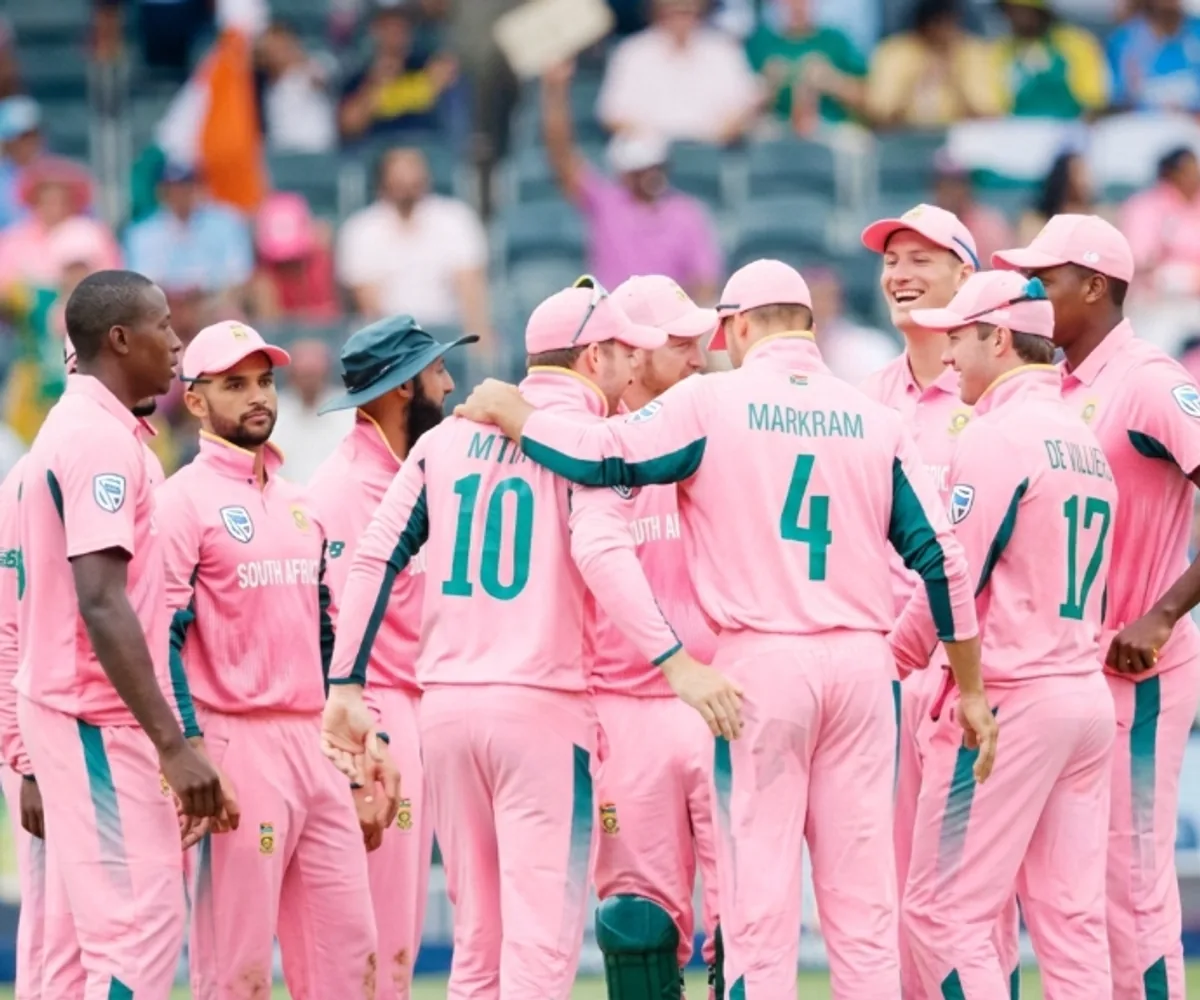
South Africa wears a pink jersey for one match a year at the Wanderers ground in Johannesburg. That is not a new team color. The Proteas change out of their normal green and gold kit for a charity match called Pink Day, played to raise money and awareness for breast cancer care.
If you are new to cricket, this looks strange until you know the story behind it. Once you understand the reason, the pink shirt fits neatly into the wider world of cricket culture, which you can read about in our cricket culture and gear guide.
Quick Answer
South Africa wears a pink jersey once a year on Pink Day, a limited overs match at the DP World Wanderers Stadium in Johannesburg. The Proteas wear pink to support breast cancer awareness and raise money for the Breast Care Unit at the Charlotte Maxeke Johannesburg Academic Hospital. It started as a Test match day in 2011 and became a full one day international in 2013.
Pink Day is a charity match, not a new kit
Most cricket jerseys stay the same for years. A team picks a color, a design, and a sponsor, then wears that same shirt home and away for a whole cycle. South Africa follows that rule too. Their normal playing colors are green and gold.
Pink Day is the exception. For one match a year, Cricket South Africa, the body that runs South African cricket, puts the team into an all-pink kit and turns the whole stadium pink to match. The opposition usually joins in, and so do the fans in the stands.
The reason is a health campaign. Pink is the international color used to raise awareness of breast cancer, and the pink ribbon is the best known symbol of that cause. By putting an entire national team and a sold out crowd into pink, the organizers make the message impossible to miss.
You can read more about how teams choose their base colors in our guide to why cricket teams have different jersey colors. Pink Day shows the opposite side of the same idea. A permanent color builds identity. A one-day color builds attention for a cause.
Where the pink day money actually goes
Charity jerseys are easy to dismiss as a marketing stunt, so it is fair to ask where the money lands.
The official beneficiary since 2018 is the Breast Care Unit at the Charlotte Maxeke Johannesburg Academic Hospital in Johannesburg. According to Cricket South Africa, the unit sees up to 350 women newly diagnosed with breast cancer each year and provides a service to seven district hospitals. Patients from other provinces and from elsewhere in Africa are also treated there.
Before 2018, the beneficiary was PinkDrive, a nonprofit focused on screening and early detection. The money does not only come from ticket sales. It also comes from a separate golf day, sponsor pledges, and the players themselves.
Cricket South Africa also pushes the idea beyond match day with two hashtags. #PitchUpInPink asks fans to wear pink to the game. #PledgePink asks people to keep the cause in mind all year and to encourage women to get checked early. You can read the organizer’s own version of the campaign on the official Cricket South Africa Pink Day page.
Important
Do not confuse Pink Day with the pink ball used in day and night Test matches. The pink ball is a different idea, introduced so the red ball could be replaced under floodlights. It has nothing to do with Pink Day, and the Proteas do not wear a pink kit for every Test.
How Pink Day started
The story begins in Australia, not South Africa.
In 2009, the Sydney Cricket Ground was painted pink for the first Jane McGrath Day. Jane McGrath was the wife of Australian fast bowler Glenn McGrath, and she died from breast cancer in 2008. The day was run by the Jane McGrath Foundation, and it turned a cricket match into a fundraiser.
Two years later, the idea crossed oceans. On the third day of a Test match between South Africa and Australia at the Wanderers in 2011, the ground went pink and both teams wore pink. Cricket South Africa and its sponsors partnered with the McGrath Foundation.
That proved the idea worked, but a single day of a five day Test was not enough. In 2013, Cricket South Africa and the Gauteng Cricket Board turned it into a full one day international, the annual Pink Day ODI. The first one came against Pakistan in March 2013.
Since then the match has stayed at the DP World Wanderers in Johannesburg, the same ground where it all began in 2011. For South African fans it now carries roughly the same weight as the Springboks rugby match against New Zealand.
Pink Day matches through the years
The Proteas have worn pink more than a dozen times. Here is the run of the fixture.
| Year | Opponent | Why it is remembered |
|---|---|---|
| 2013 | Pakistan | The first ever Pink Day ODI |
| 2013 | India | First Pink Day ODI against India |
| 2015 | West Indies | South Africa scored 439 for 2, still their highest ever in a one day international |
| 2016 | England | Regular fixture by this point |
| 2017 | Sri Lanka | Standard annual charity match |
| 2018 | India | First Pink Day with the hospital as beneficiary |
| 2019 | Pakistan | Held in January that year |
| 2020 | England | One of the last matches before the pandemic stopped crowds |
| 2021 | Pakistan | Played with no spectators because of COVID-19 rules |
| 2022 | Bangladesh | Returned in front of a full crowd |
| 2023 | Netherlands | South Africa won by 146 runs |
| 2023 | India | Later in the same year |
| 2024 | Pakistan | Most recent full season before 2026 |
| 2026 | West Indies | First time South Africa wore pink in a T20 international, on 31 January |
| 2026 | Australia | Pink Day ODI at the Wanderers on 27 September, against Australia’s cricket team |
The 2015 match is the one that made Pink Day famous around the world. South Africa batted first and reached 439 for 2 in 50 overs. AB de Villiers reached three figures from just 31 balls, which remains the fastest century in one day international cricket. He finished on 149 from 44 balls, with 16 sixes. South Africa won by 148 runs.
It is worth noticing the pattern in that table. The same players who wear the pink shirt also wear the normal green and gold shirt for the rest of the year. Nothing about the charity kit changes how the team is selected or how it plays.
2026 brought a first and a big series
Two things made 2026 unusual for Pink Day.
The first was a format change. On 31 January 2026, South Africa hosted the West Indies in a Twenty20 international at the Wanderers and wore pink for the first time in that format. Cricket South Africa called it a send off before the side left for the T20 World Cup. It was the fifteenth edition of Pink Day, and the ground was sold out.
The second was the size of the opponent. The next Pink Day ODI, played on 27 September 2026 at the Wanderers, was the second match of a three match one day series against Australia. Temba Bavuma captains South Africa, and the series is sponsored by Dafabet. Australia are one of the biggest rivalries in the sport, so Cricket South Africa expected the Wanderers to be a spectacle in pink again.
If you follow cricket and you have never watched a Pink Day match, this is a good place to start.
What South Africa wear the rest of the time
Outside Pink Day, the picture is straightforward. South Africa play in green and gold. Green is the long standing base color, and the gold trim has been part of the look for a long time. The national team is known as the Proteas, named after the king protea flower that appears on the badge and on the Test cap.
That name is also a useful shortcut. A South African player in pink is a Proteas playing one charity match. A South African player in green is a Proteas playing any other match on the calendar.
Why fans bother dressing in pink
It is easy to look at a crowd wearing pink and assume it is just decoration. It is not. The whole visual effect is the point.
Awareness campaigns work by being visible. A cause that is discussed once a year in a newspaper is easily forgotten. A cause attached to a full stadium, a broadcast match, and tens of thousands of people in the same color gets remembered. The stadium is deliberately turned pink, and the scoreboards and advertising boards follow, so the match itself carries the message on television as well.
For many South African fans it is also a family tradition. If you grew up watching the Proteas, you probably remember going to the Wanderers in pink with your parents or your children.
Frequently Asked Questions
Why does South Africa wear a pink jersey?
They wear it once a year on Pink Day, a charity match at the DP World Wanderers Stadium in Johannesburg, to raise awareness and money for breast cancer care. The player kit change is temporary and does not alter the team’s normal colors.
Is the South Africa pink jersey a permanent kit?
No. South Africa’s regular colors are green and gold. The pink kit is worn for one limited overs match each season and then goes back in the cupboard until the next Pink Day.
When did South Africa first wear pink?
On the third day of a Test against Australia at the Wanderers in 2011. The idea came from Australia’s Jane McGrath Day, which began at the Sydney Cricket Ground in 2009. The first Pink Day one day international was played in 2013 against Pakistan.
Where does the money from Pink Day go?
Since 2018 it has gone to the Breast Care Unit at the Charlotte Maxeke Johannesburg Academic Hospital in Johannesburg, which treats up to 350 newly diagnosed women a year. Before 2018 the beneficiary was the screening charity PinkDrive.
Has South Africa ever won a match while wearing pink?
Yes, many times. The most famous was on 18 January 2015 against the West Indies, when South Africa scored 439 for 2 and won by 148 runs. AB de Villiers hit the fastest one day international century in that innings.
Conclusion
South Africa’s pink jersey is not a new identity and it is not a fashion choice. It is a single match a year, in one city, for one cause. The team changes into pink, the Wanderers changes into pink, and the money and attention go to breast cancer patients in South Africa. The rest of the year, the Proteas go back to green and gold.
Read More: Lucky Jersey Numbers in Cricket: What Superstitions Say
