




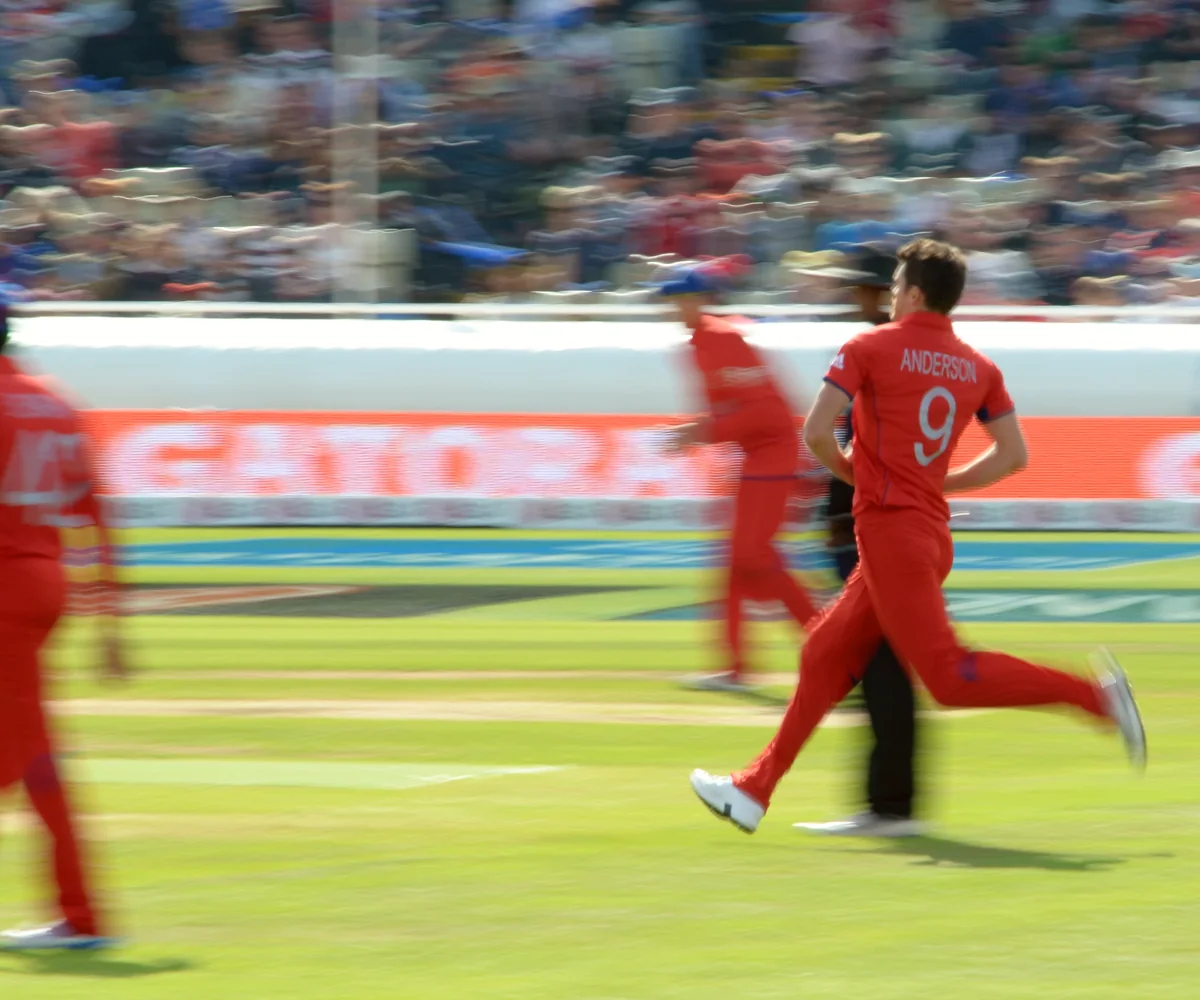
You have just watched a fast bowler send down three deliveries that all look identical. The seam is angled the same way, the action is the same, the speed looks the same. The first one goes away from the bat. The third one comes straight back in at the stumps, and nobody in the ground saw it coming.
That is not an illusion and it is not a trick with a hidden ball. It is the same delivery moving in the opposite direction, and it has a name. The reverse swing section of our cricket skills guide is a good place to see where it sits among the other bowling fundamentals, and this guide explains what it actually is.
Quick Answer
Reverse swing is when an old cricket ball moves through the air in the opposite direction to the one the bowler is aiming for. With conventional swing, the ball travels toward the direction the seam is pointing. With reverse swing it travels away from it, so an outswinger becomes an inswinger and an inswinger becomes an outswinger, with no change to the bowler’s grip or action. It needs an aged ball, a prominent seam and real pace, and it is why the same bowler can be harmless with a new ball and dangerous with an old one.
What Reverse Swing Is, in One Sentence
The ball moves through the air in the opposite direction to the one the seam is pointing. That is the whole definition, and it is worth holding on to, because everything else follows from it.
To make that useful, you need one more idea. A cricket ball has an encircling stitched seam that splits its surface into two halves. Those two halves end up behaving differently as the ball is used, and that difference is what creates sideways movement in the air.
Researchers who study this, most usefully Rabindra Mehta, divide what happens into three categories. Knowing which one you are looking at is the fastest way to understand the whole subject.
| Type of swing | Which way the ball moves | When it happens |
|---|---|---|
| Conventional swing | In the same direction the seam is pointing, so an angled seam to the slips gives an outswinger | Early in an innings, with a new or nearly new ball |
| Reverse swing | Opposite to the seam, so the same angled delivery goes the other way | Once the ball has aged and both its halves are worn |
| Contrast swing | Decided by speed and the contrast between the two halves rather than by the seam angle | A ball with a strong contrast between a smooth half and a rough half |
You do not need to bowl contrast swing to understand it, but you will see it mentioned in commentary and it explains a delivery that seems to move with no seam angle at all.
Why a Ball Swings Through the Air at All
This is the part that sounds complicated and is not, once you have the right picture.
Air flowing over a cricket ball does two different things depending on the surface it passes over. Over a smooth surface it flows in neat, orderly layers. Over a rough surface, or over a stitched seam, it breaks into a churning, uneven flow called turbulence. Turbulent air grips the surface harder and separates from it later, further back on the ball.
Where air separates earlier or later, the pressure differs. Smooth air that peels off early leaves lower pressure behind it. Turbulent air that clings on and leaves late also leaves lower pressure behind it. The side with the lower pressure pulls the ball towards it, and that sideways pull is the swing.
So a bowler gets swing by aiming the seam at an angle. The seam churns the air on one side into turbulence, the other side stays smooth, the two sides separate at different points, and the ball bends towards the seam side. That is conventional swing, and it is why the angle of release matters so much. Release the seam straight up and the two sides behave the same way, so the ball goes straight. Angle the seam towards the slips and you have set up an outswinger.
A useful extra detail, since it explains why a wobbling seam is useless: the ball spins through the air, and a steady seam angle holds its orientation. A seam that wobbles on its way down the pitch keeps losing its angle, and a ball that changes its angle halfway through its flight cannot commit to moving one way.
Why the Same Delivery Suddenly Goes the Other Way
Here is where the old ball changes everything, and the mechanism is genuinely counter-intuitive.
A new ball has two clearly different halves. One is smooth and shiny from the factory, and the other is the stitched seam. That clean contrast is what produces conventional swing.
As the ball is used, both halves change. The fielding side will polish one half repeatedly during an innings, usually with a towel or a trouser leg, to keep it as smooth as they can. The other half is deliberately left alone, and it roughens, scuffs and picks up abrasions as the ball is hit along the ground and thrown back into play. Some fielders also keep that half as dry as they can.
Eventually the once-obvious contrast is gone. Both halves of the ball are worn, and the polished half is only polished relative to the other one, never as smooth as a new ball. When both halves are rough enough, the balance of the flow changes, the side force that was pushing the ball one way reduces, passes through zero and then starts pushing the other way. The ball is released with the identical seam angle and identical action, and it goes the other way.
This is why reverse swing is described as the bowler’s best delivery turning into their worst. A bowler who has spent an innings finding a seam angle that moves the ball away from the bat suddenly has that same angle bringing it back at them, and there is nothing to change in their technique to fix it.
It is worth being honest about the limits here. The fine detail of exactly how the air behaves over a worn ball is still an active research question. A 2024 review in the journal Flow, which reassessed seventy years of swing research against new measurements, concluded that current understanding still does not fully explain the movement seen in professional matches. The broad picture is settled. The last few percent is not.
How Old Does the Ball Have to Be, and How Fast?
Two conditions, and both are required.
Age and wear. Reverse swing is a phenomenon of an old ball. It is commonly reported as arriving somewhere in the region of 25 to 30 overs into an innings, though the exact point moves around depending on the cricket ball, the pitch and how hard it is being hit into the ground. The Laws set a useful outer limit here. Under Law 4.4, in a match of more than one day’s duration, the fielding captain can demand a new ball once 80 overs have been bowled with the old one. That old ball can stay in play for most of a day, so reverse swing can show up at any point in a long innings, right up to the moment a new ball can be called for.
Law 4.3 also allows either captain to demand a new ball at the start of each innings, unless it was agreed otherwise beforehand. That is why reverse swing is a Test-match phenomenon in the way that people expect. In a one-day game the ball simply never gets old enough, and in T20 it never comes close.
Pace. The bowler has to be genuinely quick. Published wind-tunnel testing by Mehta’s group at the University of Bath gives an approximate picture of the thresholds. With a new ball, conventional swing works up to around 128 km/h, or about 80 mph, and a new ball only starts to reverse at speeds above roughly that. An older, rougher ball lowers the bar noticeably, with reverse swing possible from around 115 km/h, or about 71 mph. The faster the bowler, the bigger the effect.
That is the practical meaning of the often-quoted claim that reverse swing belongs to the fast bowlers. It is not bravado. A club bowler running in at medium pace simply will not get it, no matter how well the action is built, and no amount of extra effort will substitute for the speed.
Important
Humidity and cloud cover are widely blamed for swing, and the belief is deeply entrenched. Wind-tunnel and pitch-level testing carried out by Mehta’s group at the University of Bath found that humidity on its own made no significant difference to swing, and that strong atmospheric turbulence, the kind a hot sunny day generates above a dry pitch, actually works against it because it destroys the smooth layered flow that swing depends on. Swing is generally better in cool, still, overcast conditions for reasons that are about air movement rather than moisture. Treat the humidity explanation as a habit, not a finding.
Why It Is So Hard to Bat Against
From the batter’s side, the problem is not that the ball moves. It is that nothing about the delivery gives the movement away.
- The action is identical. Same run-up, same release, same follow-through. There is no visual cue in the bowler’s body.
- The seam angle is identical. The seam is pointing the same way it pointed for the previous delivery.
- The grip is identical. The bowler does not change grip, so the hands give nothing away.
- It happens late. Like all swing, the movement develops mostly in the back half of the flight. That late movement is not something reverse swing adds. It is built into every swinging delivery, because the ball slows as it travels, and the slower it is going the more the sideways force can act on it.
So the batter sets up for the delivery they have seen a hundred times that innings, plays the line they have been trusting, and the ball arrives somewhere else. If you are new to cricket and watching this for the first time, the most useful takeaway is not to try to solve it. Play the ball in front of you, keep watching it, and accept that an aged ball and a fast bowler are a genuine test.
What Fielders Do Is Fine, and What They Must Not Do Is Not
Because so much of the explanation depends on one half of the ball being kept smooth, it is worth being clear about where the line sits.
Polishing a ball is legal and is done constantly. Fielders rub one side of the ball with a towel or a trouser leg between deliveries to keep that side as smooth as possible. Keeping the other side dry is also just normal match behaviour. Shouting at your bowler to keep hitting the ball on the deck is also entirely normal, and it is doing exactly what the physics requires.
What is not legal is artificially altering the ball to help it move in the air or bounce higher. That means scratching or scuffing it deliberately, applying any foreign substance, or using sandpaper, and it applies to players, their captain, and their team support staff. The Laws of Cricket forbid it, match officials inspect the ball, and it is treated as a serious breach of the laws of the game rather than a clever tactic. There have been a number of high-profile bans for it.
One method deserves naming because it is widely discussed. You will hear players say they wet the ball to help it swing. The published research is unambiguous that wetting has no scientific basis for this purpose, and it is also a prohibited practice. If a bowler tells you wetting the ball is a legitimate part of reverse swing, that is simply wrong.
Common Misconceptions About Reverse Swing
| The belief | What the evidence shows |
|---|---|
| It moves through the air more than normal swing, and later | The sideways force is comparable in size and direction to conventional swing. Late movement is built into all swing, not added by reverse |
| You need a brand new ball to reverse swing | The opposite. A new ball only reverses at the very top of the speed range. An old, rough ball reverses at a lower speed |
| Humid or cloudy weather is what makes the ball swing | Testing found no significant effect from humidity alone. Atmospheric turbulence, which sunny days create, actually suppresses swing |
| It is only possible for bowlers bowling above 90 mph | That is the figure for a new ball. A worn ball lowers the threshold to roughly 71 mph, so a strong club fast bowler is in the range |
| The bowler has to change his grip to bowl the other way | That is the whole point. Same grip, same action, same seam angle, opposite movement |
| Wetting the ball is a legitimate part of the technique | No scientific basis, and prohibited under the Laws |
Reverse swing is a genuinely difficult art to bowl and a genuinely unpleasant thing to face. Nobody in club cricket should feel bad about not producing it. Understanding why it happens is enough for most players, and it makes watching a Test match a lot more interesting.
Frequently Asked Questions
What is the difference between reverse swing and an inswinger?
An inswinger is a type of conventional swing. A bowler aiming to bring the ball into a right-handed batter angles the seam towards the leg side and the ball follows the seam towards them. With reverse swing the ball moves opposite to the seam, so a delivery that was angling away from the batter curves back towards them instead. The difference is which way the seam is pointing relative to the movement.
Can reverse swing happen with a new ball?
In principle yes, but only at the very top of the speed range. Testing puts the conventional swing limit for a new ball at around 128 km/h, or 80 mph, with reverse swing only appearing above that. This is why you occasionally see a genuinely fast bowler reverse a new ball, and why it is treated as exceptional. For a worn ball the threshold drops to roughly 115 km/h, or 71 mph, which is where the effect becomes a normal part of a Test innings.
Why does reverse swing happen in Test matches more than in limited-overs cricket?
Because of how long the ball lasts. Law 4.3 allows either captain to call for a new ball at the start of each innings, and Law 4.4 allows the fielding captain to call for one once 80 overs have been bowled in a multi-day match. A Test innings gives a ball time to age into the state where reverse swing is possible. A fifty-over game does not, and a T20 game never will.
How do fielders prepare a ball for reverse swing?
They polish one side of the ball regularly during play to keep it as smooth as they can, and they leave the other side alone so that it roughens and scuffs through normal use. They also try to keep the untreated half dry. That is all legal and it is what produces the contrast between the two halves that reverse swing depends on. Deliberately damaging the surface, or applying any substance to it, is not legal.
Is reverse swing more dangerous than conventional swing?
It is more difficult to pick, rather than measurably more violent. The sideways force involved is comparable to normal swing, but because the bowler has not changed anything visible, the batter has no cue that the ball is about to behave differently. Batters who have faced it describe it as the most uncomfortable delivery in the game for exactly that reason.
Conclusion
Reverse swing is the same delivery going the other way, and it only happens to an old ball bowled at real pace. If you are watching cricket, the things worth remembering are that the seam points one way and the ball goes the other, that it arrives somewhere in the middle of a Test innings, and that the bowler gives you absolutely nothing to go on. If you are learning to bowl, treat it as a distant goal, check the ball’s condition before you blame your action, and remember that the fundamentals of a good pace bowling action come long before the ball starts moving in the air at all.
Photo: England fast bowler James Anderson in his delivery stride during the 2013 ICC Champions Trophy match against Australia at Edgbaston. Photograph by Nic Redhead, licensed under CC BY-SA 2.0. Cropped to 1200 by 1000 pixels.
Read More: How a Cricket Match Works: Innings, Breaks and the New Ball
