




A lot of people assume a cricket career means playing for a national team or an Indian Premier League franchise. That is the hardest path in the sport and the least likely one for a beginner. The wider truth is that cricket employs umpires, scorers, coaches, commentators, photographers, statisticians, pitch curators, and tournament administrators, and most of those jobs do not ask for a professional playing record.
If you are new to cricket in the USA, start with the main career paths below, what each one asks of you, and what training actually exists. It helps to separate the roles that need a formal qualification from the ones that only need a body of work. If you still need the basics explained first, our cricket basics and rules guide covers formats, equipment, and scoring before you come back here.
Quick Answer
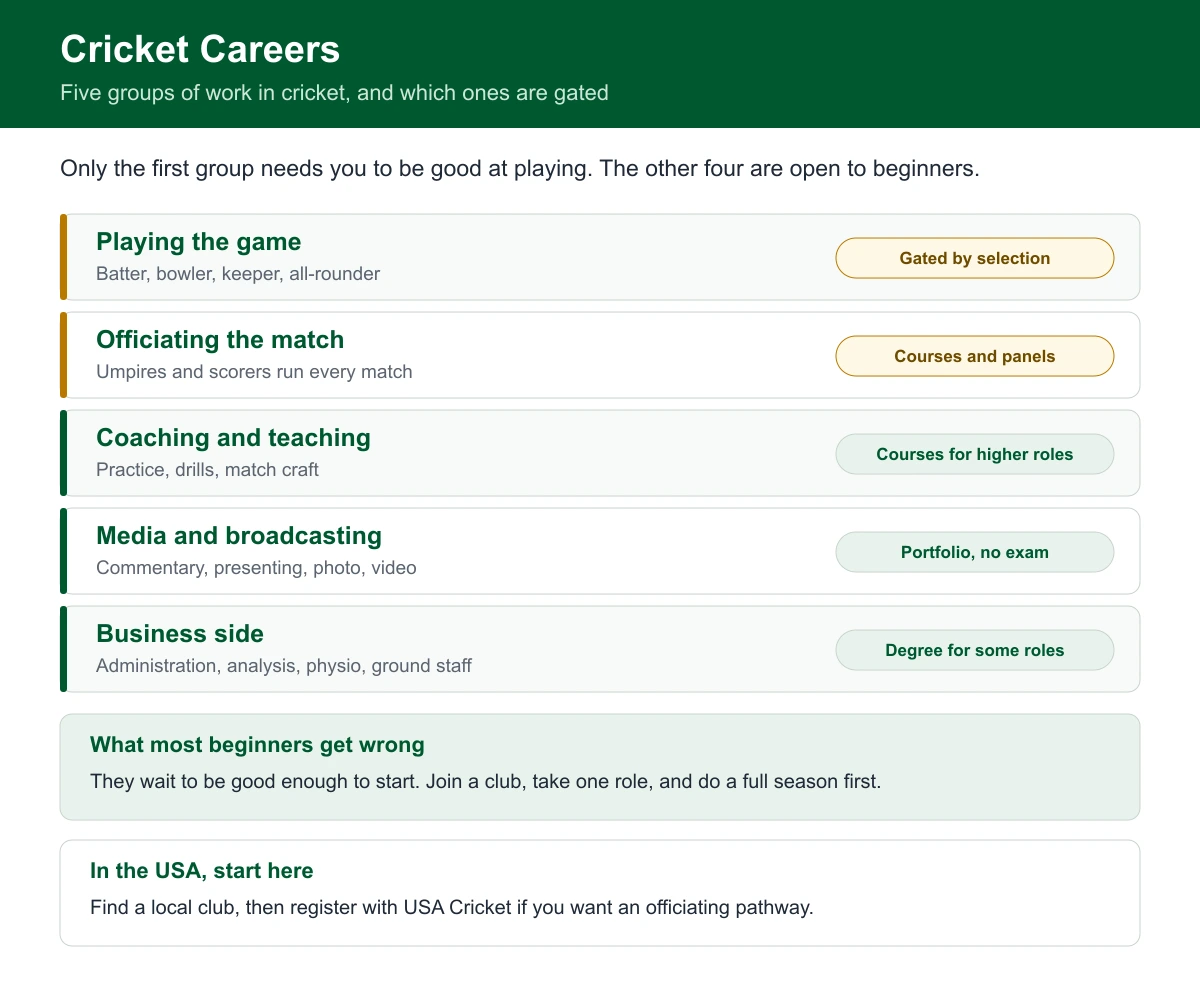
Cricket careers fall into five groups: playing the game, officiating matches, coaching and teaching, working in media, and running the business side of the sport. Most of these do not require you to be a professional player, and a beginner in the USA can usually start by joining a local club, registering with USA Cricket, or volunteering at a tournament.
Cricket Careers Beyond Playing the Game
The phrase cricket career makes most people picture a player. That picture is incomplete, and it discourages people who would be excellent at the sport but never at international level.
Here is the full map, grouped by what the job actually involves.
Playing the game
This is the visible career: batter, bowler, wicketkeeper, and all-rounder. It is also the path with the fewest openings and the longest odds. Only a small number of players are paid, and they are paid by national boards, franchise leagues, and a handful of major domestic competitions.
Officiating the match
Umpires and scorers run the match alongside the players. Every match needs them, at every level, and this is where the sport has a genuine shortage of people willing to do the job. It is the most reliable route into a cricket career for someone who loves the game and wants to be paid per match.
Coaching and teaching
Coaches work with players at every age and skill level. In the USA the biggest demand is not for elite academy coaches but for people who can run a good practice for a group of ten-year-olds on a Saturday morning. That is a real job, and it is often the first one a cricket fan can get paid for.
Media and broadcasting
Commentators, presenters, journalists, photographers, and video producers cover the sport. Most of this work is portfolio-based, which means what you can show matters more than a certificate.
The business side
Tournament administrators, league managers, scorers, statisticians, grounds staff, pitch curators, equipment sellers, and physios all earn a living from cricket. None of this is on television, and much of it is stable work.
What an Umpire Actually Does
Umpiring is the career most beginners have never heard of, so it is worth describing properly.
Before a match, two umpires are appointed, one for each end. Their job is to control the match under the Laws with what the Laws call absolute impartiality. They must be on the ground and report to the ground executive at least 45 minutes before the scheduled start of each day’s play.
Before the toss, the umpires meet both captains and agree the practical details: which balls will be used, the hours of play and the interval times, which clock will be used, where the boundary is and what the boundary allowances are, whether covers will be used, and any special conditions for the match.
They also check the physical setup. The umpires make sure the wickets are properly pitched, the creases are correctly marked, and the boundary meets the requirements of the Laws. They confirm that the bats, pads, helmets, and wicketkeeper gloves all comply, and that nobody is using equipment that is not permitted.
Once play starts, the umpires stand where they can best see any act that might need a decision. The umpire at the bowler’s end has to avoid interfering with the bowler’s run-up or blocking the batter’s view. The two umpires change ends after each side has completed one innings.
The four powers that define the job
These are the parts of umpiring that beginners find most surprising.
- They are the sole judges of fair and unfair play. The Laws state this directly. No player, captain, or spectator has a vote.
- They alone decide whether play is safe. If conditions of ground, weather, or light are dangerous or unreasonable, the umpires must suspend play immediately.
- They settle disagreements. Where there is any disagreement or dispute, the two umpires together make the final decision.
- Their decision is final. An umpire may change a decision, but only promptly, and once a decision stands it cannot be reopened on the field.
The signals are fixed
Every decision has a set signal, and the umpire must wait for each scorer to acknowledge it before play continues. Out is one index finger raised above the head. No ball is one arm extended horizontally. Wide is both arms extended horizontally. A boundary four is an arm waved side to side. A boundary six is both arms above the head. There are separate signals for a bye, a leg bye, a new ball, a short run, penalty runs, and revoking a decision.
You can learn all of it. It is a fixed code, not a matter of opinion, which is part of why umpiring rewards people who study.
Coaching and Teaching Careers
Coaching is the path with the clearest ladder in the sport, and the ladder is real rather than marketing.
The International Cricket Council runs an official Training and Education programme, launched in 2021, that builds certified pathways for coaches, umpires, scorers, and pitch curators. It includes an ICC Coach Tutor Course at Levels 1 and 2, a foundation course aimed at teachers, parents, and community leaders who want to run fun and inclusive cricket sessions for beginners, and the ICC Global Master Educators Programme. You can read the ICC Training and Education programme for the current course list.
For beginners in the USA, the honest starting point is smaller. Help at a local club. Run a nets session. Learn to drill the basics properly, because a beginner who learns a bad habit is hard to coach later. The formal courses matter when you want to move into academy or high-performance work, but the first step is turning up and teaching.
How to Become an Umpire in the USA
The USA runs its own official umpiring pathway, and the detail matters because the route is specific to the country rather than a generic version of the international one.
USA Cricket took full ownership of umpiring support across the country after its Foundational Plan for 2020 to 2023 identified a need to increase participation and set out to design and deliver a pathway, education materials, and certification for all match officials. The Umpiring Program and Pathway that followed covers everything from grassroots umpiring up to international level, and it also set up an umpire registration and categorisation process, match appointment guidelines, and performance monitoring.
Two panels sit at the top. The USA Cricket Umpires Development Panel is drawn from umpires who have certified at Level 2. The USA Cricket Umpires Elite Panel is the highest level of umpiring inside the country, drawn from umpires who have passed Level 3, and appointments to it are by invitation only.
The courses themselves run in this order, and each one has a minimum age:
- Introductory course. No minimum age. It covers rookie leagues and modified junior formats.
- Level 1: Umpiring Fundamentals. Minimum age 13. It covers local junior, youth, and recreational adult league cricket, and it is assessed with an online examination where 80 percent is the pass mark.
- Level 2: Umpiring Performance. Minimum age 18, and you must have passed Level 1 first. It prepares you for local competitive youth and adult league cricket, and it is assessed with an oral and written examination.
- Level 3: Umpiring Advanced. Minimum age 18, and you need Level 2 plus at least one year of officiating and a minimum of 15 matches. It is assessed by written examination and practical assessment, and the resulting qualification is valid for three years.
- International panels. Above Level 3 sit the ICC development umpire panels.
Six experienced volunteer umpire coordinators, one for each zone of the country, act as the first point of contact for anyone who wants to get involved. The stated first step is to register as an official member umpire of USA Cricket, and you do not need existing umpire certification to begin, because training and resources are provided to members.
One practical note if you are in the USA now. USA Cricket has been running in-person Level 1 coaching and umpiring workshops, and the process is specific: you must be a current member, you register through the USA Cricket membership portal, and the ICC Level 1 online module has to be completed before you attend the in-person workshop. That structure is a real barrier for beginners who were expecting to walk into a course, so it is worth knowing about it in advance.
Media and Commentary Careers
This is the path where people assume there must be a formal exam. There is not.
No cricket board runs a commentary examination, and commentary does not appear on the ICC’s list of certified pathways, which cover umpiring, coaching, and educator programmes instead. What gets you hired is a demonstration that you can do the job, and the demonstration is a reel of recorded commentary.
A practical route looks like this:
- Watch a match with the sound off and record yourself calling the action. Do whole sessions, not highlights.
- Play the recording back and note where you ran out of things to say, where you rushed, and where your description was wrong.
- Commentate a real local match, even a small one. Live crowd noise and genuine uncertainty are different from a television broadcast.
- Publish your best clips as short reels so organisers can find you.
- Offer to commentate local tournaments, often free at first, and keep every recording.
You do not need a playing background. You do need to know the Laws well enough to explain what happened, and you need to be able to speak while the match is moving. A journalism or sport studies degree helps but is not required.
Important
In cricket the match official is called an umpire, not a referee. The name matters when you go looking for training, because a search for cricket referee courses will send you in the wrong direction. The Laws also make the umpire’s authority unusually clear. Two umpires are appointed before a match, they stand where they can best see any act that may need a decision, and the umpires are the sole judges of fair and unfair play. Once a decision is made it is final. A cricket match is not officiated by a referee at any level.
What Each Path Requires
The single most useful thing a beginner can learn is which paths are gated and which are not. Gated means a course, exam, or degree stands between you and the work.
| Career path | What you do | Where to start | Formal qualification? |
|---|---|---|---|
| Professional player | Bat, bowl, field and keep wicket | Club and district cricket, then selection by a state or national board | No exam, but selection decides everything |
| Umpire | Apply the Laws and control the match | Register with USA Cricket, contact your zonal coordinator, then take the umpiring courses | Yes, courses and panel assessments |
| Scorer | Keep the official ball-by-ball record and the score | Score local matches and learn the umpire’s signals | Often a short board course |
| Coach | Teach technique, fitness, and match craft | Help at a club, then an ICC or board coaching course | Yes, for academy and higher roles |
| Commentator | Call the match live for broadcast or streams | Record practice reels, then commentate local games | No, there is no commentary exam |
| Statistician or analyst | Turn match data and video into useful information | Learn spreadsheets and video tagging, then build a public portfolio | Usually self-taught or a short course |
| Photographer or videographer | Capture matches for teams, media, and supporters | Shoot local games, publish the work, take referrals | No |
| Physiotherapist | Treat injuries and rebuild players for competition | A physiotherapy degree, then sports specialisation | Yes, a degree is required |
| Pitch curator or grounds staff | Prepare and maintain the playing surface | Volunteer with a club or ground, then take board courses | Board courses exist |
| Tournament administrator | Run fixtures, entries, venues, and volunteers | Volunteer with a league or a state association | No |
Two patterns stand out. The roles that pay per match, such as umpiring and scoring, are the ones where a beginner can earn something within a season. The roles that pay best, such as physiotherapy and elite analysis, are the ones that need study first.
How to Choose the Right Path for You
Three questions narrow it down faster than any amount of reading.
- Do you want to be on the ground on match day? If yes, umpiring, scoring, coaching, and administration all put you there. Media does not.
- Do you want your work judged on a result, or on quality? Playing is judged on results. Commentary, photography, and analysis are judged on the work itself.
- Can you commit to a season before you see money? Almost every path asks for a season of unpaid or lightly paid work before it becomes reliable. If that season is not possible right now, volunteering is still the correct first step rather than a compromise.
One honest warning. Almost nobody starts at the top. The common route is one role, one season, and then a move up using the record of that season. People who switch roles every month never build the record that makes the next step possible.
How to Begin in the USA
Here is the order that works for most newcomers.
- Find a club and watch a match. Go before you commit to anything. The atmosphere is the best recruiting tool the sport has.
- Join a local league. This is the step most beginners overthink. Our guide to how to join a cricket team in the USA covers how leagues are structured and what to bring.
- Pick one path and commit to a season. One path, not three.
- Register with USA Cricket. This is required for officiating pathways and it connects you to the people who appoint officials.
- Do the unglamorous work. Keep the scorecard, keep the clips, keep the record of your own hours.
- Ask for the next level. Nobody promotes you. You ask.
If you are still deciding which direction suits you, our guide to cricket teams and roles explains how a side is organised and what each position involves, which is the same question asked at a different level.
Frequently Asked Questions
Do I need to be a good player to work in cricket?
No. Umpiring, scoring, coaching at junior level, commentary, photography, analysis, and tournament administration are all judged on something other than a playing record. Playing experience helps your credibility, but it is not the entry requirement for any of them.
What is the easiest cricket career to start in the USA?
Umpiring and scoring, because every match needs both and both are paid per match day. The barrier is not skill, it is willingness to learn the Laws and the signals carefully and to turn up for games that are not glamorous.
Do I need a degree to work in cricket?
It depends on the role. Umpiring, scoring, coaching at community level, commentary, photography, and tournament administration need courses or a portfolio rather than a degree. Physiotherapy, strength and conditioning, and sports analysis need formal academic study.
Is there a qualification to become a cricket commentator?
No. No cricket board runs a commentary exam, and commentary is not on the ICC’s certified course list. Broadcasters hire on demonstrated ability, so a recorded reel of your commentary is the qualification that matters.
How long does it take to reach a professional cricket career?
For playing, it is measured in years and most players never get there. For umpiring, scoring, coaching, and media, a single committed season of local work is usually enough to move up one level. The honest pattern is one role, one season, then a move using the record of that season.
Start Where the Cricket Is
No cricket career begins at a national camp. They begin at a ground near home, with a club that needs someone to score, umpire, coach, or record the match. Pick the path that fits your week, do one season of it honestly, and keep the record. That is how every one of these roles gets filled.
Read More: Major League Cricket Explained
