




Most people picture cricket as a game you either were born into or were not good enough for. Both ideas are wrong. Cricket is one of the easier sports to start late in, because the skills that matter most in a club match are learnable and the sport is forgiving of beginners in a way that, say, football or basketball is not.
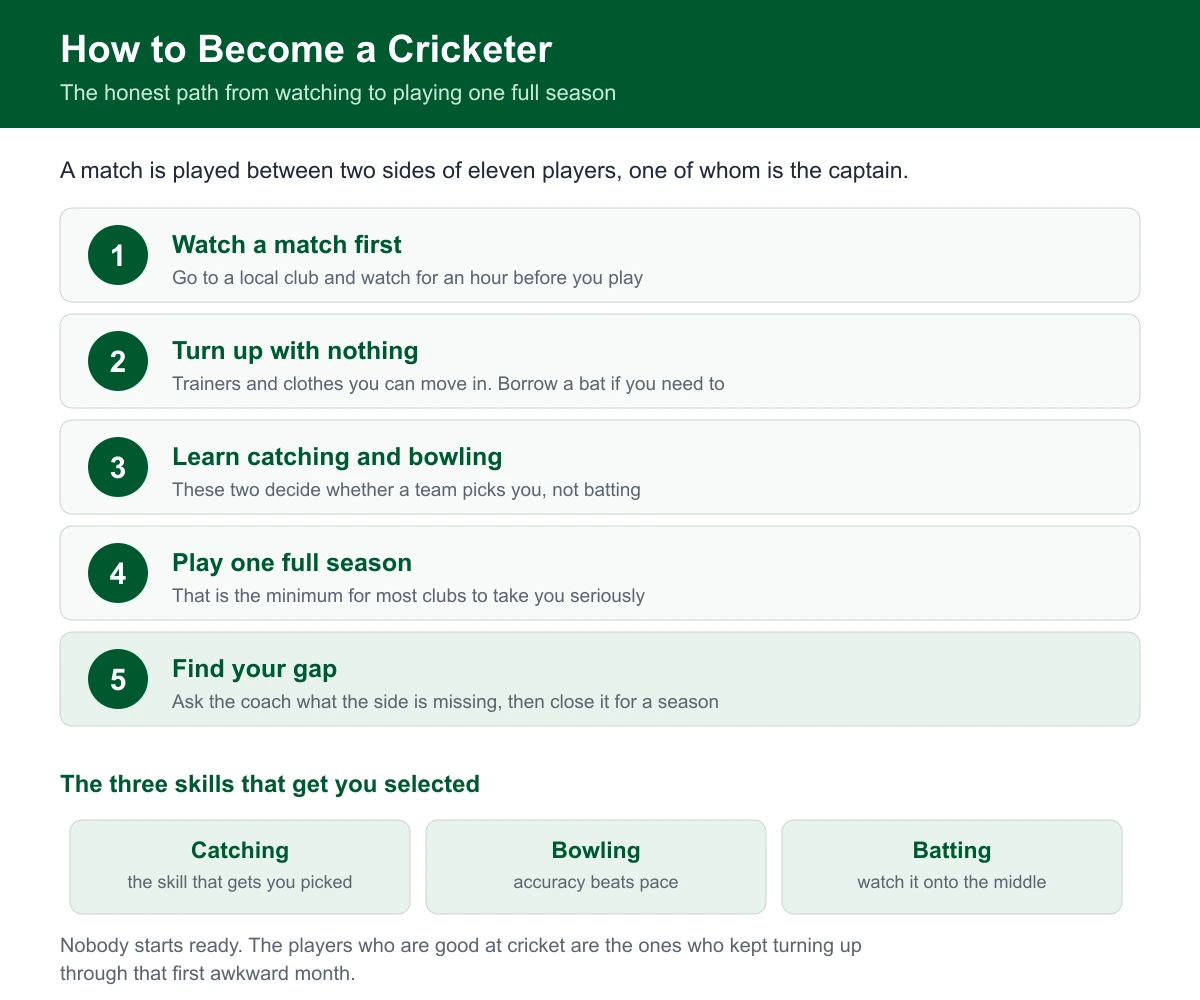
The rule that catches new players is the one nobody tells you about. A match is played between two sides of eleven players, one of whom is the captain, and by agreement it can be played with fewer or more than eleven, but no more than eleven players may field at any time. That single rule shapes everything below, from a side of nine in a park match to a full eleven in a league final. If the scoring, the equipment, or the basic terms are still unfamiliar, our cricket basics and rules guide covers them first.
Quick Answer
You become a cricketer by joining a local club or league, playing a full season, and being selected for a team that needs your particular skill. A match is played between two sides of eleven players, one of whom is the captain, though sides of fewer or more than eleven are allowed by agreement as long as no more than eleven field at any time.
What You Actually Need to Start
Less than most people expect. For your first few sessions you need very little, and this is the most common reason people give up before they start.
- Clothing you can move in. Trainers, jeans, shorts, whatever you would wear to the gym. Nobody will judge you.
- A cricket bat, if your club has not got spares. Most beginner sessions and leagues lend bats, and many clubs keep a rack of them for exactly this purpose. Ask before you buy.
- A soft ball or a tape ball for the first weeks. These are the low-speed balls used for junior and beginner cricket, and they make catching possible for people who have never caught anything.
- Pads, gloves and a helmet, but not for week one. These are for batting and are not needed while you are fielding or learning to bowl. Buy pads and gloves when you start batting regularly, and a helmet any time you face a hard ball.
You do need the right safety equipment, and the law is specific about it. Under the Laws, the umpires must satisfy themselves that the implements used in the match conform to the requirements, that no player uses equipment other than that which is permitted, and that the wicketkeeper’s gloves comply with the rules set out for gloves. In plain terms: the bat, the ball, the stumps and bails, and the wicketkeeper’s gloves all have to meet the specification, and you cannot turn up in random protective gear. The Laws of Cricket set out the full list.
The Three Skills That Actually Get You Selected
Newcomers often work hardest on the thing that matters least. Batting stroke technique is fun to practise, and it is the third most important thing on this list.
Catching and fielding
This is the skill that decides whether a team picks you, and it is the easiest to improve. Two hands on the ball, eyes on it until it hits your hands, and a soft pair of hands. A cricket ball is small and it is coming at you, so catching is genuinely harder than it looks from the boundary.
The single best drill for a beginner is the high catch. Someone throws straight up in the air and slightly toward you, and you catch it with two hands above your head. Ten minutes of that once a week will improve your hands more than an hour of shadow swinging.
Bowling
Cricket rewards accuracy far more than pace. A bowler who puts the ball on the same spot six times is far more useful than one who is fast and does not know where it is going.
Start with a medium or off-spin. It is slower than a fast ball, which helps the batter, but it does not swing or bounce as much, which helps you. Throw, do not bowl, and remember that a flat, side-on release is hard to control. Land on your front foot and follow through toward the batter.
Batting
Nobody expects a club trial to be won with a cover drive. What coaches actually look at is whether you can defend, and whether you can hit the ball out of the middle when it arrives.
Start by standing still and watching the ball all the way onto the bat. Most beginner batting problems are actually seeing problems. If you are missing the ball because you are playing a shot you saw in a video, play the ball that is actually there. Which skills to work on first, and which can wait, is covered in our cricket skills guide.
How Selections Actually Work
There is no mystery to it, and no back door. Here is the formal part first, because it surprises people.
Under the Laws, each captain nominates their players in writing to one of the umpires before the toss, and no player may be replaced after the nomination without the consent of the opposing captain. A replacement is considered the same player as the nominated player they replaced for the purposes of the Laws, a replacement may not bat in an innings in which the player they replaced has already batted, and any unserved penalty time, warnings, or suspensions that applied to the original player carry over to the replacement. The captains are responsible at all times for ensuring that play is conducted within the Spirit of Cricket as well as within the Laws.
That is the framework. In practice, at club level, selection usually happens through one of four routes.
- You walk into a club and join the squad. The most common route in the USA. Recre leagues are often mixed-experience and forgiving, so this is the realistic starting point for a total beginner.
- You play a season, then a team that needs a specific player selects you. A side that already has four openers does not need a fifth, so the opening that exists is usually a gap: a wicketkeeper, a left-handed batter, a genuine fast bowler, or someone who can bowl.
- You go to an open trial or a showcase. Common for youth leagues and for academy pathways. Bring your own gear, arrive early, and treat it as a first impression rather than an audition.
- You are asked in. Coaches watch players, not applications. If nobody has asked you, nobody has actually watched you yet.
Pick the role that is missing rather than the role that sounds best. If you are the only person in your club who can keep wicket, you will play. If you are the fifteenth batter, you may not.
If you want the wider picture first, our cricket careers guide sets out which jobs in the sport are open to beginners and which ones are not, and playing is only one of them.
How Long It Takes to Become a Real Player
Be honest with yourself about the timescale, because this is where most people quit.
- First month: You cannot catch cleanly, your bowling goes wherever, and you have no idea what an over is. This is normal and everyone starts here.
- Three to six months: Regular play fixes catching. You start to bowl a few overs without thinking about it. Batting is still inconsistent, and that is fine.
- One full season: You are a useful member of a team. This is the point where coaches start asking you back rather than reminding you.
- Two to three seasons: You have a defined role and you are picked on merit.
- Beyond that: How far you go depends on talent, coaching, and opportunity, and nobody can promise you the last part.
One warning. Progress in cricket is not linear and it is not weekly. You will go four weeks feeling like you have improved, then lose a wicket in a way that makes you doubt the whole thing. That plateau is where almost everyone who ever played club cricket spent their first season.
Important
A cricket team is not eleven of the best players available, it is eleven nominated players, and the nomination is a legal act done in writing to an umpire before the toss. This is why a player who is dropped or injured cannot simply be swapped for whoever happens to be watching. No player may be replaced after the nomination without the consent of the opposing captain, and the replacement inherits everything the original player was carrying, including unserved penalty time and suspensions. If you are new, you do not need to know this to play, but it explains why coaches care so much about availability and behaviour.
How to Find a Club in the USA
This is the only part that is genuinely different about starting cricket in America, and the good news is that the pathway is short.
Cricket in the USA runs through local clubs, regional leagues, and then state associations and the national body. You do not need a national body to start playing. You need a club within driving distance, and almost every urban area with a South Asian community has at least one. If you have no idea where to start, the last line of this guide covers exactly how to find a team.
A workable plan looks like this.
- Find a club near you and go and watch a match. Watching costs nothing and tells you more in an hour than a month of searching online.
- Ask what they need. Every club is short of something. Scorers, umpires, and people to run drills are often needed more than players.
- Turn up with nothing. Do not buy a full kit before your first session. Borrow, rent, or use what the club has.
- Play a full season before you judge it. One season is the minimum for most clubs to take you seriously.
- Ask your coach what gap you fill. Then go and close it deliberately for a season.
Frequently Asked Questions
Can I start playing cricket as an adult with no experience?
Yes, and most club cricket in the USA is made up of adults who did not start young. The skills that matter most, catching and bowling accuracy, are learnable by anyone who can commit to a regular practice. Age slows down nothing in a club match except your recovery.
How many players does a cricket team need?
A match is played between two sides, each of eleven players, one of whom is the captain. By agreement a match may be played between sides of fewer or more than eleven players, but no more than eleven players may field at any time. Many park and beginner matches use nine or ten per side for exactly this reason.
Do I need to be naturally athletic to play cricket?
No. Cricket rewards hand-eye coordination, timing, and accuracy more than raw power or speed. A slow bowler who can land the ball on the same spot is genuinely valuable, and a batter who watches the ball onto the middle of the bat scores more than a powerful hitter who swings early.
What equipment should I buy first?
Almost nothing. Start with clothes you can move in and a ball your club provides. Ask before buying a bat, because most beginner setups lend bats out. Buy pads and gloves once you are batting regularly, and a helmet any time you face a hard ball. The umpires are required to check that all equipment meets the Laws, so badly fitted or non-compliant gear is a real problem, not a detail.
How long does it take to get good at cricket?
One full season makes you a useful club player, and two to three seasons usually gives you a defined role. Reaching a high standard takes far longer and depends on coaching and opportunity as much as effort. Expect four to six weeks of visible progress, then a plateau that lasts most of your first season.
Start With One Season
Nobody becomes a cricketer by reading about it. Find a club, turn up for a session with nothing, and accept that the first month will be awkward. The people who are good at cricket two years from now are almost all the people who kept turning up through that awkward month, and the ones who quit were mostly the ones who waited until they felt ready.
Read More: How to Join a Cricket Team in the USA
