




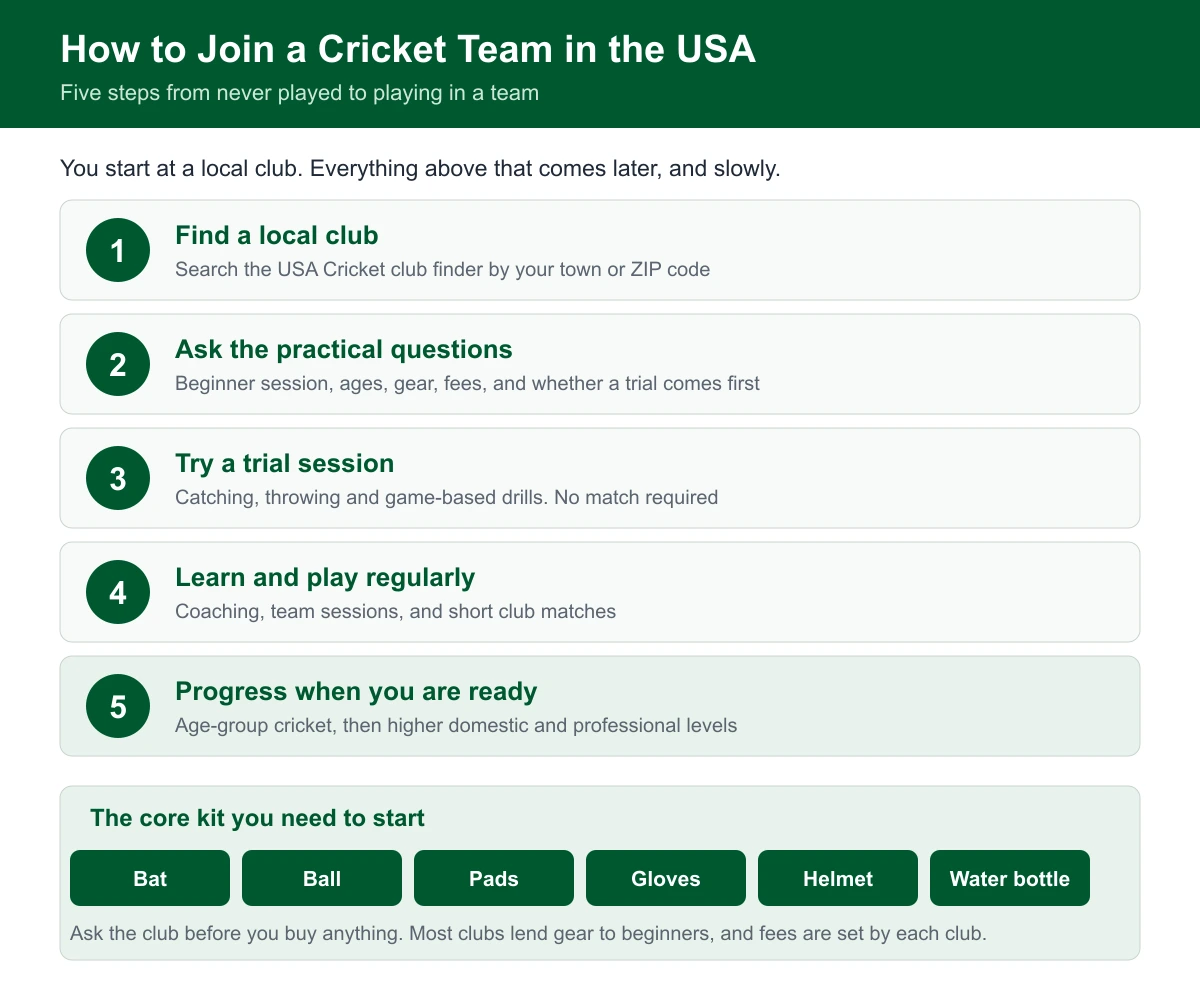
Joining a cricket team in the USA is easier than most newcomers expect. You do not have to be selected, you do not need years of experience, and you do not need to travel far. Cricket in America is organised from the local club upward, and the club is where almost everybody starts.
If you have only just picked up the sport, it helps to be comfortable with a few basics first, so our cricket basics and rules guide covers the terms you will hear in your first few weeks at a club.
Quick Answer
The fastest way to join a cricket team in the USA is to find a local club and ask whether you can come to a trial session. USA Cricket, the national governing body for the sport, runs a club finder so you can search near you. Young children usually start in game-based skills programs before moving into age-group and league cricket.
Find a Cricket Club Near You First
Almost every cricketer in the United States joined through a club rather than by applying to a national body. A club is a group of players who meet to train and then play matches against other clubs. It is the entry point to the whole sport.
USA Cricket has set up regional zones for the purpose of administering local cricket, from grassroots through to high performance. That work happens in states and regions, not at one national office, which is why a club in your own city is the right first stop.
The fastest way to find one is the USA Cricket club finder. Search with your town or ZIP code, then contact the clubs that come up.
If the club finder comes up empty, cricket in the USA also runs through a few other places. USA Cricket’s entry level program for children is designed to run in schools, recreation centers, community groups, cricket clubs and academies, so a school, a park district, or a community organization can all be a way in. A college or university team is another route if you are a student.
Questions to Ask Before You Turn Up
Most clubs are happy to hear from a complete beginner. The email that gets a reply is the one that asks practical questions rather than “do you take new players”. Here is what to ask.
| Ask this | Why it matters |
|---|---|
| Do you have a beginner or novice session? | These are sessions built for people who have never played. Not every club runs one, so it is worth asking early. |
| What ages do you take? | Each club sets its own age bands, and they are not all the same across the country. |
| Do I need my own equipment to start? | This single answer saves you from buying a full kit on day one. Many clubs loan or share kit for beginners. |
| When and where do you train and play? | Cricket in America is often played on public fields, so you need to know the ground and the time. |
| What are the fees, and is it per season? | Fees are set by each club, not by USA Cricket, so the number you are quoted is the only one that counts. |
| Do you need a trial before joining? | Many clubs want you to come along once first. That is normal and is not a selection test. |
The Gear You Actually Need to Start
Beginners are often worried about equipment. The good news is that you can usually start with very little, and the first session is often played with gear the club has on hand.
The core items in cricket are a bat, a ball, batting pads, batting gloves and a helmet. A water bottle and clothing you can move in complete the list. That is the whole kit, and a club can tell you which of it they already have.
One item is not worth skipping. The helmet protects your head, and a blow to the head is the injury that ends a season. If you do not have one, ask the club before your first session rather than playing without it.
On the bat, take the club’s advice before you buy. A bat is the most personal and usually the most expensive item in the kit, and a shop will happily sell you the wrong one. The same goes for gloves and pads, which have to fit your hands and your legs properly to do any good.
For the wider picture on equipment, what a club night looks like, and why kit means more than just equipment, read our guide to cricket culture and gear.
What to Expect at a Trial Session
Your first session is less dramatic than people imagine. Nobody is asked to bat in a match straight away.
A typical beginner session starts with a warm up, then catching and throwing drills, then a short piece of game-based work. Fielding comes before batting, because catching is the skill every player needs and it is the easiest place for a newcomer to succeed on day one.
You do not need to know the Laws in detail to turn up. You will learn the parts of the rules that apply to what you are doing, and you will pick up the rest by playing.
Two practical notes. First, expect to spend your first few weeks in the field rather than at the crease. Second, local club and youth matches are often short, so a small game is not a sign that something is wrong.
Important
USA Cricket sets up national programs and regional zones, but individual clubs set their own age bands, fees, schedules and game lengths. Those details change, and they differ from one club to the next. Treat the program information below as the current national structure, and confirm anything local with the club itself.
What USA Cricket Runs for Young Players
USA Cricket describes its Rookie League as the national entry level program, aimed at inspiring the next generation of cricketers across the United States. The Rookie Skills part of it is designed for children aged 5 to 8, and it is game-based, so that children build skills while having fun rather than sitting through technical drills.
That program is meant to run in the places children already are: schools, recreation centers, community groups, cricket clubs and academies. So a parent looking for a first team may well find one through a school rather than a cricket club.
Above that entry level, USA Cricket has said that it has established its regional zones to administer local cricket from grassroots through to high performance, and that programs and services will be developed from the under 13 age groups upward for both women and men.
That leaves a simple and honest picture for a parent. Entry level is game-based skills for the youngest children. Age-group and league cricket is run by clubs, and the national body supports it from the under 13 groups upward. The ages in between, roughly 9 to 12, are mostly covered by clubs and local leagues rather than by a single national program.
Where the Pathway Can Lead
The top professional level in the United States is Major League Cricket. If you want to know what that competition looks like and how the format works, our page explains what Major League Cricket is.
USA Cricket also runs a player registration process for people who are interested in playing at a high level in the USA. Their stated process is that you register your interest, they assess your standard and suitability, and they then pass on information about appropriate playing opportunities, which can include Minor League Cricket and, in due course, Major League Cricket.
The point worth holding onto is where that process starts. It does not start at a national registration form. It starts at a local club, and the registration route exists for the small number of players who have already climbed that far.
Common Worries New Players Have
I am too old to start. Adults who have never played join beginner sessions alongside children, and the gap in experience is usually the smallest thing about the session. Age matters far less than people assume.
I have never batted in my life. You will not be asked to. The first sessions are catching, throwing and game-based work, which is where everyone actually learns.
It is going to be expensive. Do not buy a full kit before your first session. Ask the club what they can lend you, and buy only what you cannot borrow. The club’s own answer is the only reliable one, because fees vary by club and by season.
I do not know anybody. Everyone arrives knowing nobody. A beginner session is designed for people who walk in on their own.
I come from a country where cricket is huge. If you have played before anywhere in the world, you are ahead of most people in the room rather than behind them.
Frequently Asked Questions
Do I need experience to join a cricket team in the USA?
No. Beginner and novice sessions are specifically built for people who have never played. The first sessions focus on catching, throwing and basic drills.
How old does my child have to be to join?
There is no single answer because each club sets its own age bands. USA Cricket runs game-based skills entry for younger children and supports age-group development from the under 13 groups upward. Ask the club near you what ages they take.
How much does it cost to join a cricket team in the USA?
Fees are set by each individual club rather than by USA Cricket, so they vary. Ask the club directly, and ask whether they loan or share equipment for beginners before you buy anything.
Where can I find a cricket club near me?
Use the USA Cricket club finder, which searches by location, and then contact the clubs listed. Schools, recreation centers and community groups are also worth asking, especially for younger children.
Can adults join a cricket team in the USA?
Yes. Adult club cricket is a normal part of the structure, and plenty of people join as complete beginners with no experience. Age bands at a club are usually the only real limit.
Conclusion
Joining cricket in the USA comes down to one first step and then a series of small ones. Find a club near you, ask whether you can come to a trial, and find out what gear the club already has. From there it is ordinary coaching, ordinary team sessions, and eventually an ordinary match day. Ask before you buy, and expect to spend your first weeks in the field catching the ball. That is where everybody starts.
Read More: our guide to the cricket competitions a club team will play in
