




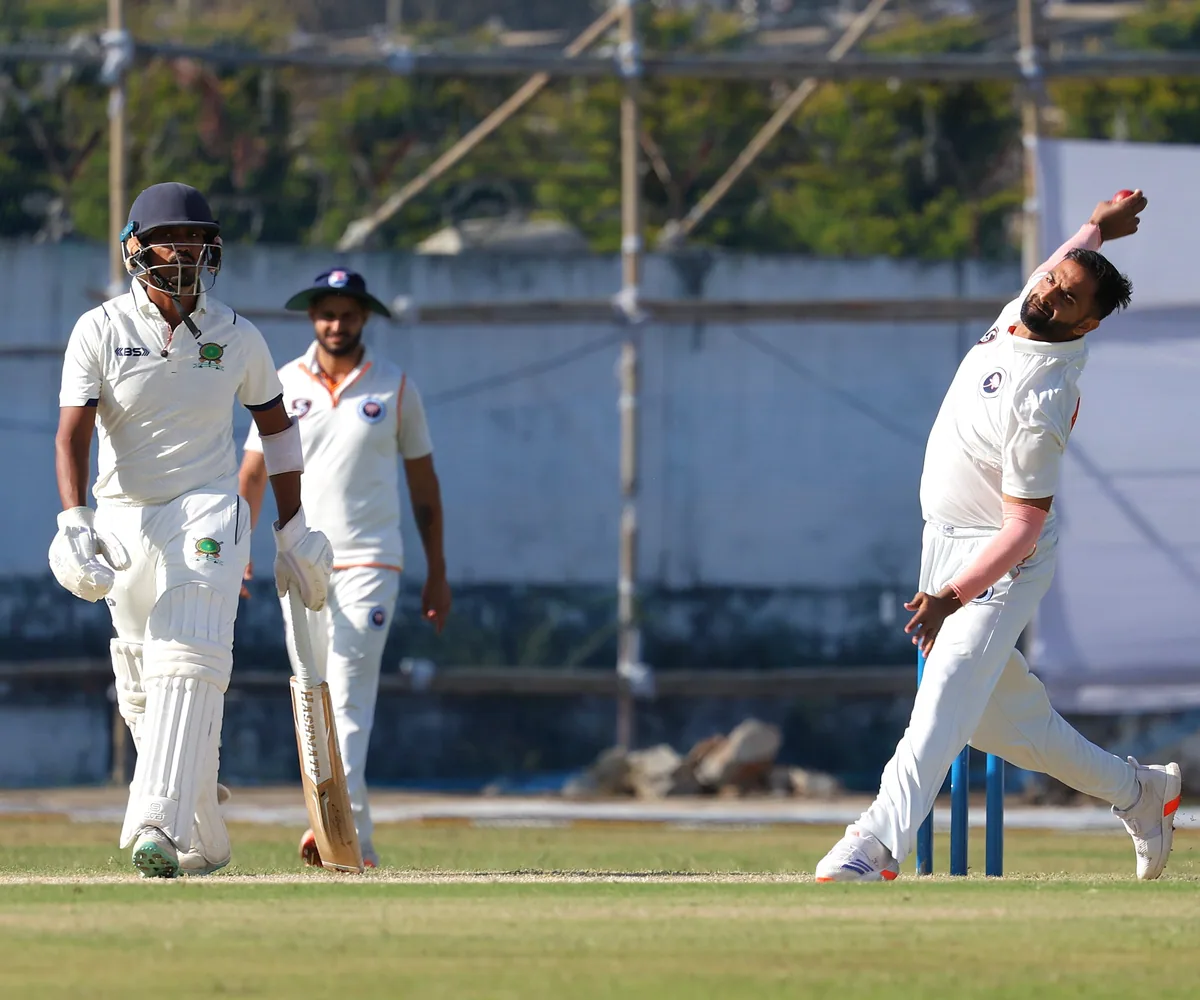
Auqib Nabi is 30 years old, bowls right-arm medium pace, and is playing his first cricket series in New Zealand. He is also one of the few players in this squad with something personal to prove. The 2027 World Cup is less than a year away, and India’s selectors are watching closely.
If you are new to cricket, the name may mean nothing yet. Nabi has played a handful of one-day internationals, and his best-known performance so far is a difficult debut rather than a match-winning spell. This CricketFocus profile explains who he is, why he is in the news this week, and what he said about the hardest part of bowling in New Zealand.
Quick Answer
Auqib Nabi is a 30-year-old right-arm medium-pace bowler from Jammu and Kashmir who made his India ODI debut against West Indies on 30 September 2026. He is with India’s squad for the five-match ODI series in New Zealand and took two wickets in the second ODI in Wellington.
Who Is Auqib Nabi?
Nabi is a medium-pace bowler who relies on movement off the pitch rather than raw speed. The ICC lists him as a right-arm medium bowler, and he bats right-handed. He was born on 4 November 1996, which made him 30 during this New Zealand tour.
He plays domestic cricket for Jammu and Kashmir. He has also been part of India A, the Delhi Capitals squad in the Indian Premier League, and Surrey in English county cricket. For a player who only turned 30 in November 2026, that is a long apprenticeship.
He is the third cricketer from Jammu and Kashmir to play international cricket for India, after Parvez Rasool and Umran Malik. That detail matters more than it sounds. Jammu and Kashmir is not one of India’s traditional cricket powerhouses, so a player from there reaching the national team is a genuine breakthrough for the region.
The Ranji Trophy title that changed his career
Jammu and Kashmir won their first Ranji Trophy title in February 2026, and Nabi was central to it. The final against Karnataka in Hubli finished as a draw, and Jammu and Kashmir won on first-innings lead after scoring 584. The BCCI match record for that final is listed on the official board website.
Indian media reported that Nabi finished that Ranji Trophy season with 60 wickets and was named Player of the Tournament. That domestic season is the reason he was picked for India, and he has said so himself.
A tough first day in international cricket
Nabi made his ODI debut on 30 September 2026 in the second ODI against West Indies in Guwahati. West Indies scored 405 for 7, their first total above 400 in one-day internationals, and Nabi conceded 84 runs in 8.5 overs.
That is an expensive debut, and it is worth saying plainly rather than hiding it. One bad day against a batting side in that mood does not decide a career. It does explain why his international record is still thin, and why this New Zealand series matters to him.
Why Is Auqib Nabi in the News This Week?
Nabi spoke to the ICC on 12 November 2026, the day before the fourth ODI at Mount Maunganui. India lead the five-match series 2-0 after wins in Auckland and Wellington and an abandoned match in Hamilton. The interview focused on adapting to New Zealand conditions and on the chance this series gives newer players.
His opportunity came partly through injury. India’s initial squad included Prasidh Krishna. The ICC confirmed on 30 October 2026 that Krishna was ruled out of the whole series after failing to secure a fitness clearance following a hamstring injury. That opened a fast-bowling place, and Nabi is one of the players using it.
What Did Nabi Say About Bowling in New Zealand?
His main point was about movement, not speed. “This is my first time bowling in New Zealand,” he told the ICC in an interview published on 12 November. “It is a little different here. Here, you have to depend more on the seam movement.”
He then explained what works for him. “If you bowl scramble seam or hit the deck here, there is a chance to get more here.”
Scramble seam means releasing the ball so the seam wobbles instead of landing upright. A wobbling seam makes the ball’s behaviour less predictable for the batter, and on helpful pitches it can produce edges and uneven bounce. Hitting the deck means bowling a length that forces the ball into the pitch so it reacts off the surface. Both are control skills rather than power skills.
Nabi was also clear that he is not trying to become a different bowler. “If you have the pace, it’s very good. My skills, I back that. I have done well. Here, I have come based on skill,” he said. “Obviously, if there is pace, it is a plus factor. But I also back my skill. What I did well in domestic cricket will be useful here as well.”
Why Seam Movement Matters in New Zealand
New Zealand is one of the friendliest places in the world for a bowler who can move the ball off the pitch. Pitches there usually carry more grass than in India, the air is often heavy, and the wind at grounds like Wellington’s Basin Reserve and Auckland’s Eden Park gives the ball something to work with.
Seam movement is different from swing. Swing happens in the air. Seam movement happens after the ball pitches, when it deviates because the seam or the surface grabs it. A bowler who can land the ball on the seam consistently is therefore more dangerous in New Zealand than a bowler who only relies on pace.
That is exactly why Nabi’s comments are worth reading. He is not saying he will overpower batters. He is saying the conditions reward what he already does well, and you can read more about the basics in this guide to pace bowling for beginners.
How Has He Bowled in This Series?
His clearest contribution came in the second ODI in Wellington, where he took two wickets. India won that match by four runs under the Duckworth-Lewis-Stern method after rain interrupted the chase, so his wickets came in a tight game that India had to fight for.
The third ODI in Hamilton on 10 November was abandoned without a ball bowled, which cost every bowler in both squads a chance to press a claim. That leaves the last two matches at Bay Oval as the remaining audition before the selectors move on to other formats and other squads.
What Is at Stake: The 2027 World Cup
Nabi was direct about the bigger picture. “It is a good opportunity for all the newcomers to show their talent and make their case for the World Cup,” he said.
That World Cup is the 2027 men’s tournament, a 14-team event hosted by South Africa and Zimbabwe. India have already qualified through the ICC ODI rankings at the 30 September 2026 cut-off, along with Afghanistan, Australia, Bangladesh, England, New Zealand, Pakistan and Sri Lanka.
Qualification is not the issue for India. Selection is. A 14-team World Cup with conditions that reward seam bowling gives India a reason to carry more than one style of fast bowler, and a 30-year-old who moves the ball could be more useful in South Africa than a younger bowler who only bowls quick.
Nabi is not competing only with himself. Gurnoor Brar, the 6ft 5in quick who was named Player of the Series in New Zealand, was added to the Test squad on 14 November, which leaves the one-day pace queue exactly as tight as it looked in October.
Important
Nabi is in India’s squad for this series, but India have not announced their playing eleven for the fourth ODI. Do not assume he will play. His two wickets in Wellington and his own comments about New Zealand conditions are confirmed by the ICC. His 60-wicket Ranji Trophy season and Player of the Tournament award come from Indian media reports, not from an official BCCI statement, so treat those numbers as reported rather than official.
What to Watch in the Fourth ODI
The fourth ODI is at Bay Oval, Mount Maunganui, on Friday, 13 November 2026. The match starts at 3:00 PM local time, which is 9:00 PM Eastern on Thursday, 12 November, and 6:00 PM Pacific for viewers in the United States. The fifth and final ODI is at the same venue on Sunday, 15 November.
For Nabi, the test is simple. Can he take the seam movement he described and turn it into wickets in a match India need to win to seal the series? If he can, the World Cup conversation becomes real. If he cannot, he stays a domestic success with a short international record, and the selectors move on.
Frequently Asked Questions
How old is Auqib Nabi?
He is 30. He was born on 4 November 1996, and the ICC lists his age as 30 during the New Zealand series.
Which team does Auqib Nabi play for?
He plays domestic cricket for Jammu and Kashmir and represents India internationally. He has also been part of India A, the Delhi Capitals squad in the IPL, and Surrey in English county cricket.
What is Auqib Nabi’s bowling style?
He is a right-arm medium-pace bowler who depends on seam movement and hitting the pitch rather than raw speed. He bats right-handed.
When did Auqib Nabi make his India debut?
He made his ODI debut on 30 September 2026 in the second ODI against West Indies in Guwahati. He conceded 84 runs in 8.5 overs on a day West Indies scored 405 for 7.
Has Auqib Nabi played in New Zealand before?
No. He said this series is his first time bowling in New Zealand, and that bowlers there have to rely more on seam movement than they do in India.
The Bottom Line
Auqib Nabi is not a headline signing or a teenage prodigy. He is a 30-year-old seamer from Jammu and Kashmir who spent years in domestic cricket, won a first Ranji Trophy title with his state, and then had a debut he would rather forget.
What makes him worth following is the fit. New Zealand rewards bowlers who can move the ball off the seam, and that is exactly what he says he does best. Two wickets in Wellington is a small sample, but with a World Cup squad to be chosen next year, small samples are all he has to work with.
Read More: IND vs NZ 4th ODI 2026: India Look to Seal Series at Bay Oval
