




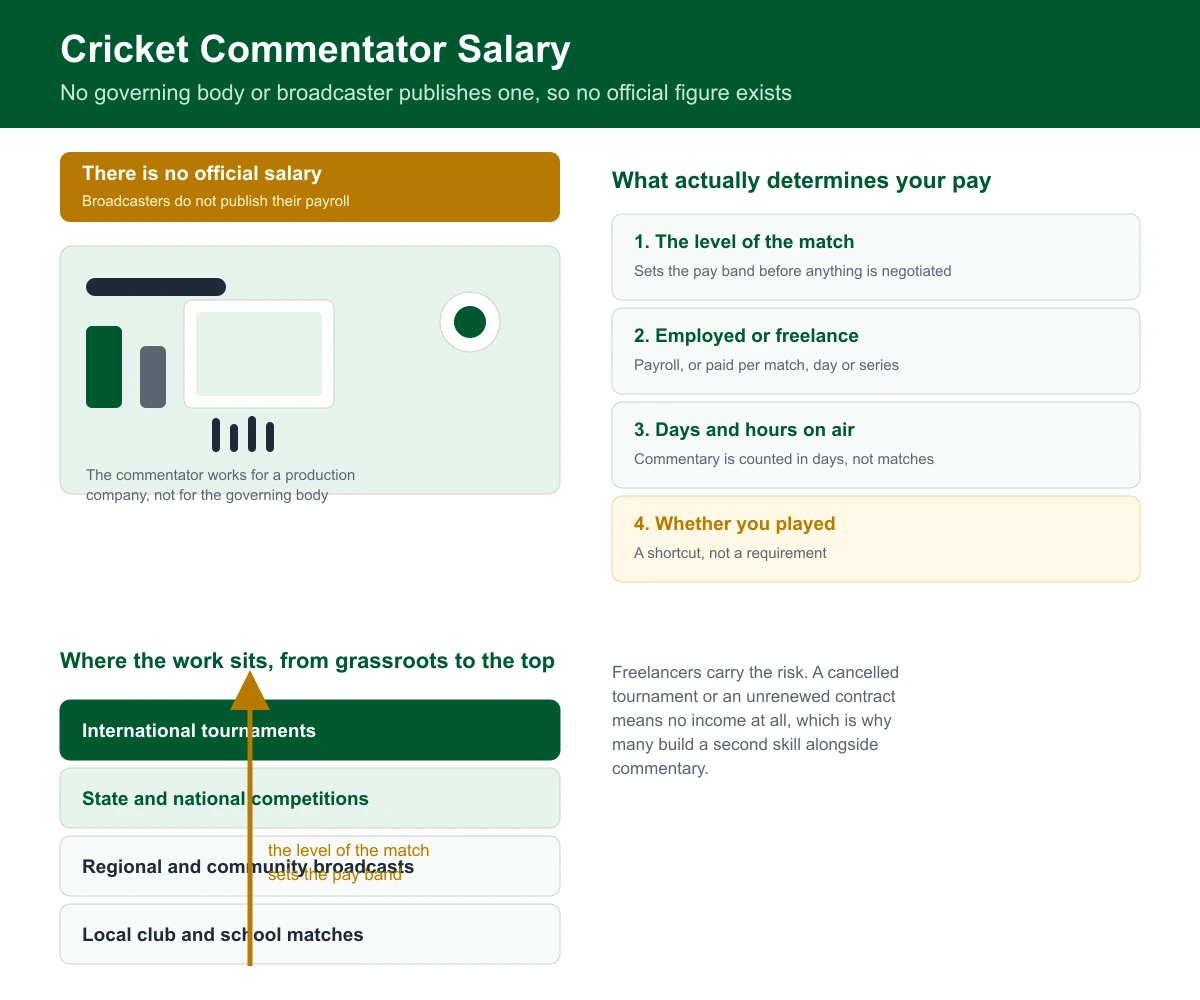
Almost nobody can tell you what a cricket commentator earns, and that is not because it is a secret. It is because the people who would know are broadcasters, and broadcasters do not publish their payroll. There is no official table of commentator salaries anywhere in the sport, from the ICC down to a local league.
That leaves beginners with an unhelpful choice: either believe a specific number that somebody posted online with no source, or assume the job is impossible to get into. Neither is true. This article explains what actually drives what a commentator earns, how the hiring works, and how to get the first match that matters. If you are still deciding whether cricket is for you at all, start with our cricket careers guide instead, because commentary is one of several routes and it is not the easiest one.
Quick Answer
No governing body or broadcaster publishes cricket commentator salaries, so any specific figure you find online is unsourced. What you earn depends on the level of match, whether you are employed or freelance, how many days you are on air, and whether you are a former player. The realistic path starts with unpaid or low-paid local matches, not the World Cup.
Why There Is No Official Salary List
It is worth being precise about this, because it is the reason so much bad information circulates.
The ICC is the sport’s global governing body and it does publish a great deal. It publishes playing conditions, a classification of officials, code of conduct documents, and tournament broadcast information. It does not publish a salary for commentators, and when it announced the commentary team for the Men’s T20 World Cup 2026 in February 2026, listing every voice on the panel, the release contained no salary, no fee, and no payment terms at all.
The same is true one level down. Broadcasters in most countries do not advertise what they pay, and a contract is a private arrangement between a production company and an individual. Even a well-known commentator’s pay is usually reported by a newspaper that got it from an unnamed source, which is one step removed from evidence.
So the honest position is this. Anyone who gives you a precise figure for a cricket commentator salary is quoting a rumour. What can be explained properly is the structure, and structure is what actually determines your income.
Who employs a commentator, and this surprises people
Most international cricket commentary is not produced by the governing body. According to the ICC’s own broadcast information, the host broadcast production rights for all ICC major events from 2015 to 2023 were retained by the ICC, and the ICC engages with several production suppliers and vendors to put together the live, highlights and programming coverage, all under the umbrella of ICC TV. The named suppliers and vendors for that period included Sunset+Vine for live and highlights editorial and production services, NEP Broadcast Solutions for outside broadcast equipment services, and Alston Elliott for graphics and scoring services, with suppliers for technology and broadcast enhancements such as ball tracking, edge detection, aerial cameras, drones and player tracking appointed on an event-by-event basis.
Read that again, because it explains the whole industry. The commentators work for a production company, not for the ICC. The ICC licenses the rights. The production company hires the talent. That is why there is no central salary list, and it is also why there is no central application form.
What Actually Determines Your Pay
With no published figures available, the honest way to think about income is the factors that broadcasters themselves build contracts around. Four of them do almost all the work.
1. The level of the match
This is the biggest factor by a wide margin, and the gap is not a matter of degrees. Commentating a local club final and commentating an international tournament are different jobs done in front of very different audiences, and no broadcaster pays the same rate for both. The level of the competition sets the band before anything else is negotiated.
2. Employed or freelance
A staff commentator is on a payroll and gets a regular fee. A freelance or contract commentator is paid per match, per day, or per series. The trade is simple and worth understanding before you start: freelancers can earn well in a good year and earn nothing in a bad one, because a tournament that is cancelled pays you nothing.
3. Days and hours on air
Commentary work is counted in days on air, not in matches. A five-day Test means five days of broadcasting for one side of the ball. A one-day game is one day. If your goal is a steady income, the volume of fixtures matters as much as their prestige.
4. Whether you played
A top-level cricket career and a top-level commentary job are closely linked because the two feed each other. The ICC’s 2026 World Cup commentary panel is a good illustration of how concentrated the top of the profession is. It was headlined by broadcasters including Ravi Shastri, Nasser Hussain, Ian Smith and Ian Bishop, joined by former tournament winners such as Aaron Finch, Dinesh Karthik and Kumar Sangakkara, along with players including Eoin Morgan, Wasim Akram, Sunil Gavaskar, Matthew Hayden, Dale Steyn, Michael Atherton, Waqar Younis, Shaun Pollock, Ramiz Raja, Simon Doull and Katey Martin.
Almost every name on that list played international cricket. That is not a coincidence and it is not a rule. It is what happens when you need someone who can explain a decision that happened four minutes ago to an audience that just watched it.
But it is not a requirement. It is a shortcut, and there are people who got in without one. Knowing the sport from the inside is genuinely useful, and so is knowing how to talk.
What the Job Is Actually Like
Before you plan around the money, it is worth knowing whether you would enjoy the work, because the money is not the attraction early on.
The scale of a top tournament tells you what a serious broadcast operation involves. For the Men’s T20 World Cup 2026, the ICC reported that the event was to be delivered by six dedicated production crews operating across eight venues in India and Sri Lanka, supported by eight broadcast kits deploying up to 45 cameras. In total, approximately 720 broadcast professionals were involved in delivering the event, spanning production, technical operations, editorial, graphics, data and broadcast management roles, and the broadcast workforce brought together expertise from more than 20 nationalities.
Commentary is a small part of that number, and it is the part the audience hears. The work is calling a match, which means preparing beforehand, keeping up in real time, being handed a feed that occasionally breaks, working to timings, and being part of a team that includes a producer and a director. The 2026 tournament also carried a pre-match show, an innings interval programme, a post-match wrap-up and daily highlights shows, so the match call is only part of the job for anyone working on a major event.
It is also a job where being wrong is public. A commentator makes dozens of claims per match and a fraction of them will be checked. The skill is not being perfect, it is being quick and being honest about uncertainty.
How People Actually Get Hired
This part is well documented by broadcasters themselves, and it is not a formal qualification process.
- There is no standard test. Unlike umpiring, where a governing body runs graded courses and examinations, there is no equivalent ICC commentary qualification. If you have seen a commentator quoted as needing a “commentary licence”, be suspicious.
- Former players are usually approached, not appointed. If you have played at a high level, your route is direct contact with production heads rather than an application.
- Non-players build a body of work instead. The industry hires people who can already demonstrate they can perform on air, which usually means regional coverage, digital content, or consistent self-produced match commentary.
- Grassroots volunteering is the normal first step. Almost nobody starts at the top. Local club matches, junior tournaments, school games and community events need commentary and often have nobody to do it.
That last point is the practical answer to “how much will I earn when I start”. At the beginning, usually nothing. You are building hours on air, and hours on air are the thing being hired for.
What a Realistic USA Path Looks Like
For a beginner reading this in the United States, the honest sequence is straightforward.
- Learn the sport properly first. You cannot call what you do not understand. Our guide to becoming a cricketer covers the foundations, and if you are not playing, the cricket skills guide will at least tell you what you are watching.
- Call matches nobody else wants to call. A Sunday league game with two scorers and no commentary. Do the whole job, including the intervals.
- Record yourself and edit it. This is the step almost everyone skips. Listen back with the sound off to hear how much you are saying, and with the sound on to hear whether it is worth saying.
- Build a public body of work. Even short clips. Producers need to hear you before they hire you, and a reel of you calling a real match is the only proof that works.
- Approach local and regional organisers directly. Club tournaments, community broadcasts, college sport, local radio. The gap is that these events have no commentary at all, which is exactly why they are easy to get into.
- Build alongside a second skill. Many people who break in combine commentary with producing, writing, or camera work, because the jobs are staffed from the same small pool.
Important
This article deliberately contains no salary figure for a cricket commentator, because no official source publishes one. The ICC’s commentary team announcement for the Men’s T20 World Cup 2026 was checked directly and contains no salary, no fee and no payment terms, and the ICC’s broadcast pages name production suppliers rather than staff or pay. If you have seen a specific number quoted as an official commentator salary, treat it as unsourced. Two further points worth knowing. First, individual contracts change, so even an accurate figure for one commentator in one season would not describe the market. Second, the suppliers named on the ICC broadcast pages cover a stated historical period, 2015 to 2023, and broadcast arrangements change between cycles, so the current production partners for any tournament should be checked on the day. Levels of play and the currencies and rates that apply also differ by country, so any comparison between markets needs care.
Frequently Asked Questions
What is the salary of a cricket commentator?
There is no published official figure, and no governing body or broadcaster releases one. What you earn depends mainly on the level of the match you are calling, whether you are employed or paid per match, how many days a season you are on air, and whether you are a former player. Any precise number given without a source should not be trusted.
Do cricket commentators need a licence or qualification?
No. There is no ICC commentary qualification or examination, in the way umpiring is graded through courses and assessments. Broadcasters hire based on demonstrated ability to perform on air, which in practice means a body of recorded work and a track record, plus a direct approach to a production company for the bigger jobs.
Do you have to have played cricket to be a commentator?
No, though it helps enormously. Most names on a top international commentary panel are former international players, because explaining the game from the inside is genuinely hard to fake. But broadcasters also hire presenters and analysts who never played at a high level, and the job needs several other skills including clarity, pacing, preparation and working to timings.
How do I get my first commentary job?
Commentate matches that currently have nobody commentating them. Local club games, junior tournaments, school and college matches and community events all need voices, and organisers are usually delighted to have a free one. Record the work, edit it, build a short public reel, and then approach regional and local organisers directly rather than waiting to be discovered.
Is commentary a stable career at the top level?
It is more stable than it looks for those who are established, because top commentators are contracted for whole tournaments and series. For freelancers it is genuinely unstable, since a cancelled tournament or an unrenewed contract means no income at all. That risk is the main practical reason many people build a second skill alongside commentary.
Judged on the Work, Not the Rumour
If you want to be a cricket commentator, the number on a website is the least useful thing you can focus on. Nobody hires on the strength of a salary rumour. They hire people who can call a match clearly, who know what happened and why, and who sound like they are enjoying it.
Go and call a match this weekend. Nobody will pay you, and that is fine, because the money comes later if the work is good.
Read More: Cricket Competitions Explained
