




Here is a question that comes up constantly, usually from somebody who has just watched a football match and is about to watch a cricket one. In football there is a referee. Is there a referee in cricket? The honest answer is that it depends on the level of cricket, and the reason is interesting.
In club cricket, there is no referee. The person standing at the end of the pitch with their finger raised is called an umpire, and their authority comes from a very short Law. In international cricket, there is a different official who is genuinely called a Match Referee, and the two jobs are not the same job with different names. Our umpire duties guide covers what the umpire actually does, so this article is about how the referee role is different and why the distinction exists.
Quick Answer
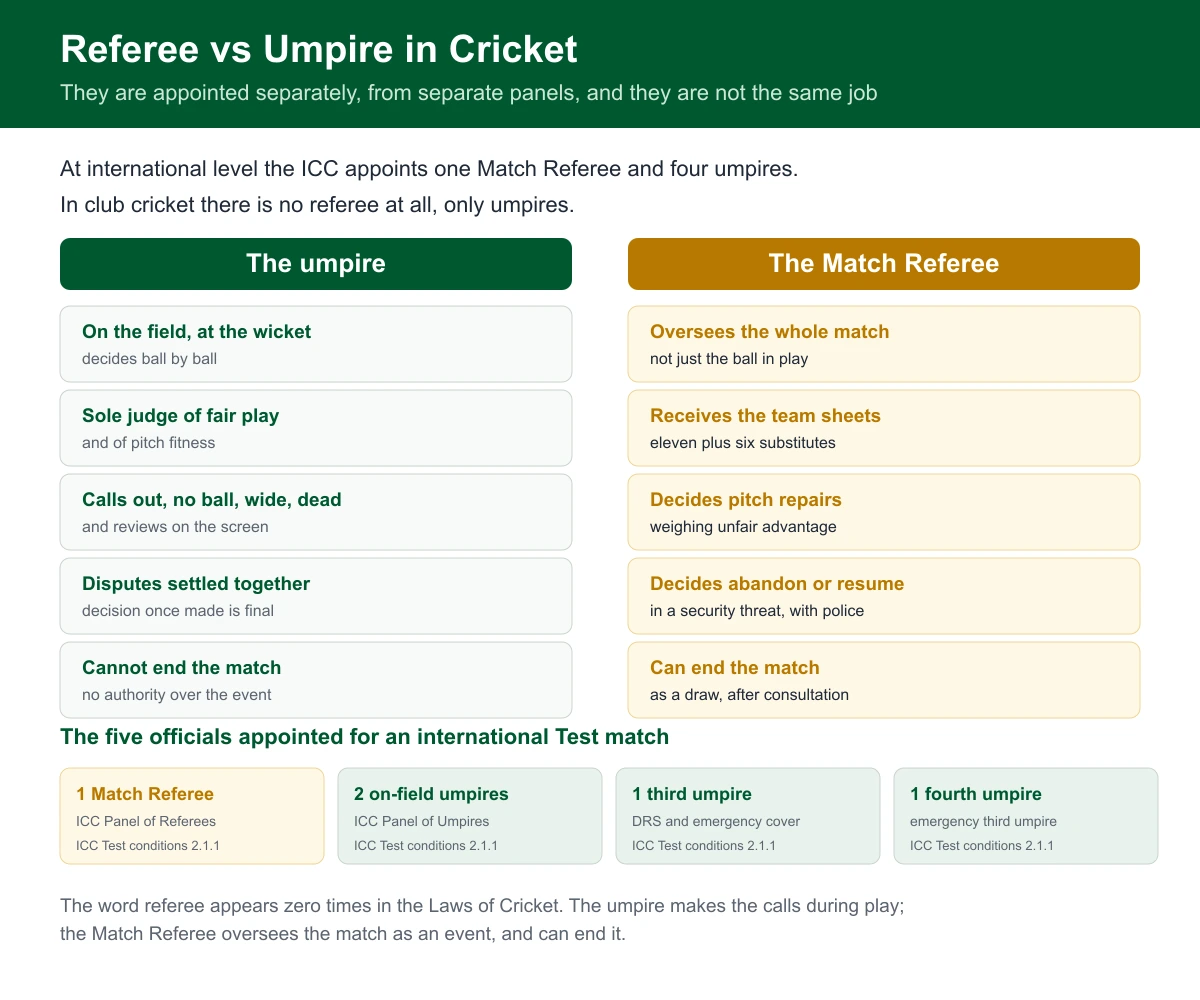
At club level there is no referee, the on-field officials are umpires. At international level the ICC appoints a separate Match Referee alongside two on-field umpires, a third umpire and a fourth umpire. The umpires make the decisions during play. The Match Referee oversees the match, receives the team sheets, and decides whether a dangerous pitch is repaired, a match is abandoned, or play is stopped for a security threat.
Why the Confusion Exists
Two reasons, and neither is your fault.
The first is language. Most of the world watches football, basketball, hockey, tennis and rugby. All of those use referee. When people arrive at cricket, they assume the same structure and simply look for the word. If you are coming from another sport, our guide to cricket basics and rules will help with the rest of the terminology.
The second reason is more interesting, and it is a real trap. The word referee does appear in official cricket, but it does not appear in the Laws at all.
The Laws of Cricket are the rulebook. The full set of Law pages was searched for the word referee, and it appears zero times across the entire document. Neither does the term third umpire appear, or television umpire. The Laws talk about umpires and nothing else, because the Laws describe the match on the field and the people standing on it.
So if a source tells you the referee calls no-balls in cricket, that source has confused two rulebooks, or two levels of the game.
At International Level, the Referee Is Real
Here is the part that surprises people, and it comes straight from the official ICC playing conditions documents, specifically the Test Match Playing Conditions of June 2025. Clause 2.1.1 sets out which Match Officials are appointed for each Test Match.
The list reads like this.
- One ICC Match Referee, appointed by the ICC from the ICC Elite Panel of Referees or the ICC International Panel of Referees.
- Two on-field umpires, appointed by the ICC from the ICC Elite Panel of Umpires or the ICC International Panel of Umpires.
- One third umpire, who shall act as the emergency on-field umpire and officiate in regard to the DRS, appointed by the ICC from the ICC Elite Panel of Umpires or the ICC International Panel of Umpires. The playing conditions governing the use of the DRS and the third umpire are set out in Appendix D.
- One fourth umpire, who shall act as the emergency third umpire, appointed by the Board from its nominees to the ICC International Panel of Umpires.
Read that list carefully, because it settles the question. In international cricket, the referee and the umpire are appointed separately, from separately named panels, and they are not the same person doing the same job. There is one Match Referee and four umpires. Even the backups are defined by role: the third umpire covers for an on-field umpire, and the fourth umpire covers for the third umpire.
The team nomination also goes to the referee. Under clause 1.2.1, each captain shall nominate eleven players plus a maximum of six substitute fielders in writing to the ICC Match Referee before the toss. Compare that to the Laws, where each captain nominates their players in writing to one of the umpires before the toss. Same action, different recipient, and the reason is the difference in scope.
What the Umpire Decides
The umpire is the decision-maker on the field. The scope is narrow, fast and constantly exercised.
The umpires are the sole judges of fair and unfair play. They are also the sole judges of the fitness of the pitch for play. Where there is disagreement or dispute about any matter, the umpires together make the final decision. An umpire’s decision, once made, is final, apart from the limited right to alter a decision promptly and never to revive a dead ball.
This is the job people picture. You watch the umpire give not out, then no ball, then review a decision on a television screen, all within the same over.
What the Match Referee Decides
The Match Referee’s scope is the whole event rather than the ball in play. The clearest examples come from the pitch.
The dangerous pitch decision
If the on-field umpires decide it is dangerous or unreasonable for play to continue on the match pitch, they stop play and immediately advise the ICC Match Referee. The on-field umpires and the ICC Match Referee then consult with both captains. If the captains agree to continue, play resumes.
If the decision is not to resume, the on-field umpires together with the ICC Match Referee consider whether the existing pitch can be repaired and the match resumed from the point it was stopped. In considering whether to authorise such repairs, the ICC Match Referee must consider whether this would place either side at an unfair advantage, given the play that had already taken place on the dangerous pitch.
That is a fundamentally different judgement. The umpire asks whether this ball is legal. The Match Referee asks whether repairing this pitch would unfairly help the team batting on it, knowing what has already happened on it.
Abandoning the match
If the decision is that the existing pitch cannot be repaired, then the match is to be abandoned as a draw. If the abandonment occurs on the first scheduled day, the ICC Match Referee consults with the Home Board to find a way for a new match, including a new nomination of teams and toss, to start on the same date and venue. Subject to the ICC Match Referee and the relevant Ground Authority both being satisfied that the new pitch will be of the required Test standard.
If it is not possible to start a new match on the scheduled first day, the relevant officials from the participating Boards agree whether the match can be replayed within the existing tour schedule. Throughout that whole process, the ICC Match Referee keeps informed both captains and the head of the Ground Authority.
Security threats
This is the clearest statement of the difference in authority anywhere in the playing conditions. If there is a suspension of play because of any security threat or risk, the umpires, on the advice of the ICC Match Referee, should suspend play and all players and officials should be immediately asked to leave the field of play in a safe and orderly manner.
And then: where play is suspended under that clause, the decision to abandon or resume play shall be the responsibility of the ICC Match Referee, who shall act only after consultation with the head of ground security and the police.
The umpire cannot end a match. The Match Referee can.
Rulings that end arguments
The pattern holds elsewhere too. On pitch access, in the event of any dispute, the ICC Match Referee will rule and his ruling will be final. That is a different sentence from the one the umpires operate under, and the difference in scope is deliberate.
Side by Side
Here is the whole difference in one place.
- The umpire is on the field, near the wicket, and decides things ball by ball. Out, not out, no ball, wide, dead ball, reviews, and whether play is safe right now.
- The Match Referee is not the person calling your no-ball. They oversee the match as an event. They receive the team sheets, rule on pitch repairs, decide whether a match is abandoned as a draw, order evacuation on a security threat, and give the final ruling in disputes.
- At club level you will probably only ever have umpires, and often volunteers. The full five-official structure only exists at the top level.
One more practical difference. Under the Laws, an umpire’s decision, once made, is final. Under the playing conditions for international cricket, the Match Referee’s decisions are also final and, in the case of a Concussion Replacement Request, expressly so, with the clause stating that neither team shall have any right of appeal. Both officials hold strong authority. They just hold it over different things.
Important
The specific structure of match officials is not the same at every level, and this is the single biggest reason the referee question gets answered badly online. The five-official structure described here, one Match Referee, two on-field umpires, a third umpire and a fourth umpire, is taken from the ICC Test Match Playing Conditions effective June 2025. Other formats and competitions, including domestic leagues, school cricket and club cricket, appoint their own officials and may use a different number, may not appoint a Match Referee at all, and will use their own competition rules. The one thing that holds across every level is the naming: the person making on-field decisions is an umpire, and the Laws contain no referee. Also note that local leagues sometimes use the word referee loosely to mean the person running a match on their ground, which is a league label rather than an official title. Always check which rulebook applies to the match you are watching.
Frequently Asked Questions
Is there a referee in cricket?
It depends on the level. In international cricket there is, and the official title is ICC Match Referee, appointed from the ICC Elite Panel of Referees or the ICC International Panel of Referees. In club, school and most domestic cricket there is no referee, and the on-field officials are umpires. The word referee does not appear anywhere in the Laws of Cricket.
Who decides if a batter is out?
The on-field umpires. The umpires are the sole judges of fair and unfair play, and where there is disagreement or dispute about any matter, the umpires together make the final decision. An umpire’s decision, once made, is final, apart from the limited right to alter a decision promptly and never to revive a dead ball. The Match Referee does not overturn out decisions.
What is the difference between the umpire and the Match Referee?
The umpire decides things ball by ball on the field. The Match Referee oversees the match as a whole event, receives the team sheets, decides whether a dangerous pitch can be repaired, decides whether a match is abandoned as a draw, and makes the decision to abandon or resume play in a security situation. The umpire cannot end a match. The Match Referee can.
Why does the team sheet go to the referee?
Because the Match Referee is responsible for the match as an event, not just for the ball in play. Under the ICC Test Match Playing Conditions, each captain nominates eleven players plus a maximum of six substitute fielders in writing to the ICC Match Referee before the toss, and the Match Referee also rules on concussion replacement requests and on whether adding a substitute is allowed in exceptional circumstances.
Do lower-level cricket matches have a fourth official?
Usually not. The five-official structure of one Match Referee, two on-field umpires, a third umpire and a fourth umpire comes from the ICC Test Match Playing Conditions and applies at international level. Local leagues appoint their own officials, often only two, and they are frequently volunteers. If you want to umpire at club level, expect to start with the same two positions described in our umpire duties guide.
Use the Right Word
Next time you are discussing a cricket match, use umpire for the person at the wicket. It sounds like a small thing, but the words are how the two rulebooks stay separate, and getting it right is how you avoid confidently repeating a claim that has no source.
If you are curious about where any of these jobs go next, our cricket careers guide covers the roles open to beginners in the sport, and umpiring is one of the most accessible.
Read More: Cricket Teams and Roles Explained
