




When you watch a cricket match, you see eleven batters listed with a number beside each name, running from 1 to 11. That numbered list is the batting order. It is usually the first idea a new player has to understand, because it decides who walks out first, who comes in after a wicket falls, and who is still waiting when the innings is nearly over.
Many beginners expect the batting order to be a rule in the Laws of Cricket. It is not. No law tells a captain which number to give a player. The order is a team choice, and it changes from match to match. If you are still learning how a cricket match works, this guide breaks the batting order into the parts you will actually use at the ground.
Quick Answer
A cricket batting order is the numbered list of the eleven batters a team names before a match. Number 1 and 2 open the innings, and the next number walks in each time a wicket falls. The Laws of Cricket do not set this order. The captain and coach choose it as a team decision.
What Is a Cricket Batting Order?
A batting order is a list of eleven batters, numbered 1 to 11, in the sequence they are expected to come to the crease. The list is fixed by the team before the match starts.
Two Laws set the foundation. The first says a match is played between two sides, each of eleven players, one of whom shall be captain. That means a side can send all eleven of its players to the crease, because every player on the team can bat. The second Law says each captain nominates the players in writing to one of the umpires before the toss. By the time the first ball is bowled, the team of eleven is already decided.
Those eleven names get sorted into a batting order. Number 1 opens the innings, number 2 is the other opener, and number 3 comes in when the first wicket falls. After that, the team works down the list as wickets fall.
You will see the older word batsman in a lot of older writing. The Laws of Cricket use the word batter. Both words mean the same person.
The number is a plan, not a promise. A batter can be given out for a single run. A lower number can come in earlier than expected if an opener is dismissed very early.
What the Numbers 1 to 11 Mean
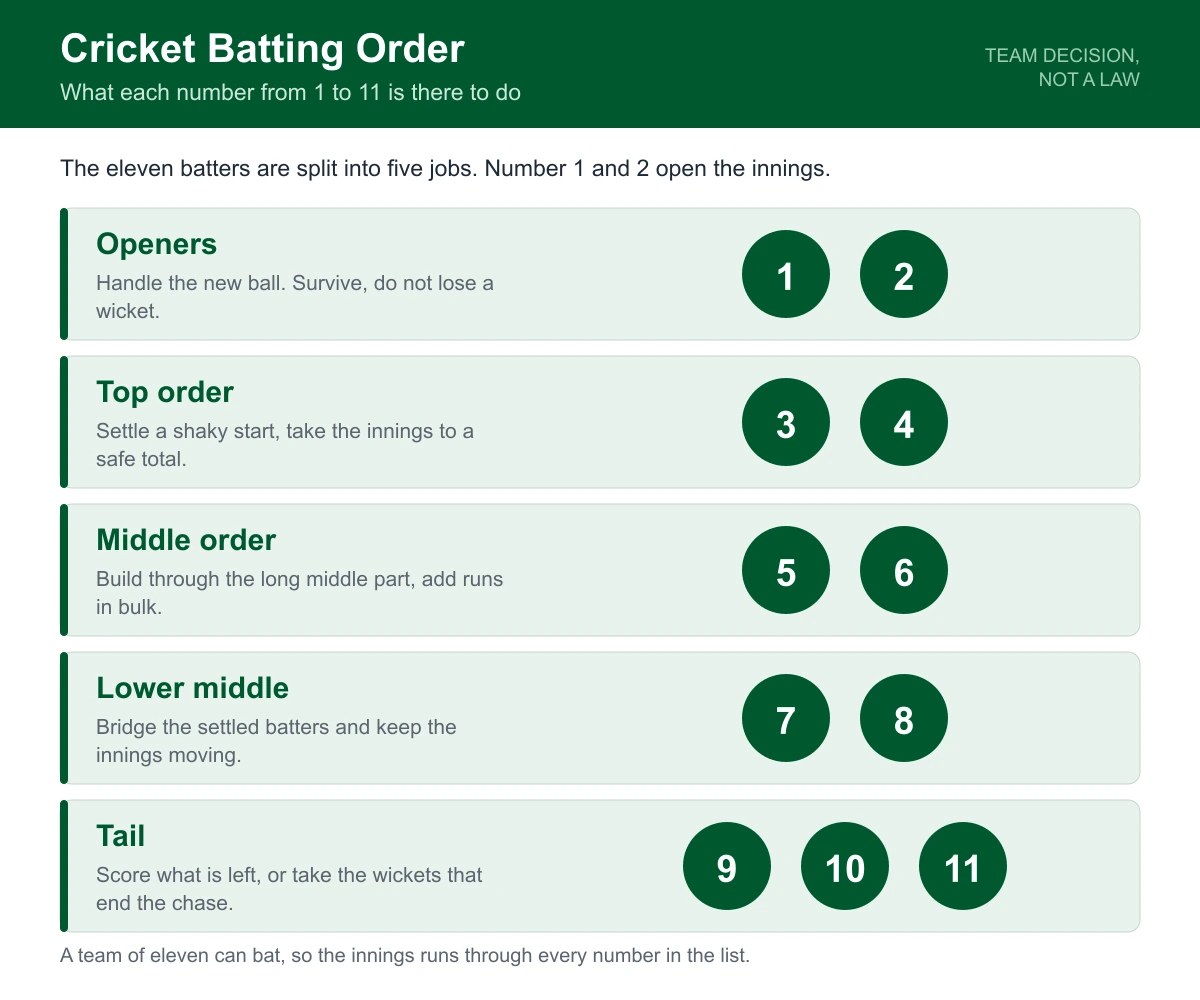
Different teams and countries split the eleven positions into groups in slightly different ways, but the jobs behind the numbers are very consistent. Think of the order in three blocks: batters who protect the start, batters who build the middle, and batters who finish the innings.
| Numbers | Often called | Job in the innings |
|---|---|---|
| 1 and 2 | Openers | Survive the first part of the innings when the ball is hardest, and score as many runs as possible without losing a wicket. |
| 3 and 4 | Top order | Steady a shaky start and take the innings to a safe total before the ball gets older. |
| 5 and 6 | Middle order | Build for the long middle part of the innings and add runs in larger amounts. |
| 7 and 8 | Lower middle order | Bridge the settled batters to the end of the order and keep the innings moving. |
| 9, 10 and 11 | Tail | Score whatever runs are still needed, and in a low-scoring match, take wickets to defend a lead. |
The label matters less than the job. Some teams call 1 to 3 the top order. The work behind each block is what a coach is actually thinking about.
Top Order, Middle Order, and Lower Order
Why the openers bat first.
Every innings starts with a new ball. A new ball is the hardest ball a batter will face in that innings. It can move in the air on its way to the pitch, and it can bounce unpredictably as it lands, which makes it harder to pick the length. It is also harder to see against some backgrounds.
After the ball has been bowled at for a while, it gets scuffed and softer. The two batters who have opened are also more settled, which usually matters as much as the ball. Together, those two reasons make the opening overs the most difficult part of a batting innings.
That is why the openers are chosen for the ability to handle the new ball, and why their job is to be still at the crease. An opener who survives the first twenty overs without losing a wicket has already done the hardest part of the job.
What the middle and lower order do.
By the time the number 5 or 6 batter comes in, the ball is older and the innings is under control. These batters usually play a long stretch of deliveries, scoring steadily and then speeding up when the required rate rises. They are the part of the order that turns a start into a big score.
The tail bats with fewer wickets left in hand. In the first innings their job is usually to add runs and not get out. In the second innings, when a team is chasing a target, the tail can be given the job of taking the wickets that would end the chase.
The Nightwatchman
The number 3 batter is often given a special job, and that job has a name: the nightwatchman. A nightwatchman comes in early, usually at number 3, mainly to protect a wicket. The name comes from the night shift, when something is being kept safe while the rest of the side is resting.
You will most often see a nightwatchman in the second innings of a match, when a team is chasing a target. A specialist batsman walks in, sees the wicket is still intact, and tries not to lose it. The rest of the batting order has time to come in behind a safe position.
If you want the full picture of this role, our guide explains what a nightwatchman is and how the position is used in real matches.
Important
The batting order is a team decision, not a rule. The Laws fix who may play, when an innings ends, and how the toss works. They say nothing about which number any batter should be given.
What Happens When a Wicket Falls
When a batter is dismissed, the next name on the list walks to the crease. This is the normal rhythm of an innings. The team keeps bringing in the next batter on the order, one at a time, until the innings is finished.
The two batters at the crease swap ends after every over. That is why the terms striker and non-striker keep changing hands, and why the batter who faced the last ball of an over will usually not face the first ball of the next one.
Sometimes a batter leaves early without being dismissed. This is called retiring. A retiring batter is not out, so no wicket is added to the total, but the innings moves on to the next batter. Retiring is often done so that a younger batter gets more time at the crease, or so that a specialist batsman comes in against a particular kind of bowling.
The Law covers the case where the list runs out. It says that at the fall of a wicket or the retirement of a batter, if there are still deliveries to be bowled but no further batter is available to come in, the innings is considered complete. The team cannot be forced to send up a player who is not there.
What the Laws of Cricket Actually Control
It helps beginners to separate what is a rule from what is a team decision. Everything below comes from the official playing rules, which you can read in full in the official MCC Laws of Cricket.
| What is set | Where it comes from |
|---|---|
| Each side has eleven players, and one of them is the captain | Law 1.1 |
| Players are nominated in writing to an umpire before the toss | Law 1.2.1 |
| A deputy can act for the captain when needed | Law 1.3.1 |
| The captains toss, no earlier than 30 minutes and no later than 15 minutes before the scheduled start | Law 13.4 |
| The captain who wins the toss decides to bat or field, and the decision cannot be changed | Law 13.5 |
| An innings ends when the side is all out, when no further batter is available, when the captain declares or forfeits the innings, or when the agreed overs or time are finished | Law 13.3.1 to 13.3.5 |
| Which number each batter is given | A team decision, not a Law |
A batting order only means something once there is an innings to bat in. If the idea of two sides taking turns is still unclear, our article on how an innings works explains where the batting order fits into the match.
Common Mistakes Beginners Make
Thinking number 1 must be the best batsman.
Being the best run scorer and being able to handle the new ball are two different skills. A batter who opens is often chosen for calm defence and the ability to leave a good ball alone, not only for scoring.
Thinking the batting order can be changed after the toss.
The team of eleven is nominated to an umpire before the toss, and players cannot be replaced without the consent of the opposing captain. Once that list exists, the squad is set. The team can still decide the running order of those eleven batters, but it cannot bring in someone new.
Thinking a lower-order batter cannot score.
The position shows when a player bats, not how many runs they can make. Several players who bat at number 9 or 10 have scored more first-innings runs in a season than most of their teammates.
Confusing batting order with bowling order.
These are two separate lists. A team decides who opens the bowling, who bowls the middle overs, and who finishes the innings. A batter at number 7 may well be the team’s main bowler, and a bowler at number 4 in the batting order may not bowl at all.
Frequently Asked Questions
What does 1 to 11 mean in a cricket batting order?
It is the sequence the eleven batters are expected to come to the crease. Numbers 1 and 2 open the innings, and the next number comes in each time a wicket falls.
Who decides the batting order in cricket?
The team does, and the captain is responsible for it. The Laws of Cricket do not set any order. The captain and coach pick eleven batters and number them based on the conditions, the pitch, and each player’s role.
Can a cricket batting order be changed during a match?
The order the eleven batters are expected to come in can be changed, but the squad itself cannot. Players are nominated to an umpire before the toss, and replacing one needs the opposing captain’s consent. A change of order does not need permission from the umpires.
What is the difference between batting order and bowling order?
Batting order is the list of batters and the sequence they come in. Bowling order is the list of bowlers and the sequence they bowl. The two lists are usually very different, and a player can appear on both.
Why is the nightwatchman usually number 3?
Because number 3 comes in after the first wicket falls, while the other opener may still be at the crease. A specialist batsman walking in at that moment can settle the innings without taking further risks with the remaining opener.
Conclusion
A batting order is a team’s plan for how its eleven batters will come to the crease, and it changes with the match. Numbers 1 and 2 handle the hard new-ball overs, the middle of the order builds the score, and the tail finishes the job or defends a total. No Law tells a captain which number to give anyone, which is why you see a different order almost every match. Once you can read the numbers on a team sheet, the rest of the innings makes far more sense.
Read More: our Cricket basics and rules guide
