




If you have watched cricket for five minutes, you have heard the word “wicket” used in three different ways. A commentator says the bowler “took a wicket,” a team is “five wickets down,” and someone says the “wicket looks dry.” No wonder new fans get confused.
This guide clears it up with simple examples, official sizes, and a comparison to baseball. If you are brand new, our cricket basics and rules guide covers the whole game. Here we focus on one word that shows up in almost every sentence about cricket.
Quick Answer
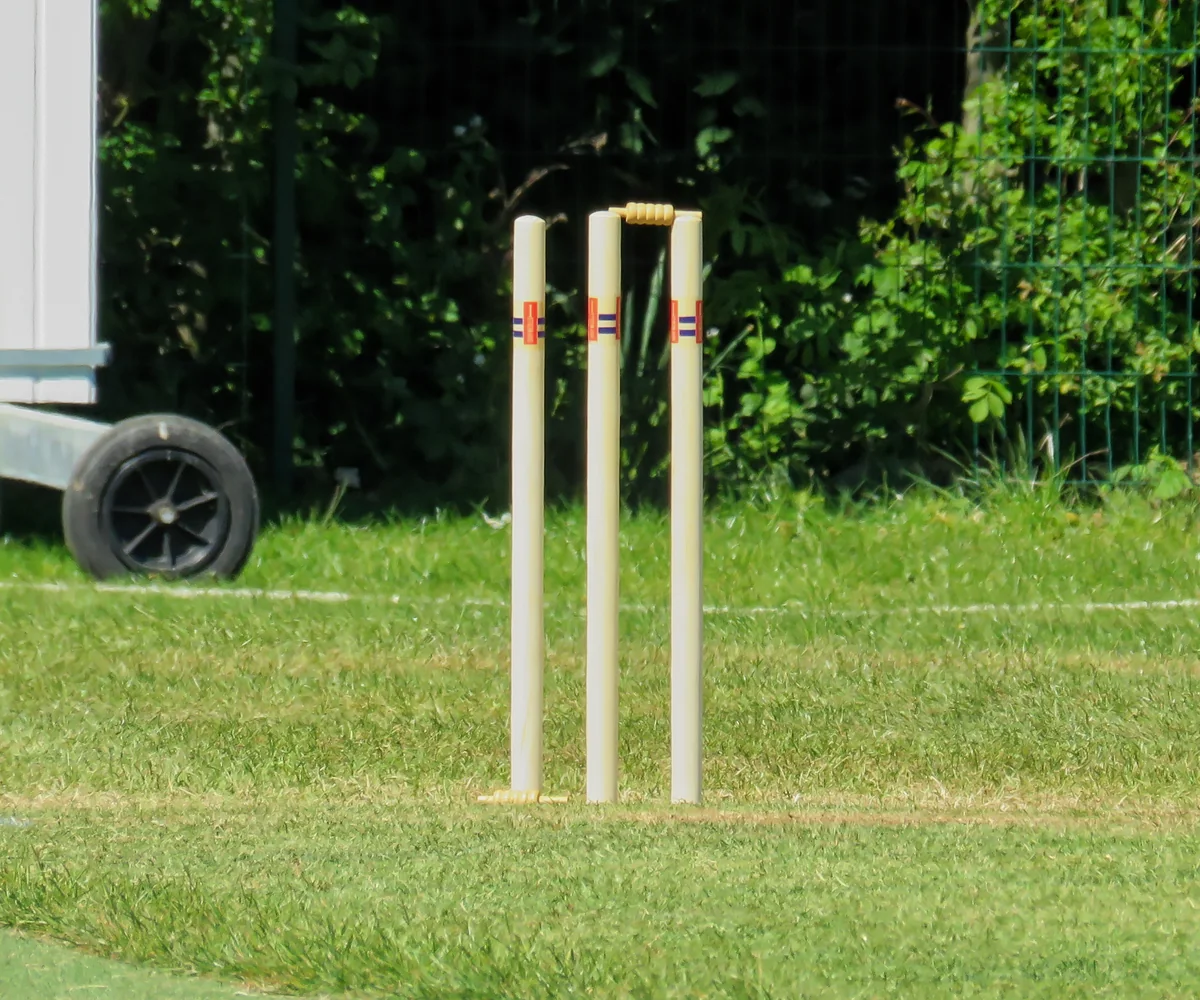
A wicket is the set of three wooden stumps with two small bails on top that stands at each end of the pitch. The word also means an out: when a batter is dismissed, the bowling team has “taken a wicket.”
What Does Wicket Mean in Cricket?
The word has three common meanings. The sentence around it tells you which one is being used.
1. The Wicket Is the Target
The main meaning is the target. Each wicket is made of three upright posts called stumps, with two small pieces of wood called bails resting on top. There is one wicket at each end of the pitch, 22 yards apart.
The bowler tries to hit the wicket with the ball. The batter stands in front of it and tries to protect it with the bat while scoring runs.
2. A Wicket Means an Out
When a batter is dismissed, people say a wicket has fallen. “The bowler took three wickets” means that bowler got three batters out. “India lost two wickets” means two Indian batters are out.
3. People Also Call the Pitch the Wicket
Commentators often call the 22-yard strip between the two wickets “the wicket.” When you hear “this is a good batting wicket,” they mean the pitch surface, not the stumps.
The ICC made this short video to explain the basics of the game, including how the bowler attacks the wicket:
How Big Is a Cricket Wicket?
The size of the wicket is set by Law 8 of the MCC Laws of Cricket. MCC, the Marylebone Cricket Club in London, writes the official rules of the sport.

| Part | Official size |
|---|---|
| Width of the wicket | 9 in (22.86 cm) |
| Height of the stumps above the ground | 28 in (71.12 cm) |
| Thickness of each stump | 1.38 to 1.5 in (3.50 to 3.81 cm) |
| Length of each bail | 4.31 in (10.95 cm) |
| Distance between the two wickets | 22 yards (20.12 m) |
To picture it, the stumps are about as high as a dining table, and the whole wicket is a little narrower than a sheet of letter paper is long. That small target is why bowling accurately is a real skill.
For junior cricket, the Laws let each country’s cricket board set its own sizes for stumps and bails.
When Is the Wicket “Broken”?
Many ways of getting out depend on the wicket being broken. Under Law 29, the wicket is broken when at least one bail is completely knocked off the top of the stumps, or when a stump is pulled or knocked out of the ground.
A ball that just brushes a stump without knocking a bail completely off does not break the wicket. If one bail is already off, removing the other bail or knocking out a stump is enough.
If needed, the umpires can agree to play without bails at both ends. Then the umpire decides whether the wicket has been hit in a way that counts.
How Can a Batter Lose Their Wicket?
The Laws of Cricket list these ways a batter can be out:
- Bowled: the bowler’s delivery hits the wicket and breaks it.
- Caught: a fielder catches the ball after it touches the bat, before it hits the ground.
- Leg before wicket (LBW): the ball hits the batter’s body when it would have gone on to hit the stumps. Our LBW rule guide explains this one step by step.
- Run out: a fielder breaks the wicket while a batter is outside the safe area, called the crease.
- Stumped: the wicketkeeper breaks the wicket when the batter steps out of the crease and is not trying to run.
- Hit wicket: the batter breaks their own wicket with the bat or body.
- Hit the ball twice: the batter deliberately hits the ball a second time, a very rare dismissal.
- Obstructing the field: a batter deliberately blocks or distracts the fielders.
- Timed out: a new batter is not ready within 3 minutes of the last out. The bowler does not get credit for this wicket.
Bowled, caught, LBW, and run out are the ones you will see in almost every match. The rest are rare.
Common Wicket Phrases and What They Mean
| Phrase | What it means |
|---|---|
| “Took a wicket” | The bowler got a batter out. |
| “Three wickets down” | Three batters on the team are out. |
| “Won by 5 wickets” | The team batting second reached the target with 5 wickets still left to fall. |
| “All out” | The batting team has no partner left to bat with, so the innings is over. With 11 players, that happens after 10 wickets. |
| “Wicketkeeper” | The fielder who stands behind the batter’s wicket wearing gloves, a bit like a catcher in baseball. |
| “A good batting wicket” | The pitch surface is flat and easy to score runs on. |
| “Sticky wicket” | Originally a damp, tricky pitch. Today it is also an everyday idiom for a difficult situation. |
The “won by wickets” phrase confuses many new fans. Under Law 16, when the team batting last wins, the margin is the number of wickets it still had left. So if a team reaches its target after losing 5 batters, it wins by 5 wickets, because 5 more would have had to fall to end the innings.
Wicket vs. Out in Baseball
If you know baseball, a wicket is close to an out, with one big difference: cricket gives each team many more of them.
- In baseball, a half-inning ends after 3 outs, and the game has 9 innings.
- In cricket, a team’s innings ends after 10 wickets, or when its overs run out in a limited-overs match. An over is a set of 6 balls from one bowler.
- Losing wickets slowly matters. Because each wicket is precious, a batter in cricket can stay in for hours and score more than 100 runs in one innings.
The batter also has a job baseball hitters do not have: guarding the wicket. A baseball hitter can let a pitch go by, but a cricket batter who misses a straight ball may be bowled.
Important
In American English, “wicket” can also mean a croquet hoop. That is a different sport. In cricket, a wicket is always the stumps and bails, an out, or informally the pitch.
Frequently Asked Questions
What sport uses a wicket?
Cricket uses wickets as the target the bowler aims at. In the United States, croquet hoops are also called wickets, but they are not related to cricket.
How many stumps are in a cricket wicket?
Each wicket has three wooden stumps with two bails on top. A full cricket pitch has two wickets, one at each end.
How tall is a cricket wicket?
The stumps stand 28 inches (71.12 cm) above the ground, and the wicket is 9 inches (22.86 cm) wide.
How many wickets end an innings?
Ten. A team has 11 players and batters bat in pairs, so after 10 wickets fall there is no partner left and the team is all out.
What is a sticky wicket?
In cricket, it was a pitch made damp and tricky by rain, which made batting hard. In everyday English, a “sticky wicket” now means any difficult or awkward situation.
Final Thoughts
When you hear “wicket,” ask which of the three meanings fits: the stumps and bails, an out, or the pitch. Most of the time it is one of the first two. Once that clicks, scores like “250 for 6” and results like “won by 4 wickets” start to make sense right away.
Read More: Cricket Scoring System Explained (Beginner-Friendly Guide)
