




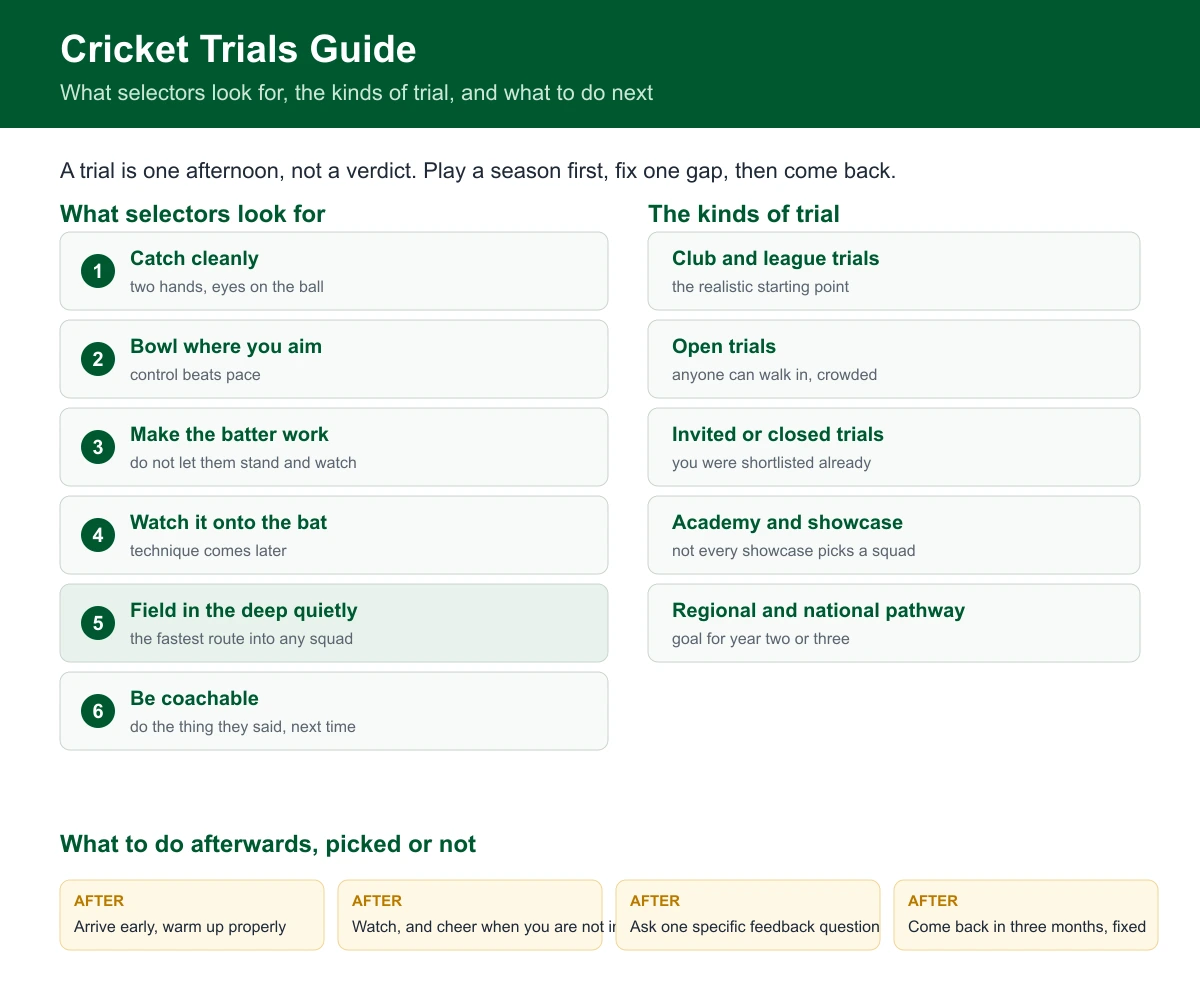
Nobody gets into a cricket team by being good enough on their own. They get picked because somebody watched them, in a specific room, on a specific afternoon, and decided they were the most useful person there. That process has a name, and it is called a trial.
A trial is a test session, not a final exam. It has a limited number of places, it is usually competitive, and most people who attend one do not leave with a spot. That is normal, and it is not a judgement about your ability. Our cricket careers guide covers the wider picture of how the sport recruits and pays people, which is worth reading before you decide how seriously to take a trial.
Quick Answer
A cricket trial is a session where a coach or selector watches a group of players and picks a squad from what they see. The best preparation is regular play, not a last month of trying to look good. Turn up early, treat it like a match, and ask for feedback afterwards whether you were picked or not.
What a Cricket Trial Actually Is
A trial is a selection session. A coach, or a panel of selectors, puts a group of players through batting, bowling and fielding drills, usually followed by a match or a set of nets. At the end, a squad is chosen. Sometimes the squad is the whole point of the day. Sometimes it is a shortlist for a stage further up.
Two things follow from this, and they explain most of the confusion beginners have.
First, the coach is not comparing you to the best cricketer in the room. They are comparing you to the standard the team needs this season, which is often much lower than you assume. A side made of club players does not need Test-standard technique. It needs someone who will turn up every week and field cleanly in the deep.
Second, a trial is a snapshot. It is one afternoon. It is not a complete judgement of you, and a coach who picks somebody else this time may well pick you next season. Plenty of good players have been through many trials before a side settled.
The Different Kinds of Trials
Not all trials mean the same thing, and knowing which one you are attending saves a lot of confusion.
Club and league trials
The most common kind, and usually the easiest. A local club needs players for a season, puts a notice on its website or social media, and holds a session. This is the realistic starting point for a beginner in the USA, and our guide to how to become a cricketer covers the step before this one.
Open trials
Anyone can walk in. These are used when a body genuinely needs to find new players, and they are advertised in advance. An open trial is a genuine opportunity for someone with no connections, and it is also the most crowded, so the standard is higher.
Invited or closed trials
You were asked, or you have already been through an earlier stage. These exist because a coach has a shortlist and wants to compare a smaller group. Turning up to an invited trial you were not invited to is a bad look, so check carefully what you have been asked to attend.
Academy and showcase events
Common for youth players and for players moving up a level. A showcase may not pick a squad at all. It may simply put you in front of coaches from several teams at once, and each of them decides separately whether to follow up. Not being picked on the day does not always mean not being noticed.
Regional and national pathway trials
The step above club cricket, run by a governing body or a state association. These are heavily oversubscribed, they usually require registration in advance, and they often have formal age and membership conditions. If you are new, this is a goal for year two or three, not year one.
What Happens on the Day
Every trial is different, but the shape is usually the same, and knowing it in advance stops you turning up in the wrong clothes with the wrong gear.
- Registration. Sign in, give your name, and find out the schedule. If it is an open trial, arrive well before the start time, because latecomers often get watched less.
- Warm-up and basic drills. Catching, throwing, and footwork. This is where most of the judgement happens, even if the coaches never say so.
- Batting and bowling nets. Everyone bowls, everyone bats. You may get a few overs and a few balls each. Do not save your best burst for the end, because the coaches may not see the end.
- A match or a set of scenarios. Sometimes a full match, sometimes smaller-sided games. In smaller games you will get more touches, which is better for you.
- Team announcement, or a promise of contact. If you are picked, you will usually be told on the day or shortly after.
Bring everything you own. Bat, pads, gloves, helmet, hard or soft ball if you have one, water, and a change of clothes. If you are not sure about a piece of equipment, our cricket skills guide sets out what each item is for and when you actually need it.
What Coaches Actually Look For
This is the part that surprises people, because it is not a list of techniques. Here is what tends to move a coach’s decision.
- Whether you can actually catch. This is the first thing on most beginners’ lists, and it is a skill, not a talent. Two hands, eyes on the ball, soft hands.
- Whether you bowl where you aim. Control matters more than pace. A slow bowler who puts it on the same spot is more useful than a quick one who sprays it.
- Whether you make the batter work. A good bowler makes the batter decide something difficult. A bad one makes the batter stand and watch.
- Whether you watch the ball onto the bat. Batting technique matters less at trial level than the simple act of seeing the ball.
- Whether you field in the deep without complaining. Almost every squad needs this player, almost nobody wants to be this player, and it is the fastest route into a team.
- Whether you are coachable. If you are told something and you do it next time, that counts for a lot. Being the person who argues with the coach does not.
- Whether you are available. A player who can only come on Sundays is often less attractive than a decent player who can come every week, no matter how good.
Notice what is missing. Nobody is selecting you on your cover drive. That matters much later, when you are already in the side and improving. The Laws of Cricket set out the official framework for who is allowed on the field, and it is a much shorter list than most beginners expect.
How to Prepare in the Weeks Before
You cannot fake your way into a squad, but you can arrive ready so that a normal day of cricket goes your way.
- Play regularly first. The best preparation is a season of actual matches. A coach can tell within ten minutes whether somebody has been playing.
- Pick your one gap and close it. If you are a weak fielder, field every day of the week. If you cannot bowl, bowl. Be the best version of a limited player rather than a diluted version of an all-rounder.
- Get your gear right in advance. Ill-fitting pads and a cracked bat are more common reasons for a bad day than people think. Check your kit the week before, not the morning of.
- Know the team. If you are trialling for a specific club, find out how they play and what position they are short of. A team missing a wicketkeeper does not need a fifteenth batter.
- Plan your rest and food. You will be asked to perform for a couple of hours. Being tired or dehydrated ruins a trial far more often than a rusty technique does.
- Ask someone else to watch you. Have a coach, a clubmate, or even a video of a match point out one thing to fix. Self-assessment is famously bad in sport.
What to Do on the Day Itself
Simple, and it works better than most people expect.
- Arrive early. Early is observable, and coaches notice who is already there when they unlock the ground.
- Warm up properly. Ten minutes of throwing, catching, and running. Turning up cold is the most avoidable mistake on the list.
- Watch when you are not involved. Stand where you can see both the bowler and the batter. Note what the coaches are saying. You will learn more in one session than in a month of reading.
- Be encouraging. If you are waiting, cheer for the people batting in front of you. Team players are what selectors are looking for.
- Do not explain yourself. Nobody asked you for your story, and a long explanation of your injuries usually makes a coach more cautious, not less.
- Thank them at the end. Briefly, whatever happened. It takes five seconds and it is the correct behaviour.
After the Trial, Whatever Happened
Being picked is the easy part. Not being picked is where a lot of players quit, and it is the most avoidable mistake in the whole process.
If you were not picked, ask for one specific piece of feedback, and make it a good question. Not “why not me,” which gets a polite nothing, but “my catching was worse than I expected, what should I work on?” Coaches answer that kind of question, and it frequently turns into the next opportunity.
Then go back. Clubs that hold trials usually need ball boys, scorekeepers, someone to fold the chairs, and a second XI. A person who helps for a season is far more likely to be offered a place than a stranger who attended one session.
Do not read a failed trial as a verdict on your ability. Selectors are choosing from one afternoon, sometimes with an incomplete picture, sometimes with a squad already half decided. Come back in three months having fixed the one thing they named, and try again.
Important
A trial does not put you in a team, and knowing how the actual selection works explains why. Under the Laws, each captain nominates their players in writing to one of the umpires before the toss, and no player may be replaced after the nomination without the consent of the opposing captain. A replacement is treated as the same player as the person they replaced, a replacement may not bat in an innings the original player has already batted, and any unserved penalty time, warnings or suspensions carry over to them. A coach who drops a player after a trial is not being cruel. They are dealing with a legal list that cannot be rewritten mid-match, and they are also responsible for ensuring play stays within the Spirit of Cricket as well as within the Laws. Registration, trial dates, and selection criteria are set by whichever body is running the session and change from season to season, so check the current details with the club or governing body rather than trusting any fixed rule of thumb.
Frequently Asked Questions
How many people get picked at a cricket trial?
It depends entirely on the team. A club needing one player may run a trial with fifteen people for one place. A new side or a league forming a squad may take most people who attend. There is no standard number, which is why you should always ask how many places are available before the session starts.
Can you get picked at a trial with no prior club experience?
Yes, especially at club level. Clubs need bodies more than they need trophies, and a beginner who catches cleanly, bowls accurately, and shows up every week is a better proposition than a talented player who cannot commit. The bigger your experience gap, the more a club trial is the right place to start.
What should I wear to a cricket trial?
Full playing kit: bat, pads, gloves, and a helmet. White or coloured clothing depending on what the club normally wears, and check that because some leagues are strict. Wear cricket shoes if you have them, otherwise trainers with grip. Bring water and something to eat, and arrive at least thirty minutes early.
Is a cricket trial the same as a tryout for a national team?
No, and the step between them is large. A club trial is watched by a club coach. National and regional pathway trials are run by a governing body, usually need registration in advance, and often have formal membership and age conditions. Treat a club trial as the entry point and a pathway trial as a goal for a later season.
What if I am too nervous on trial day?
Everyone is, and selectors know it. Nerves usually come from caring about the result, so take the pressure off by treating it as a match you want to play well rather than an audition you must not fail. Arrive early, warm up thoroughly, and focus on the next ball. The players who handle nerves are the ones who have a routine, not the ones who try to be calm.
Treat a Trial Like a Match
The people who do well at trials are rarely the most talented people in the room. They are the ones who arrive early, warm up properly, field in the deep without complaint, cheer for their teammates, and ask one good question at the end. Every one of those things costs nothing and none of them can be coached into you later.
Play a season first, get honest about the one gap in your game, then go and find a team that needs exactly that. That is the whole process.
Read More: Cricket Teams and Roles Explained
