


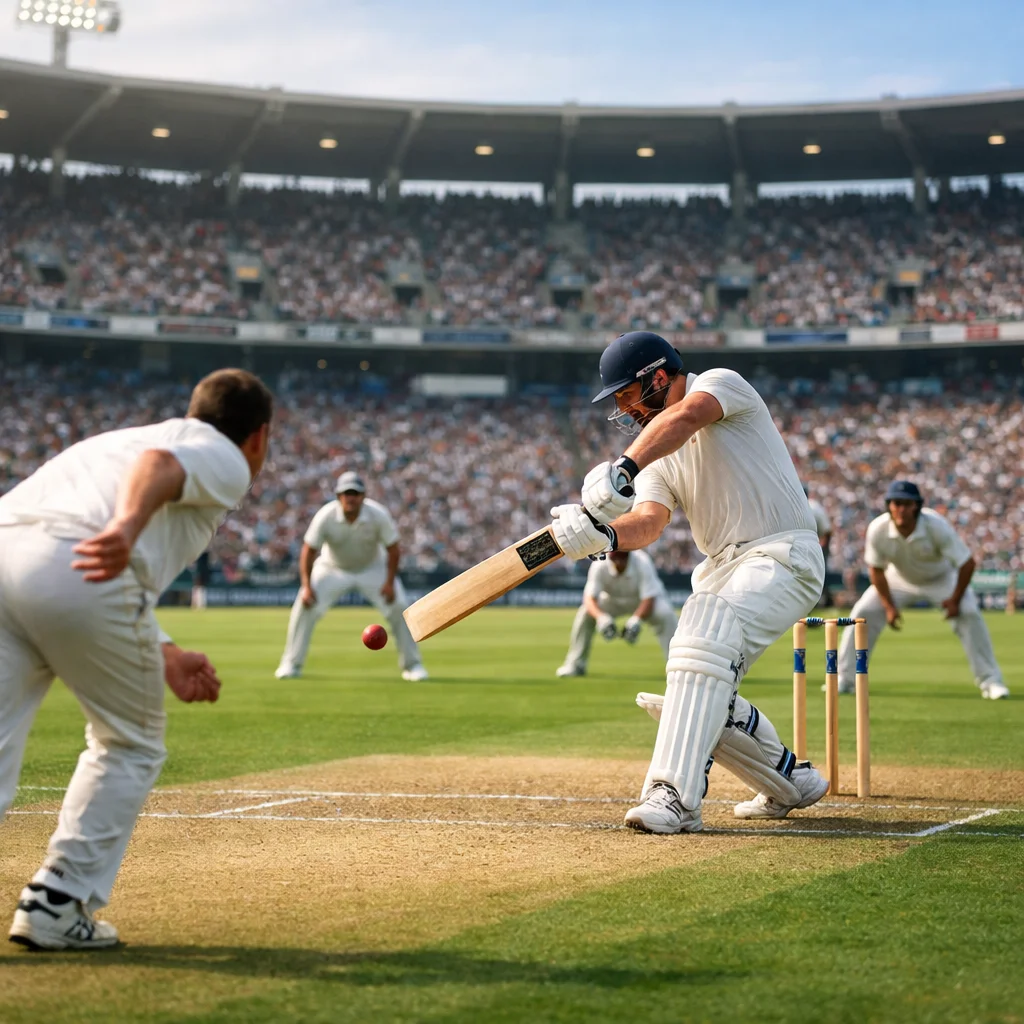
If you are new to cricket, the game can feel confusing at first. Many beginners hear terms like overs, innings, Test matches, ODI, and T20, but they do not fully understand what they mean. When watching a match, it may also be hard to know why some games last only three hours while others continue for several days. Because of these differences, new fans often struggle to understand how a cricket match actually works.
From my experience explaining cricket to beginners and sports learners, most people ask the same questions: How does a cricket match start? Why do teams bat in turns? What is the difference between Test, ODI, and T20 cricket? Once these basics are explained clearly, the game becomes much easier to follow. In this guide, you will learn how a cricket match works step by step, along with the key differences between Test cricket, One Day Internationals (ODIs), and T20 matches.

How a Cricket Match Works (Test vs ODI vs T20)

Cricket is one of the most popular sports in the world. Millions of fans watch it every year. However, many people still ask a simple question: how does a cricket match work?
A cricket match is played between two teams of eleven players. One team bats to score runs. The other team bowls and fields to stop them.
Cricket has three main formats today:
- Test Cricket
- One Day International (ODI)
- Twenty20 (T20)
All formats follow the same basic rules. However, they differ in overs, match duration, and playing style.
This guide explains how a cricket match works and the difference between Test, ODI, and T20 cricket in a simple way.
How a Cricket Match Works (Step-by-Step)
Every cricket match follows a clear sequence. The format may change, but the structure stays similar.
Here is how a cricket match works.
What Is an Over in Cricket?

An over consists of six legal deliveries bowled by one bowler.
After six balls:
- The over ends.
- Another bowler bowls from the opposite end.
Overs control the pace of the game. They are very important in limited-overs formats like ODI and T20.
What Is an Innings in Cricket?

An innings is the period when one team bats and tries to score runs.
The number of innings depends on the format.
- Test cricket: each team bats twice
- ODI cricket: each team bats once
- T20 cricket: each team bats once
An innings usually ends when:
- Ten batters are dismissed, or
- The overs limit is reached.
Difference Between Test, ODI and T20 Cricket

Cricket formats follow the same rules. However, they differ in several ways.
The biggest differences include:
- Match duration
- Overs per team
- Playing style
- Number of innings
Here is a simple comparison.
Because of these differences, each format offers a unique experience.
What Is Test Cricket?
Test cricket is the oldest and most traditional format.
A Test match can last up to five days. Each team bats two times.
There is no fixed overs limit, but teams usually bowl about 90 overs per day.
Test cricket focuses on:
- Patience
- Skill
- Strategy
Because matches last several days, teams must plan carefully.
Sometimes a Test match ends in a draw if time runs out.
What Is ODI Cricket?
ODI stands for One Day International.
In this format:
- Each team gets 50 overs
- That equals 300 balls
The match usually finishes in one day.
ODI cricket balances strategy and aggressive batting.
Teams try to score as many runs as possible in their innings. Then the second team attempts to chase the target.
The ICC Cricket World Cup uses this format.
What Is T20 Cricket?
T20 cricket is the shortest international format.
Each team gets 20 overs, which equals 120 balls.
The entire match lasts about three hours.
Batters play aggressive shots from the start. Because of this, matches are fast and exciting.
Many popular leagues use this format, such as:
- Indian Premier League (IPL)
- Big Bash League (BBL)
- Pakistan Super League (PSL)
T20 cricket attracts many new fans.
Test vs ODI vs T20 – Comparison Table
The three formats differ in several key areas.
| Feature | Test | ODI | T20 |
|---|---|---|---|
| Match Duration | Up to 5 days | One day | About 3 hours |
| Overs | No limit | 50 overs | 20 overs |
| Innings | 2 per team | 1 per team | 1 per team |
| Playing Style | Strategic | Balanced | Fast |
This comparison helps beginners understand the formats quickly.
How a Team Wins a Cricket Match

A team wins by scoring more runs than the opponent.
The result can happen in different ways.
A team may win:
- By runs when defending a target
- By wickets when chasing a target
- By an innings in Test cricket
Test matches can also end in a draw.
Key Basic Rules
Cricket follows several important rules.
The match begins with a coin toss. The captain chooses to bat or bowl.
The batting team scores runs. The bowling team tries to dismiss batters.
A batter can be out by:
- Bowled
- Caught
- Run out
- LBW
When ten batters are dismissed, the innings ends.
All Types of No Ball Rules According to ICC Laws
A no ball is an illegal delivery by the bowler.
When a no ball happens:
- The batting team gets one extra run
- The ball does not count in the over
- The delivery must be bowled again
The International Cricket Council (ICC) defines these rules.
Front Foot No Ball
This occurs when the bowler’s front foot crosses the popping crease.
It is the most common no ball.
Dangerous Non-Pitching Deliveries (Beamer)
A full toss that reaches the batter above waist height is dangerous.
The umpire immediately calls a no ball.
These deliveries are known as beamers.
Deliberate Front Foot No Ball
If a bowler intentionally bowls a no ball, it goes against the spirit of cricket.
Umpires may issue warnings or penalties.
Variations in No Ball Rules Across Cricket Formats
Most no ball rules are the same in all formats.
However, limited-overs cricket has one extra rule.
In ODI and T20 cricket, a front foot no ball results in a free hit.
During a free hit, the batter cannot be dismissed in most ways.
This rule increases scoring opportunities.
No Ball Out Rules in Cricket
A no ball changes how dismissals work.
When a Batter Is NOT OUT
A batter cannot be dismissed by:
- Bowled
- Caught
- LBW
When a Batter CAN Be OUT
A batter can still be dismissed by:
- Run out
- Hit the ball twice
- Obstructing the field
Why Cricket Has Three Different Formats
Cricket introduced different formats to attract more fans.
Test cricket preserves the traditional game.
ODI cricket provides a balanced format.
T20 cricket focuses on fast entertainment.
Because of this variety, cricket appeals to many audiences.
Cricket vs Baseball: Understanding the Difference

Many new fans compare cricket with baseball.
Both sports include:
- Batting
- Fielding
- Scoring runs
However, cricket uses overs and wickets, while baseball uses innings and bases.
Also, cricket fields are usually oval, while baseball fields are diamond-shaped.
This comparison helps new fans understand cricket faster.
FAQs About Cricket Formats
Are all cricket formats equally challenging?
Yes. Each format tests different skills. Test cricket requires patience, while T20 demands fast decision-making.
Why does cricket have multiple formats?
Different formats help the sport reach new audiences and create exciting tournaments.
Which format is most popular today?
T20 cricket is currently the most popular format because of its fast pace.
Conclusion
Cricket becomes much easier to understand once you learn the basic structure of the game. In my experience helping new viewers understand cricket rules, the biggest challenge is usually the difference between overs, innings, and match formats. However, once you understand how teams bat, bowl, and chase targets, the game starts to make sense. Each format also offers a unique experience: Test cricket focuses on patience and strategy, ODI cricket balances skill and excitement, and T20 cricket delivers fast-paced entertainment.
These formats follow the official laws governed by the International Cricket Council (ICC), which ensures that matches are played fairly around the world. When you understand how a cricket match works, watching the sport becomes far more enjoyable and engaging.
