




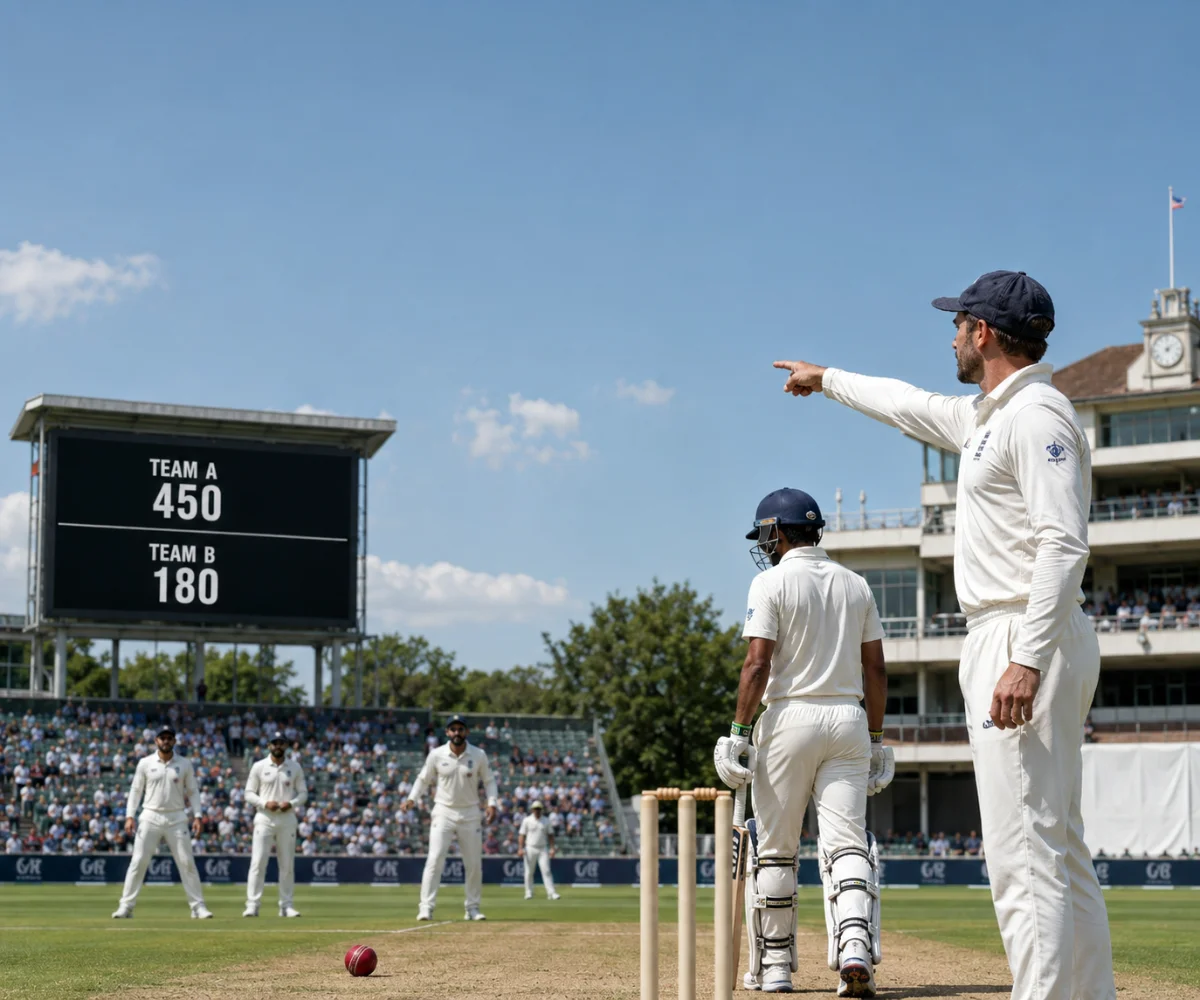
Many new viewers feel confused the first time they watch a full Test match. I remember sitting beside a friend who had only watched T20 cricket before, and on Day 3 the commentator said, “The captain has enforced the follow on.” He immediately asked why the same team was batting again when they had already finished their innings. This is the exact moment most people search for this rule because the match suddenly stops following the normal turn-by-turn pattern they expect.
Test cricket works differently from shorter formats because it is built around time, pressure, and decisions rather than just scoring runs. When one team falls far behind, the leading captain can choose to keep them batting instead of taking his own turn. To new fans it looks like a scoring error, but to experienced viewers it is a calculated attack meant to control the match. Once you understand this moment, the game stops feeling slow and starts making tactical sense.
Table of Contents
- Follow On Explained in 30 Seconds
- What Is the Follow On Rule in Cricket?
- Official Law Behind the Follow On
- Minimum Lead Required
- Why 200 Runs? (The Mathematical Logic)
- Step-by-Step Match Scenario
- Why Captains Enforce the Follow On
- When Captains Avoid the Follow On
- Importance of Time Remaining
- Match Conditions That Affect the Decision
- The Biggest Risk of Enforcing Follow On
- What Usually Happens After Follow On
- Psychological Pressure on the Batting Team
- Can a Team Win After Follow On?
- Famous Comeback After Follow On
- Follow On vs Declaration
- Baseball-Style Analogy (For New Fans)
- How Modern Cricket Changed the Rule
- FAQs
- Conclusion
Key Takeaways
- Follow on forces a team to bat again immediately
- Only happens in Test and first-class cricket
- Needs a 200-run lead in a 5-day match
- Used to push for victory and avoid a draw
- Risky because bowlers get tired
Follow On Rule in Cricket (Complete Beginner Guide)
Follow On Explained in 30 Seconds
You are watching a Test match and the commentator says:
“They enforced the follow on.”
It means the team that just batted poorly must bat again immediately.Normally both teams bat once before switching roles.
But here the captain skips his second batting turn to push for victory earlier in the match.
What Is the Follow On Rule in Cricket?
In Test cricket, each team usually bats two times.
Normal order:
Bat → Bowl → Bat → Bowl
But if one team falls far behind in runs, the leading captain can enforce the follow on.
New order becomes:
Bat → Bowl → Bowl → Bat
So the weaker team must continue batting again without getting rest.
Think of it like telling the opponent:
“You haven’t caught up yet, keep batting.”
Official Law Behind the Follow On
The follow on rule comes from MCC Law 14 of Cricket Laws.
It allows the captain of the team batting first to ask the opponent to bat again after a large lead.
Important:
The captain always has a choice.
It is never automatic.
Minimum Lead Required
The required lead depends on match duration.
| Match Duration | Minimum Lead Needed |
| 5 days | 200 runs |
| 4 days | 150 runs |
| 3 days | 100 runs |
| 2 days | 75 runs |
Example:
Team A scores 450
Team B scores 230
Lead = 220 runs
Captain may enforce follow on.
Why 200 Runs? (The Mathematical Logic)
The number exists to prevent easy draws.
A team trailing by 200 must first erase the deficit and then build a target.
That usually takes a very long innings, often more than a day of play.
So the rule helps produce a match result instead of a boring draw.
Shorter matches reduce the margin because less time is available.
Step-by-Step Match Scenario (Live Viewer Explanation)
Imagine you are watching live:
Day 1–2: Team A scores big
Day 3: Team B collapses
Commentators say:
“Follow on enforced”
Now Team B must bat again late on Day 3.
They are tired and under pressure.
This is why matches suddenly become exciting at that moment.
Why Captains Enforce the Follow On
Captains use follow on when they believe the opponent is weak right now.
They enforce it when:
- pitch is breaking
- bowlers are fresh
- time is short
- opponent is mentally down
The idea is simple:
Keep pressure constant and finish the match quickly.
When Captains Avoid the Follow On
Captains sometimes choose safety instead of attack.
They avoid it when:
- bowlers need rest
- pitch is easy to bat
- opponent has strong batters
- long time remains in match
Instead they bat again and build a massive lead.
Importance of Time Remaining in the Match
Time is as important as runs.
If 2 days remain → bat again
If only 1 day remains → enforce follow on
Captains use follow on mainly to avoid a draw.
Match Conditions That Affect the Decision
Different countries produce different decisions.
Follow on likely when:
- dry spinning pitch
- cracks forming
- ball turning
Avoided when:
- flat pitch
- easy batting weather
- rain interruption expected
The Biggest Risk of Enforcing Follow On
Follow on is aggressive but dangerous.
The same bowlers must bowl again immediately.
They become tired.
If the batting team survives long enough, momentum changes.
Now the leading team must chase runs in the fourth innings — the hardest situation in Test cricket.
This is why commentators debate the decision heavily.
Psychological Pressure on the Batting Team
Follow on sends a message:
“You are still behind.”
Batters feel pressure:
- fatigue
- panic
- defensive mindset
Mistakes increase quickly under scoreboard pressure.
Can a Team Win After Follow On?
Yes, and that is why cricket becomes dramatic.
A team can:
- bat very long
- set huge target
- bowl last
Famous Comeback After Follow On
Some historic matches were won after follow on.
They are remembered because they almost never happen.
This possibility makes captains think carefully before choosing attack.
Follow On vs Declaration (Understanding Match Flow)
Both are attacking decisions.
Follow On: opponent bats again immediately
Declaration: you bat again briefly and set target
Captains choose depending on time, pitch, and energy levels.
Baseball-Style Analogy (For New Fans)
If you follow baseball:
Follow on is like forcing the opponent to continue batting before your next turn because they have not caught up yet.
It keeps pressure on them instead of resetting the game flow.
How Modern Cricket Changed the Rule
Modern teams use follow on less often.
Reasons:
- aggressive batting era
- flat pitches
- bowler workload management
- championship point strategy
FAQs
Q:Does follow on exist in T20 or ODI?
Ans:No. Only in long-format cricket.
Q:Does follow on mean the match is ending soon?
Ans:Often yes, but not guaranteed.
Q:Is enforcing follow on risky?
Ans:Yes. That is why captains debate it.
Q:Can the captain refuse it?
Ans:Yes. It is optional.
Conclusion
After explaining this rule to many first-time viewers, I noticed they begin watching cricket differently. Instead of only counting runs, they start paying attention to pitch behavior, bowler fatigue, and how much time is left in the match. The follow on is not just a rule about batting order; it is the point where a captain chooses between safety and risk. When commentators discuss whether it was the right decision, they are really discussing match strategy, not just numbers.
So the next time you hear “follow on enforced,” you can read the situation yourself. The captain believes pressure is at its highest and wants to push for a result, even though the decision can sometimes backfire. That single call often shapes the final outcome of the Test match, and understanding it turns you from a passive viewer into someone who can anticipate what may happen next.
Read More: LBW Rule Explained
